 微物联研究院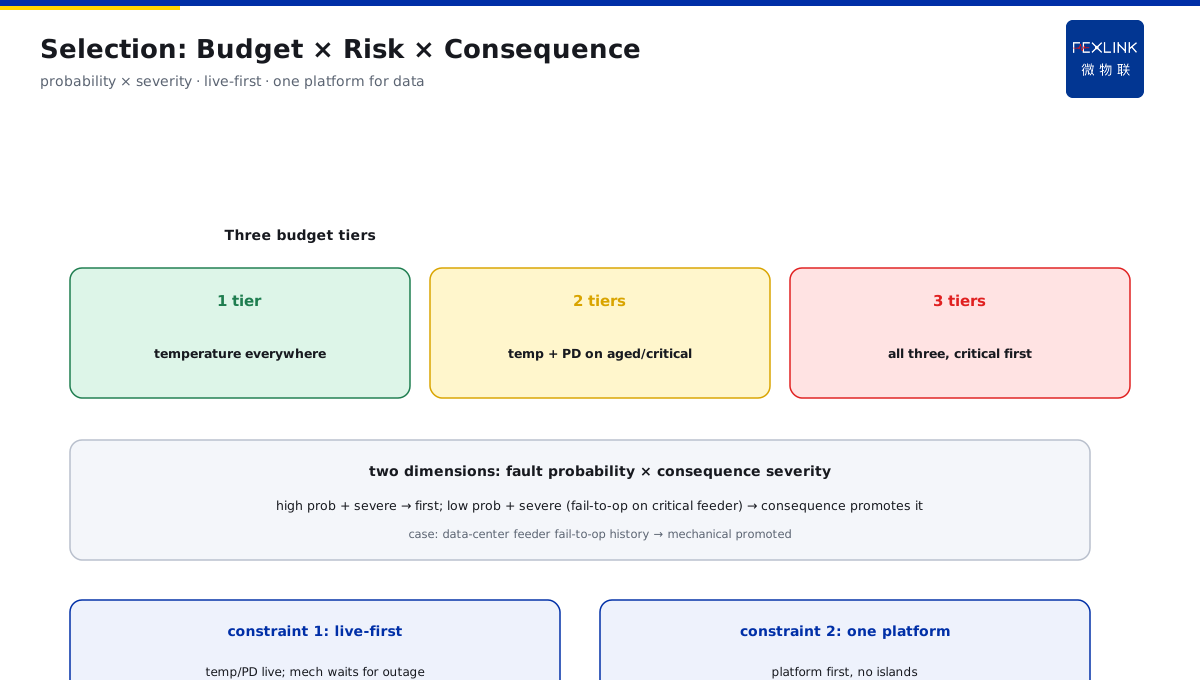
Direct Answer
A switchgear retrofit has a limited budget — which of the three sensor types (temperature, partial discharge, mechanical state) should you deploy first? The answer: tier by risk — temperature-rise monitoring (contacts/busbars) covers the most common faults at the best value, deploy it first; partial-discharge monitoring targets insulation defects, use it on aged or critical circuits; mechanical-state monitoring (trip/close coils) is for breakers with high failure-to-operate risk. With a tight budget, configure "temperature first, then PD, then mechanical."
At a factory, 20 switchgear panels were to be retrofitted with only enough budget for 1–2 sensor types per panel. Full "three-in-one" on every panel clearly busted the budget; temperature-only risked missing insulation defects. A risk-ranked analysis: the panels had run 12 years; historically, contact overheating was 60% of faults, insulation breakdown 25%, mechanism failure-to-operate 15%. Tiered deployment: Tier 1 — contact temperature sensing on all 20 panels (covers 60% of faults, best value, lowest per-panel cost); Tier 2 — PD monitoring added to 6 aged/critical circuits (covers insulation defects, priority circuits first); Tier 3 — mechanical-state monitoring deferred (lowest fault share, and breaker maintenance cycles are relatively fixed). Within a year, temperature sensing caught 3 contact-overheating cases early and PD found 2 insulation risks — the least money covering the highest-probability faults.
Because:
- Fault probability sets priority: contact overheating is the most common fault (over half); temperature sensing covers it at the lowest cost — first;
- Coverage × cost must balance: PD covers insulation defects (important but secondary); it pays only on aged/critical circuits;
- Live-installability is a hard premise: temperature (wireless/fiber) installs live; PD (surface sensors) too; mechanical monitoring needs a maintenance window;
- Data must reach the platform: all three sensor streams eventually feed one supervision system (e.g., the Digital Electrical Intelligent Supervision System); island monitoring halves the value.
Key insight: selection is not "the more, the better"; it is "rank by fault probability × cost." Temperature first, then PD, then mechanical — tiered deployment covers the main risks even with a tight budget.
At a campus 10 kV critical-circuit switchgear, the breaker mechanism had a record of failure-to-operate (two delayed trips). Selection considered not only fault share but "consequence": the circuit fed a data center main; one failure-to-operate is severe — mechanical-state monitoring (coil-current curves) was promoted to equal footing with temperature. Final: temperature + mechanical deployed; PD deferred because the panels were relatively young. Selection uses both "fault probability" and "consequence severity," not probability alone.
1. What the Three Sensor Types Monitor
First clarify which fault class each sensor handles, then trade off:
1. Temperature-rise monitoring (contact/busbar temperature):
- Monitors: contact, busbar connection, cable-joint temperature;
- Covers: increased contact resistance (most common), overload heating, loose fasteners;
- Fault share: roughly half or more of switchgear faults relate to overheating;
- Characteristic: directly reflects the highest-frequency "poor contact" fault.
2. Partial-discharge monitoring (TEV/ultrasonic/UHF):
- Monitors: PD from insulation defects;
- Covers: dirty insulators, insulation aging, cable-head defects, air-gap discharge;
- Fault share: insulation breakdown is secondary (about a quarter) but severe (short circuit);
- Characteristic: earliest detection of insulation defects; most predictive.
3. Mechanical-state monitoring (trip/close coil current, travel):
- Monitors: breaker operating mechanism (coil-current waveform, operating time, travel);
- Covers: mechanism binding, coil aging, failure-to-operate/misoperation;
- Fault share: mechanism faults are relatively low (about 10–15%), but failure-to-operate consequences are severe (protection failure);
- Characteristic: reflects "can it actually operate," directly tied to protection function.
Comparison conclusion:
- Temperature = covers the most common fault, low cost, must-have;
- PD = covers insulation defects, most predictive, critical circuits;
- Mechanical = covers failure-to-operate risk, circuits with severe consequences.
Key insight: each sensor class owns one fault class; they are coverage complements, not substitutes. First ask "which fault is most probable and severe in my panels," then map to sensors.
2. Coverage and Cost of Each
Value-for-money is the core yardstick:
Coverage (estimated fault share):
- Temperature: covers overheating class, ~50–60% of all faults;
- PD: covers insulation class, ~20–30%;
- Mechanical: covers mechanism class, ~10–15%;
- Total: all three together cover 85–95% of common faults.
Cost (relative per panel):
- Temperature: lowest (wireless sensor + receiver; point count selectable) — best value;
- PD: medium (TEV/ultrasonic sensors with signal processing) — worth it on critical circuits;
- Mechanical: medium-high (coil-current sampling + travel analysis, needs mechanism-circuit access) — worth it on important circuits.
Value ranking (fault probability covered per ¥10k):
- Temperature (first tier): lowest cost, covers the most common fault;
- PD (second tier): medium cost, covers the next-most-frequent and severe fault;
- Mechanical (third tier): higher cost, covers low-frequency but severe faults.
Budget-constrained principles:
- Budget for one tier: deploy temperature on every panel (all panels, not cherry-picked);
- Budget for two tiers: temperature everywhere + PD on aged/critical circuits;
- Budget for three tiers: all three, priority circuits first.
Key insight: value = coverage ÷ cost. Temperature covers the most faults per yuan — with a tight budget, it is the first choice, not one of the choices.
3. The Priority Logic of Tiered Configuration
"Temperature first, then PD, then mechanical" is not a guess; it is risk logic:
Tier 1: temperature-rise monitoring (full coverage):
- Why: overheating is the highest share (50–60%), lowest cost, easy live install;
- Action: contact/busbar temperature on all panels;
- Expected: catch poor contact early, avoid overheating damage, cover "most common."
Tier 2: PD monitoring (critical circuits):
- Why: insulation defects are severe (short circuit) with high early-detection value, but medium cost;
- Action: add on aged panels and critical circuits (main feeders, data centers, hospitals);
- Expected: find insulation defects early, avoid breakdown short circuits, cover "severe."
Tier 3: mechanical-state monitoring (high-risk circuits):
- Why: failure-to-operate is severe (protection failure) but low share and higher cost;
- Action: breakers with prior failure-to-operate, frequent operation, or protection-critical duty;
- Expected: find mechanism degradation, guarantee "reliable operation."
Summary of tier logic:
- Tier 1 solves "most frequent"; Tier 2 solves "severe consequence"; Tier 3 solves "protection reliability";
- Budget extends from Tier 1 to Tier 3; each tier stands alone (no dependency);
- Each additional tier covers the next risk class in "probability × consequence."
Key insight: tiering is not a simplified version of full deployment; it is the complete version of risk ranking. Every tier targets a real risk class — more budget, one more class covered.
4. Live-Installation Feasibility
The hard constraint of a retrofit: can it be installed without an outage?
Temperature-rise monitoring:
- Wireless temperature (induction-powered/battery): mounts on contacts or busbars, live;
- Fiber-optic: fiber application, live;
- Verdict: fully installable live; the most flexible retrofit window.
PD monitoring:
- TEV (transient earth voltage): sensor on the panel surface, live;
- Ultrasonic: on or in the panel, live;
- UHF: sensor applied, needs proximity to the PD source, generally live;
- Verdict: basically live-installable.
Mechanical-state monitoring:
- Trip/close coil current: needs control-circuit access (CT or parallel), may require an outage window or live-work permit;
- Travel/speed: sensors on the mechanism, usually with a maintenance window;
- Verdict: highest outage-window requirement.
Live-first principle:
- At equal budget, prefer live-installable solutions (retrofit does not stop production);
- Outage-needed items (mechanical) are scheduled with maintenance;
- Installation mode is part of cost: live = hidden savings.
Key insight: "can it be installed live" decides feasibility. Temperature/PD install live; mechanical waits for a maintenance window — fold installation constraints into the priority when selecting.
5. Data Integration and Platform Requirements
Sensors installed but data not reaching the platform equals no installation:
Integration requirements:
- All three sensor streams integrate into a supervision system/gateway (e.g., ESX Edge Computing Gateway aggregating; Digital Electrical Intelligent Supervision System displaying);
- Each class has its own data format (temperature / PD amplitude / coil current); the platform must normalize them;
- Alert linkage: temperature over-limit, PD over-threshold, mechanism abnormal — unified alerts, unified dispatch.
Platform capabilities required:
- Trend analysis: temperature/PD trend curves (judge deterioration rate);
- Threshold management: thresholds configurable per equipment type;
- Health-score linkage: monitoring data feeds health scoring (temperature/PD become deduction items);
- History: event replay, before/after maintenance comparison.
Island risk:
- One software suite per sensor class = three islands: data scattered, alerts missed;
- Correct approach: define the platform first (unified access), then choose sensors (compatible protocols);
- Digital Electrical Intelligent Supervision System path: sensor data → edge gateway → unified platform management.
Key insight: sensors are the eyes; the platform is the brain. Choose the platform first, then the sensors — only when all three streams enter one system do you have a monitoring loop.
6. Product Landing: An Integrated Tiered-Monitoring Solution
FEXLINK's Digital Electrical Intelligent Supervision System turns "tiered selection" into a deployable solution:
- EST Multi-Channel Temperature Controller: contact/busbar temperature (Tier 1), wireless or fiber, live install;
- PD monitoring components: TEV/ultrasonic/UHF sensors (Tier 2), surface-mounted, live;
- Mechanical-state monitoring: trip/close coil current and travel analysis (Tier 3), with maintenance windows;
- ESX Edge Computing Gateway: unified aggregation of the three streams, edge computing, alert linkage;
- The platform shows temperature/PD/mechanical trends together; health scores auto-link deduction items;
- Tiered configuration by budget and risk: from "temperature full coverage" to "all three lines," deployed incrementally.
Design principle in one sentence: turn "selection anxiety" into "risk-ranked tiered deployment." Temperature first, then PD, then mechanical — any budget covers its corresponding risk, and all data ends in one platform.
7. Common On-Site Mistakes
- Tight budget → cheapest only: temperature everywhere but PD missing even on critical circuits. Consequence: insulation defects missed. Correct: temperature full coverage + PD on critical circuits.
- Chasing the "three-in-one" all at once: forcing full deployment beyond budget. Consequence: budget blown, or installed without O&M. Correct: tiered deployment matching the budget.
- Ignoring fault history: new and old panels configured identically. Consequence: old-panel insulation risk missed. Correct: PD first on aged/critical panels.
- Ignoring installation windows: mechanical monitoring needing an outage scheduled in a live-work slot. Consequence: cannot install, or live-work risk. Correct: mechanical monitoring synchronized with maintenance.
- Sensor islands: three software suites for three classes. Consequence: scattered data, missed alerts. Correct: define the unified platform first, then select sensors.
Scope and Limitations
This article discusses selecting and tiering switchgear online-monitoring devices (temperature / PD / mechanical state) for medium- and low-voltage switchgear retrofits. Fault shares, costs, and value rankings are engineering experience references; actual figures follow site equipment condition, vendor proposals, and quotes. Installation mode (live vs outage) must be confirmed against site conditions and safety procedures. The three sensor streams need unified platform integration to form a monitoring loop. All cases are anonymized (a certain factory / campus) and do not refer to any specific customer.