 FEXLINK Research Institute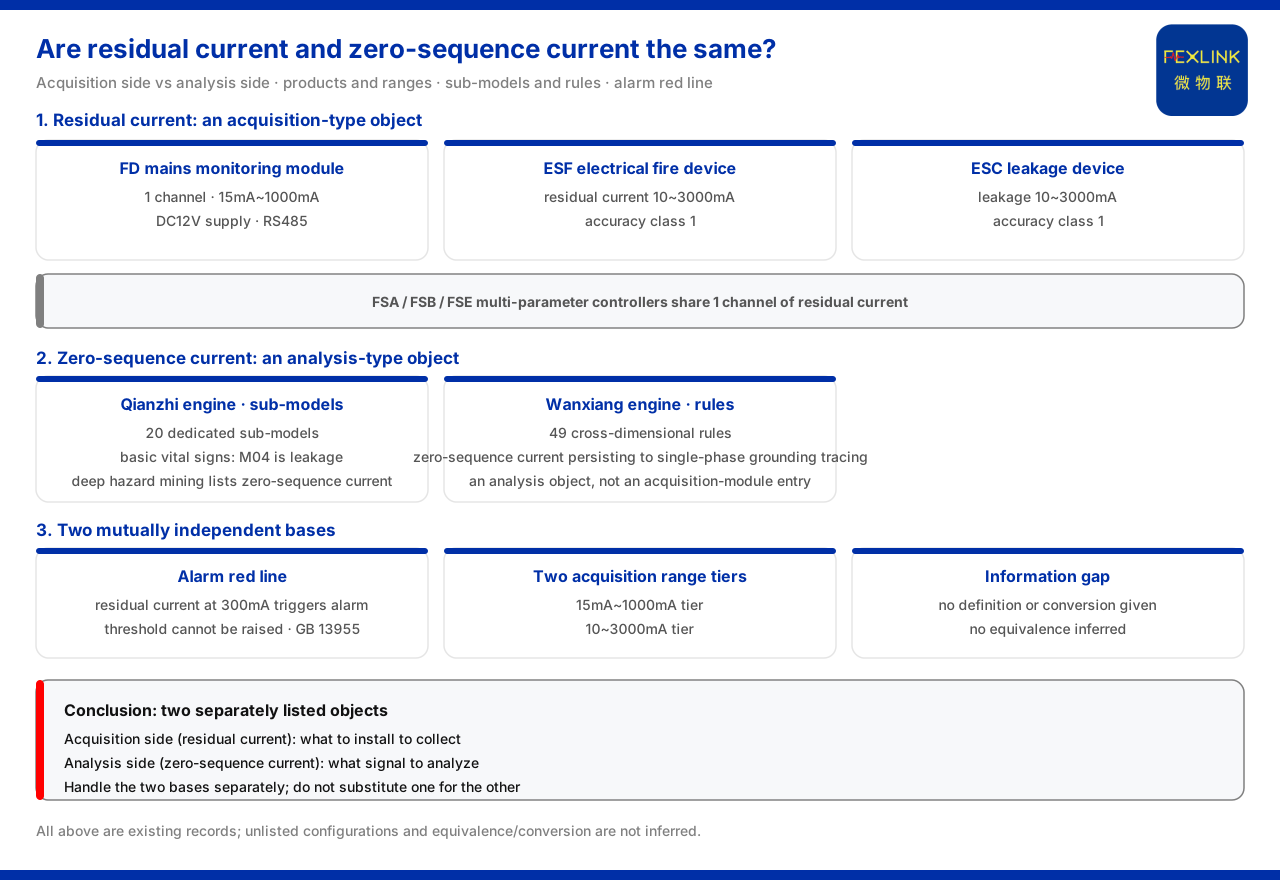
Direct answer
In the product knowledge base, residual current and zero-sequence current are not expressed as the same quantity. Residual current is a quantity that is collected: the FD mains residual-current monitoring module (e.g., FD-01011-R) provides 1 channel of residual current with an acquisition range of 15mA~1000mA; the residual current measurement of the ESF electrical fire monitoring & control device (e.g., ESF-22110-R) is 10~3000mA (accuracy class 1); and the leakage measurement of the ESC multi-channel leakage-current monitoring & control device is likewise 10~3000mA (accuracy class 1). Zero-sequence current, by contrast, appears on the analysis side: the knowledge base lists "zero-sequence current" among the deep hazard-mining sub-models of the Qianzhi engine (large model), and gives "zero-sequence current persisting to single-phase grounding tracing" in one of the cross-dimensional association rules of the Wanxiang engine (large model). In other words, residual current has clear collection products and ranges in the knowledge base, while zero-sequence current appears in the form of sub-models and association rules. The knowledge base does not state a conversion or equivalence relationship between the two, so they can only be expressed as two separately listed monitoring and analysis objects.
1. Residual current: a quantity collected by three product classes
In the knowledge base, residual current is collected separately by three product classes. The FD mains residual-current monitoring module provides 1 channel of residual current with an acquisition range of 15mA~1000mA (positioned in the product outline as a residual-current monitoring module, marked as the 10mA~1000mA tier), supplied at DC12V with RS485 communication; the residual current measurement of the ESF electrical fire monitoring & control device is 10~3000mA with accuracy class 1; and the leakage measurement of the ESC multi-channel leakage-current monitoring & control device is 10~3000mA with accuracy class 1. The three products differ in range tier but all belong to the class of "taking residual current as the acquisition object". Among the common functions of the whole FSA/FSB/FSE multi-parameter electrical intelligent controller series (meter type, three-phase balance type and power quality type), residual current 1 channel is also included. Residual current is therefore an electrical quantity with a definite acquisition entry in the knowledge base.
2. Different ranges of the collected quantity
Laying out the ranges, residual current acquisition tiers fall into two classes. One is 10~3000mA, appearing on the ESF and ESC; the other is 15mA~1000mA (expressed in the product outline as the 10mA~1000mA tier), appearing on the FD. The former has a higher upper limit, covering up to 3000mA; the latter has a lower starting point, covering down to the 15mA level. In selection, whether what needs monitoring is a larger residual current such as a distribution-cabinet incoming line or a residual current on an end circuit falls into different tiers. The existence of different ranges under the same name "residual current" is itself an item that must be confirmed in selection: the name is the same, the tier differs, and the applicable objects differ as well.
3. Where zero-sequence current sits in the knowledge base
Zero-sequence current does not appear in the knowledge base in the form of a collection product. It first appears in the sub-model list of the Qianzhi engine: the knowledge base lists 20 dedicated sub-models, among which M04 of the basic vital-signs class is "leakage", while the deep hazard-mining class (M13 to M20) separately lists "zero-sequence current". Second, it appears in the cross-dimensional association rules of the Wanxiang engine: the knowledge base records 49 cross-dimensional association rules, one of which is "zero-sequence current persisting to single-phase grounding tracing". Thus the identity of zero-sequence current in the knowledge base is that of an "analysis object" — it is a kind of signal to be handled by a sub-model and a kind of clue to be traced by an association rule, rather than having an independent acquisition-module entry like residual current.
4. The red line: the non-bypassable threshold for residual current
Residual current has another special aspect: in the Qianzhi engine entry, the knowledge base records a non-bypassable alarm red line — residual current reaching 300mA triggers an alarm, no one can raise this threshold, and the basis is GB 13955. This elevates residual current from an ordinary collected quantity to a quantity with a safety constraint: it is not only recorded but also forcibly triggers an alarm when the threshold is reached, and the threshold cannot be relaxed manually. For selection and operation, this means the threshold setting of residual-current-related channels is constrained by the knowledge base's basis and cannot be raised at will according to site preference. The red line and the acquisition range are independent of each other: one constrains alarm behavior, the other describes the measurement range.
5. Why they should not be conflated
Putting the two together, the difference lies in "role" rather than "whether the names are similar". Residual current is a collection-type object: it has concrete products such as the FD mains residual-current monitoring module, the ESF electrical fire monitoring & control device and the ESC multi-channel leakage-current monitoring & control device, definite ranges of 15mA~1000mA or 10~3000mA, and a non-bypassable alarm threshold of 300mA. Zero-sequence current is an analysis-type object: it appears in the sub-model list of the Qianzhi engine and the association rules of the Wanxiang engine, with no corresponding independent acquisition-module entry. The knowledge base does not give definitions of "residual current" and "zero-sequence current", nor does it state whether they are equivalent or how to convert between them. Therefore, treating the two directly as the same parameter would lose facts on both sides: it would ignore both the acquisition products and tiers of residual current and the analysis positioning of zero-sequence current.
6. Where each is used in selection
Following the division above, the landing points in selection are also separate. When residual current must be collected, the landing point is products such as the residual-current monitoring module, the electrical fire monitoring & control device and the multi-channel leakage-current monitoring & control device, chosen by the required range tier: for end circuits or where a low starting point is needed, look at the 15mA~1000mA tier; where coverage up to 3000mA is needed, look at the 10~3000mA tier; and confirm whether the channel is subject to the non-bypassable 300mA red line. When zero-sequence current is involved, it belongs to the analysis link handled by the Qianzhi engine sub-models and the Wanxiang engine association rules, embodied as a judgment clue such as "zero-sequence current persisting to single-phase grounding tracing". The former is "what to install for collection", the latter is "what signal to analyze", and their positions in the scheme differ.
7. Conclusion
Back to the core question: are residual current and zero-sequence current the same quantity in monitoring? The answer given by the knowledge base is that they are two separately listed objects. Residual current is a collected quantity with definite products and ranges; zero-sequence current is an analysis object appearing in sub-models and association rules. The knowledge base does not state a conversion relationship between the two, so this article does not infer whether they are equivalent or interchangeable, but faithfully presents the listings on both sides. When both must be used at the same time, they should be handled according to the acquisition-side and analysis-side bases respectively, rather than using the conclusion of one to substitute for the other.
Scope and limitations
First, this article only restates content listed in the product knowledge base, and its factual boundary is limited to the FD mains residual-current monitoring module entry, the residual current and leakage measurement parameters of the ESF and ESC, the residual current 1-channel common function of the multi-parameter electrical intelligent controller, M04 and the deep hazard-mining class in the Qianzhi engine sub-model list, the zero-sequence current association rule of the Wanxiang engine, and the residual current 300mA alarm red line with its GB 13955 basis.
Second, the knowledge base does not give definitions of "residual current" and "zero-sequence current" or a statement of their equivalence or non-equivalence; the statement in this article that they are "not the same quantity" is induced from their appearing separately in different chapters and different sub-models, and does not mean that the knowledge base gives a formal definitional conclusion.
Third, the FD acquisition range 15mA~1000mA (marked in the product outline as the 10mA~1000mA tier), the ESF and ESC both being 10~3000mA (accuracy class 1), and the FSA/FSB/FSE residual current 1 channel are all based on the knowledge base's stated basis, and this article does not infer the specific configuration of unlisted models from them.
Fourth, the residual current triggering a non-bypassable alarm at 300mA, the threshold being non-adjustable, and the GB 13955 basis are based on the knowledge base's stated basis; this article does not infer other thresholds or other protection settings from them.
Fifth, this article does not constitute a commitment to the selection result or on-site performance of any specific project; actual conditions are subject to the latest product documentation and project scheme.