 FEXLINK Research Institute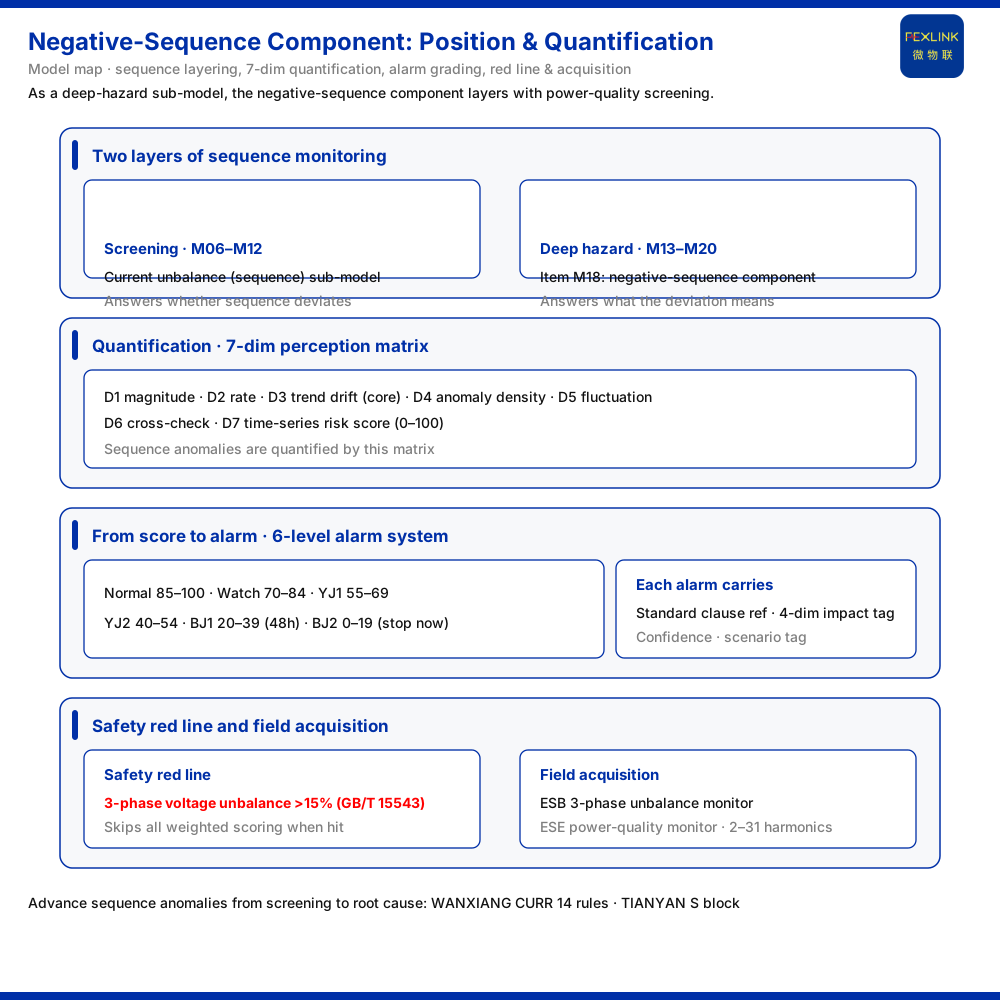
Direct answer
What the negative-sequence component is and where it comes from is not given as a full causal conclusion in the product knowledge base; what can be confirmed is its place in the overall model system. The product knowledge base lists the negative-sequence component as item M18 of the deep-hazard mining specialised sub-models of the Qianzhi engine, positioned at the parameter-level perception layer. Also belonging to sequence monitoring is the current imbalance (sequence components) sub-model in the power-quality health check, one in the basic check and one in deep-hazard mining, together forming the layered structure of sequence monitoring. As to origin, the product knowledge base positions it to identify the negative-sequence content caused by unbalanced loads and faults, quantified by the 7-dimension perception matrix, graded by the 6-level alarm system, and constrained by the three-phase voltage imbalance safety red-line. Field acquisition rests on two classes of devices: the three-phase imbalance monitor (ESB-22111-R) and the power-quality monitor (ESE-22111-R). This article sets out the model placement, the quantification path and the monitoring value of the negative-sequence component, and marks the material boundary.
1. Where the negative-sequence component sits in the model system
The product knowledge base divides the deep-hazard mining of the Qianzhi engine into eight specialised sub-models, M13 to M20, of which the negative-sequence component is the M18 item. This placement carries two implications: first, it is grouped under deep hazard rather than daily health check; second, its point of application is the parameter-level perception layer, that is, finding problems through continuous observation of electrical parameters rather than through a single test.
Listing the negative-sequence component on its own, rather than folding it into a general imbalance, shows that the model system treats it as an independent diagnostic entry. For a user, this means sequence anomalies have a dedicated model to receive them and need not be inferred from other entries.
2. The layering of sequence quantities: basic health check and deep hazard
The negative-sequence component is not the only model related to sequence quantities. The power-quality health check covers M06 to M12 and includes a current imbalance (sequence components) sub-model. Sequence monitoring is therefore split into two layers: the power-quality check handles basic current-imbalance observation, and deep-hazard mining uses the M18 negative-sequence component for further judgement.
The division can be understood this way: the basic check answers whether a sequence quantity has deviated from normal, and deep-hazard mining answers what that deviation means. The product knowledge base lists the two side by side, which shows sequence quantity is not a single-point indicator but a chain from check to hazard.
From a usage standpoint, the layering has a practical benefit: a slight imbalance will not be confused with a serious negative-sequence hazard. The check layer screens first and the hazard layer then characterises, giving the judgement an order. If sequence anomalies are to be brought into routine operation and maintenance, inspection priorities can be arranged in that order.
3. How negative-sequence anomalies are quantified: the 7-dimension perception matrix
Once the negative-sequence component enters analysis, the 7-dimension perception matrix receives it. The seven dimensions the product knowledge base lists are D1 amplitude, D2 rate of change, D3 trend drift (core), D4 anomaly density, D5 fluctuation amplitude, D6 correlation validation, and D7 time-series risk score. D3 trend drift is marked as core, and D7 gives a composite decision score of 0 to 100.
For negative sequence, the value of this matrix is that it does not look only at the value at one instant. Amplitude and rate of change describe the present, trend drift and anomaly density describe the process, correlation validation checks negative sequence against other quantities, and everything finally aggregates into a time-series risk score. The product knowledge base makes clear that sequence anomalies such as negative sequence can be quantified through this matrix.
It should be noted that D3 being marked core does not mean the other dimensions are unimportant. If only amplitude is read, a short fluctuation may be exaggerated; if only trend is read, an abrupt and severe change may be smoothed away. The seven dimensions each play their part, and only together do they form a complete judgement. Keeping this in mind helps explain why the same stretch of data may receive different levels of attention.
4. From score to alarm: the 6-level alarm system
The risk score feeds upward into the 6-level alarm system. The mapping the product knowledge base gives is Normal at 85 to 100, Watch at 70 to 84, YJ1 at 55 to 69, YJ2 at 40 to 54, BJ1 at 20 to 39 with handling within 48 hours, and BJ2 at 0 to 19 with immediate shutdown. The lower the score, the closer to the side requiring immediate intervention.
Notable is what each alarm carries: standard-clause references, four-dimension impact labels, confidence, and scenario labels. The four-dimension impact label splits impact into the safety, efficiency, life and carbon directions, making it easy to judge what a negative-sequence anomaly actually affects. This shows an alarm is not an isolated score but a conclusion carrying its basis and its impact range.
5. The safety red-line that cannot be bypassed
Above the score and weighting there is a constraint that cannot be bypassed. The safety red-line of the product knowledge base triggers when three-phase voltage imbalance exceeds 15%, under GB/T 15543. Once triggered, the red-line skips all weighting and gives a conclusion directly.
The relationship of this red-line to the negative-sequence component is that three-phase imbalance is one intuitive representation of negative sequence. In other words, when the imbalance is severe enough to cross the 15% line, the system no longer weighs a score but rules directly. For the field, this is both a protection and a hint about the priority order of investigation.
6. Field acquisition: division of the two device classes
Field acquisition related to negative sequence rests on two classes of devices. The first is the three-phase imbalance monitor (ESB-22111-R), for which the product knowledge base gives 3×220/380 V, an OLED display and RS485 communication, adding phase monitoring on top of the all-parameter smart-meter architecture. The second is the power-quality monitor (ESE-22111-R), which adds harmonic monitoring on top of phase monitoring, covering harmonics of order 2 to 31 at an accuracy of ±1%.
The division is clear: when only imbalance is of interest, the three-phase imbalance monitor is enough; when harmonic conditions must also be grasped, the power-quality monitor is used. Sequence monitoring therefore has both a model on the analysis side and device support on the acquisition side.
7. Investigating negative sequence down to root cause
The final step is to trace negative-sequence anomalies to root cause and make predictions. The Wanxiang engine of the product knowledge base contains 49 cross-dimension correlation rules, of which the CURR series has 14, with an example rule such as persistent zero-sequence current pointing to single-phase grounding tracing. The S block of the Tianyan engine contains a three-phase imbalance hazard model. Together, the two move sequence anomalies from where something is wrong to why it is wrong and how it will develop.
Scope and limitations
First, this article restates only what the product knowledge base lists; the factual boundary is limited to the records of the Qianzhi engine, the Wanxiang engine, the Tianyan engine and the related devices.
Second, the negative-sequence component as the M18 deep-hazard sub-model and the current imbalance (sequence components) as an M06 to M12 check sub-model are cited as listed in the product knowledge base; this article does not infer unlisted specific load or fault lists.
Third, the seven dimensions of the 7-dimension perception matrix and the 0 to 100 score are cited as listed in the product knowledge base; the same applies to the score intervals and handling points of the 6-level alarms.
Fourth, the safety red-line of three-phase voltage imbalance above 15% and its GB/T 15543 basis are cited as listed in the product knowledge base; this article does not change their threshold or triggered consequences.
Fifth, the parameters of the three-phase imbalance monitor and the power-quality monitor, and the 2 to 31 harmonics and ±1% accuracy of the power-quality monitor, are cited as listed in the product knowledge base; this article does not infer the performance of other models.
Sixth, the 49 rules of the Wanxiang engine and its 14 CURR rules, and the three-phase imbalance hazard model of the Tianyan S block, are cited as listed in the product knowledge base; this article does not provide specific engineering settings or handling schemes.