 FEXLINK Research Institute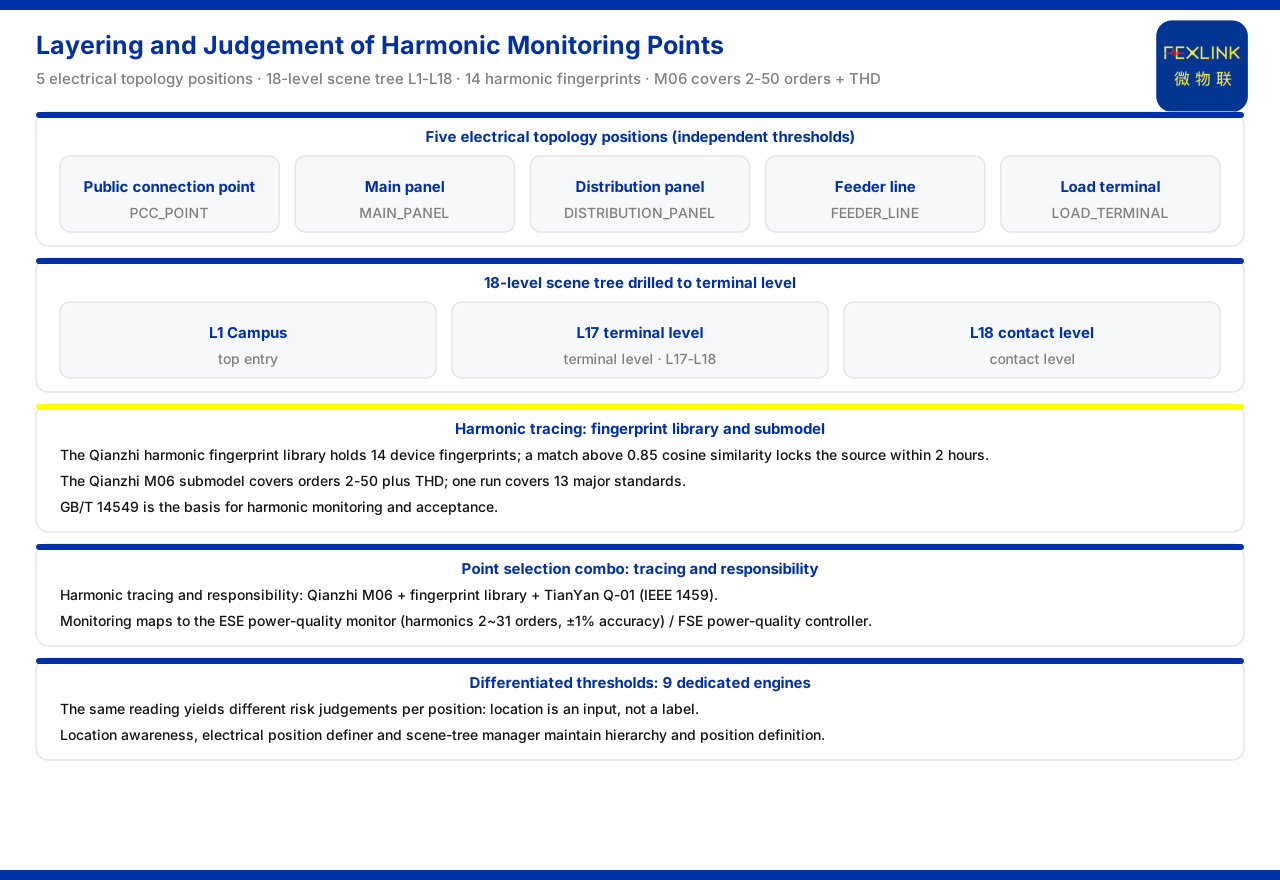
Direct answer
The placement of harmonic monitoring points comes down to two steps: layering by electrical-topology position and judging by a standard specification. The product knowledge base records that Wanxiang position awareness maintains independent thresholds and risk models for 5 types of electrical topology position: the point of common coupling, the main distribution panel, the distribution panel, the feeder line and the load terminal. An 18-level scene-positioning tree (L1 to L18) can drill down level by level from the park to the wiring-terminal level and the contact level, so an alarm can be located precisely to a specific outgoing terminal. On the traceability side, the Qianzhi harmonic fingerprint library contains 14 classes of device fingerprints and matches when the cosine similarity is greater than 0.85, allowing the pollution source to be locked within 2 hours. On the judgement side, the M06 harmonic sub-model covers the 2nd to 50th order plus total harmonic distortion, and a single analysis round covers 13 major standards, among which GB/T 14549 is the criteria basis for harmonic monitoring and acceptance. On the selection side, the combination for harmonic traceability and responsibility allocation is Qianzhi M06, the fingerprint library and Tianyan Q-01. This article only restates the specifications above.
Why harmonic monitoring points should be layered
Within one distribution system, the severity of harmonics is not the same at every position. The point of common coupling is the interface between the public grid and the dedicated grid, the feeder line handles downward distribution, and the load terminal sits close to specific utilisation equipment; at these positions the meaning of the same reading and the risk it represents differ. Without distinguishing position and using a single threshold, a point near the pollution source may be underestimated, while a point far from it may be falsely alarmed. Layering points by position gives each position a threshold and risk model suited to its role, so that "where harmonics appear" and "how severe the harmonics are" can be seen separately. This is also the precondition for harmonic traceability: only when the point is clear enough can waveform data be mapped to a specific device and line.
The topological basis for placement: five electrical positions
The knowledge base records that Wanxiang position awareness maintains independent thresholds and risk models for 5 types of electrical topology position: the point of common coupling, the main distribution panel, the distribution panel, the feeder line and the load terminal. These 5 positions cover the main links from intake to terminal. Maintaining independent thresholds for them means that, when placing points, measurement points at different positions cannot be mixed into one class: the main distribution panel and the load terminal play different roles, and their normal ranges and points of concern differ as well. Independent risk models matter equally, because the same class of reading may correspond to different risk conclusions at different positions; a placement plan should therefore first map the site onto these 5 positions and then decide what data each position must collect and what judgement it serves.
Drill-down positioning: the 18-level scene tree
Once the position type is set, the position must be refined to an actionable granularity. The knowledge base records that Wanxiang provides an 18-level scene-positioning tree (L1 to L18) covering levels such as the park, building, floor, distribution area, transformer area and main distribution room, down to the L17 wiring-terminal level and the L18 contact level; an alarm can be located precisely to "the outgoing terminal of circuit 5 in the power cabinet of workshop 3". The significance for harmonic monitoring is that it moves a point beyond a coarse description such as "there are harmonics in a building" to a specific outgoing terminal, so that the traceability result maps to a maintainable object. Placement should confirm positions level by level along this tree, ensuring each measurement point falls on a definite level.
Differentiated thresholds and dedicated analysis engines
Distinguishing thresholds by position requires dedicated analysis capability. The knowledge base records that Wanxiang provides 9 dedicated analysis engines, including the position-awareness engine, the electrical-position definer and the scene-tree manager. Their role is to make the same reading receive different risk judgements at different topology positions, thereby supporting post-placement differentiated thresholds. In other words, position information is not a label but an input to computation: the position-awareness engine brings position into the analysis, the electrical-position definer defines the position, and the scene-tree manager maintains the hierarchy. Considering these capabilities together when placing points is what lets each point's data be interpreted at the correct position.
The traceability side: the harmonic fingerprint library and its match threshold
Harmonic traceability depends on the quality of the waveform data at the point. The knowledge base records that the Qianzhi harmonic fingerprint library contains 14 classes of device fingerprints, uses cosine-similarity matching, judges a match when the similarity is greater than 0.85, and can lock the pollution source within 2 hours, whereas the traditional approach takes weeks. This shows that the speed and accuracy of traceability depend on two things: whether the point can collect enough waveform data to form a fingerprint, and whether the library covers the device types that may appear on site. A placement plan should therefore be designed together with the traceability goal: data quality at key positions such as the coupling point and the feeder directly decides whether fingerprint matching holds.
Standards and criteria: M06 and 13 standards
Sampling and judgement must land on a standard specification. The knowledge base records that the Qianzhi M06 harmonic sub-model covers the 2nd to 50th order plus total harmonic distortion, and its technical specification states that a single analysis round covers 13 major standards such as GB/T 12325, GB/T 14549 and GB/T 15543, among which GB/T 14549 is the criteria basis for harmonic monitoring and acceptance. Putting this step into the placement process means that points must not only be placed correctly but must also let the collected data be evaluated by the standard specification. Because GB/T 14549 is the criteria basis for harmonic monitoring and acceptance, the judgement at the acceptance stage should follow it rather than be replaced by another standard.
Device selection at the point
On the device side, the knowledge base records that the ESE power-quality monitor adds harmonic monitoring on top of phase monitoring, with an order range of the 2nd to 31st and an accuracy of ±1%; the selection for power-quality and harmonic-specific governance points to the ESE power-quality monitor or the FSE power-quality controller, together with the harmonic analysis of the Tianyan engine. Selection should first confirm the monitoring goal: if it must cover the high-order harmonics and fingerprint data needed for traceability, it should combine the point layering and data-quality requirements described above; if responsibility allocation is also involved, it should follow the combination for harmonic traceability and responsibility allocation, using Qianzhi M06, the fingerprint library and Tianyan Q-01. Device parameters are limited to the specifications listed in the knowledge base.
Applicability and limits
First, the content of this article is limited to what the knowledge base lists: the 5 types of electrical topology position of Wanxiang position awareness, the 18-level scene-positioning tree, the 9 dedicated analysis engines, the Qianzhi harmonic fingerprint library and M06, and the selection entries of power-quality monitoring devices.
Second, the 14 classes of device fingerprint in the harmonic fingerprint library, the cosine similarity greater than 0.85 and the 2-hour lock on the pollution source are restated according to the knowledge base; this article does not promise a traceability time for a specific site.
Third, the coverage of the 2nd to 50th order plus total harmonic distortion by M06, the 13 major standards and the GB/T 14549 criteria basis are limited to the knowledge base; this article does not infer the application details of unlisted standards.
Fourth, the 2nd to 31st order harmonic monitoring and the ±1% accuracy of the ESE power-quality monitor are device specifications listed in the knowledge base and do not constitute a promise about the measurement result at a specific point.
Fifth, point placement and selection must be confirmed item by item together with the on-site topology, load and acceptance requirements; this article does not replace on-site verification.