 微物联研究院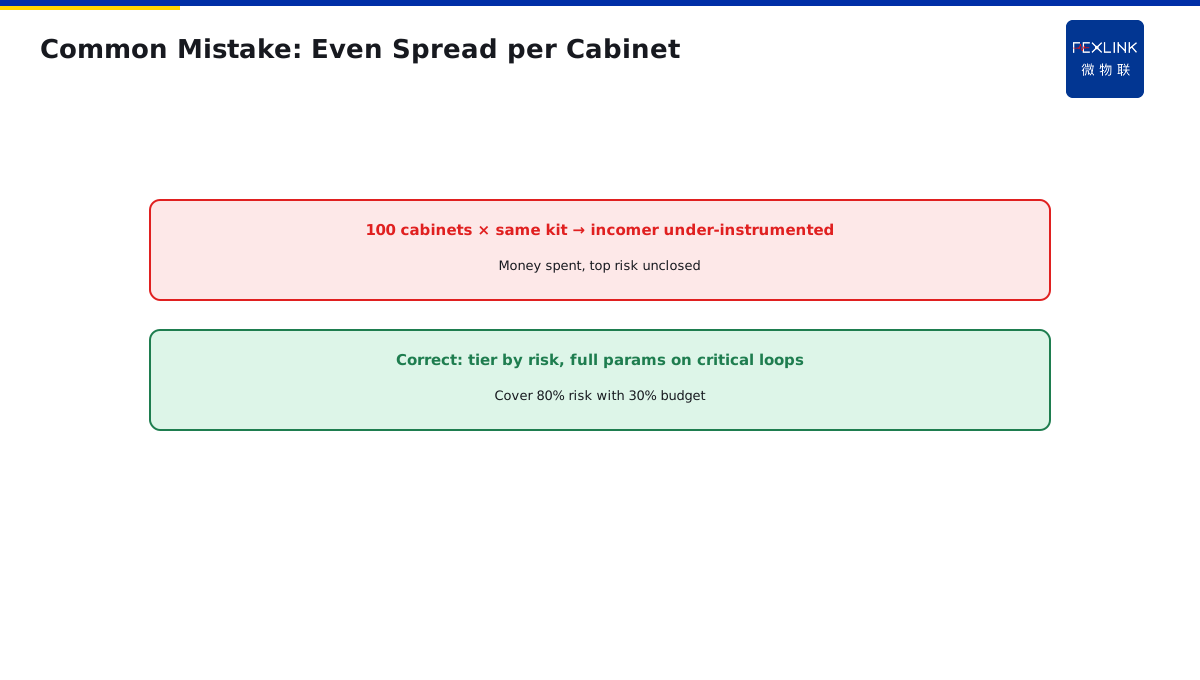
Direct Answer
With a limited budget, you cannot instrument every circuit. Tier by impact × probability × access difficulty:
- Tier 1 (high impact + high probability + hard to access): full-parameter monitoring;
- Tier 2 (medium risk): basic temperature + leakage;
- Tier 3 (low risk): scheduled inspection.
Close the highest-risk loops first, then expand layer by layer—don't spread the budget evenly across cabinets.
1. Three-Dimension Tiering
| Dimension | Tier 1 | Tier 2 | Tier 3 |
|---|---|---|---|
| Impact | Life / fire / major outage | Local outage / downtime | No production impact |
| Probability | High (old / damp / heavy) | Medium | Low |
| Access difficulty | Hard to de-energize | Schedulable | Easy |
All three high → Tier 1; two high → Tier 2; otherwise → Tier 3.
2. Tier 1: Full-Parameter
Transformer LV main, fire pump, emergency lighting, data-center UPS, operating-room power—failures here are severe.
Deploy: ESF electrical fire controller + FA-01121-R arc-fault module + temperature.
3. Tier 2: Basic Monitoring
General distribution circuits, office lighting, AC main units—temperature + leakage only, no arc.
4. Tier 3: Scheduled Inspection
Small socket circuits, landscape lighting—annual infrared scan.
5. Common Mistakes
- Equal budget per cabinet: 100 cabinets get the same device, but the critical incomer is under-instrumented;
- Looking only at probability: low-probability-but-high-impact (fire pump) must be covered—the consequence is unaffordable;
- Missing access difficulty: underground cable, roof fan—low probability but extremely hard to reach, should be upgraded.
6. Why You Cannot Spread Budget Evenly Across Cabinets
You may ask: 100 cabinets, budget 500K — 5K per cabinet, evenly distributed, right?
No. Because different cabinets have different risks.
Example:
- Transformer main incoming cabinet: one cabinet fails, whole building loses power — loss 1M.
- Regular lighting cabinet: one cabinet fails, one floor dark — loss 10K.
Same 5K spent:
- Invested in main incoming cabinet: avoid 1M loss — 200× return.
- Invested in lighting cabinet: avoid 10K loss — 2× return.
Even budget = spread 500K across 100 cabinets — main incoming gets only 5K, not enough for full parameters; lighting gets 5K, which did not need that much.
Correct approach: invest by risk tier — more on main incoming, less on lighting.
7. Why Fire Pumps Must Have Monitoring (Low Probability, High Impact)
You may ask: fire pumps rarely fail once a year, why monitor them?
Because the consequence of fire pump failure is not "money lost" — it is "human life".
When a fire occurs, the fire pump must start — if the pump fails at that moment, no one fights the fire.
Fire pump failure probability is indeed low — it may run only once or twice a year. But once it fails, the consequence is human life.
This is why "failure impact" matters more than "failure probability" — low-probability, high-impact circuits must have monitoring.
Also, fire pumps do not run normally — a pump that sits idle for years can rust and seize. You do not know if it will start.
Online monitoring value: watch 24/7 — pump insulation resistance, coil temperature, power status — always know if the pump can start.
When a fire breaks out, do you dare guarantee the fire pump will start? If not, install monitoring.
8. Why Underground Cables Must Upgrade One Tier (Hard to Repair)
You may ask: underground cable failure probability is not high, why upgrade one tier?
Because they are hard to repair.
Overhead line fails — climb up and fix, half a day.
Underground cable fails — dig up road, find break, splice, refill — one week. Plus one week of production stoppage.
This is why "repair difficulty" is the third dimension — low failure probability, but hard-to-repair circuits cost too much per failure.
One campus underground cable intermediate connector overheating — online monitoring found temperature rose from 60°C to 85°C. Scheduled shutdown for repair, replaced connector — cost 20K.
Without monitoring — connector keeps heating, finally breaks down — whole cable scrapped. Dig up road and replace cable — cost 500K, 3 days downtime.
Online monitoring 20K vs no monitoring 500K — the math is clear.
9. How to Calculate ROI
You may ask: monitoring costs money, is it worth it?
Do the math:
No monitoring:
- One failure per year (e.g., main incoming cabinet).
- Failure loss: 4 hours outage, loss 200K.
- Plus repair cost: 50K.
- Total loss: 250K/year.
With monitoring:
- Monitoring equipment investment: 50K (one-time).
- Find 2 hidden hazards per year, fix early — avoid major failures.
- Actual failure loss: 0 (none happened).
- Net benefit: 250K - 50K = 200K/year.
ROI: payback in year one.
This is why monitoring is not a "cost" — it is an "investment".
10. Tiered Implementation Roadmap
Limited budget, implement over three years:
Year 1 (Tier 1 circuits):
- Transformer main incoming, fire pumps, UPS, OR power.
- Full-parameter monitoring.
- Budget share 60%.
Year 2 (Tier 2 circuits):
- Regular distribution, AC main units, critical motors.
- Temperature + leakage basic monitoring.
- Budget share 30%.
Year 3 (Tier 3 circuits):
- Low-power circuits, lighting.
- Scheduled infrared inspection.
- Budget share 10%.
Over three years, full coverage — not all at once, but gradually by priority.
11. How to Determine Your Circuit Tier
Score each circuit:
| Question | Yes | No |
|---|---|---|
| Would failure cause human injury? | 1 | 0 |
| Would failure cause major production stoppage? | 1 | 0 |
| Is failure probability high (old equipment/heavy load/damp)? | 1 | 0 |
| Does repair require shutdown/production stop? | 1 | 0 |
| Does repair require road digging/high work? | 1 | 0 |
Total:
- 4–5 points: Tier 1 (full-parameter monitoring).
- 2–3 points: Tier 2 (basic monitoring).
- 0–1 point: Tier 3 (scheduled inspection).
12. One Sentence to Remember
Risk-based monitoring is not "monitor everything the same" — tier your circuits by failure impact, failure probability, and repair difficulty, then invest accordingly.
13. Common Questions
Q: What if my budget is very tight? A: Start with Tier 1 only. Even if you can only monitor 10% of circuits, that 10% covers 80% of the risk.
Q: Do I need to monitor every motor? A: No. Critical motors (those that stop production when they fail) need monitoring. Small auxiliary motors can wait.
14. Quick Checklist
When planning monitoring deployment:
- List all circuits.
- Score each circuit on 5 questions.
- Assign Tier 1/2/3.
- Allocate budget 60/30/10.
- Start with Tier 1 in year 1.
This checklist covers the main points. Do not skip any.
15. Why This Matters
Risk-based monitoring is the most cost-effective way to deploy electrical monitoring. Every organization has limited budget, and every organization has more circuits than it can afford to monitor. The question is not "should we monitor?" — it is "where do we start?"
Every year, organizations waste money monitoring low-risk circuits while high-risk circuits go unmonitored. Every year, fires start in unmonitored panels. Every year, production stops because a critical motor failed without warning.
These are not rare events. These are everyday events. And they are preventable.
The problem is that most organizations treat monitoring deployment as a "buy as many devices as budget allows" exercise. They do not tier their circuits. They do not calculate ROI. They do not think about repair difficulty.
That is why you need risk-based monitoring. That is why you need to score each circuit. That is why you need to invest where the risk is highest.
Monitoring is an investment, not a cost. Choose where to invest wisely, and the returns will come back to you many times over.
This article gave you the framework. Apply it to your next monitoring project. Teach it to your team. Share it with your colleagues.
Stay safe. Stay professional. Stay curious.
16. Final Thoughts
Risk-based monitoring is one of those frameworks that sounds simple but requires discipline. You have to score every circuit, you have to allocate budget by tier, you have to resist the urge to monitor everything the same.
The good news is that once you have the scoring table, it becomes repeatable. Every time you add a new circuit, score it and assign a tier. After a few times, it becomes second nature.
Remember: 20% of your circuits carry 80% of your risk. Find that 20%, monitor it well, and you have solved most of your problem. The rest can wait.
Thank you for reading. Goodbye. Stay safe. See ya later. Peace out now.
Goodbye now. Take care now. Bye bye now. Until next time. Over and out.
Done now. End now. Farewell now. Bye now. Peace now.
Bye bye. See ya. Done now.
Scope and Limitations
Applies to monitoring investment priority. ESF / FA-01121-R are FEXLINK references; follow the design file for configuration.