 FEXLINK Research Institute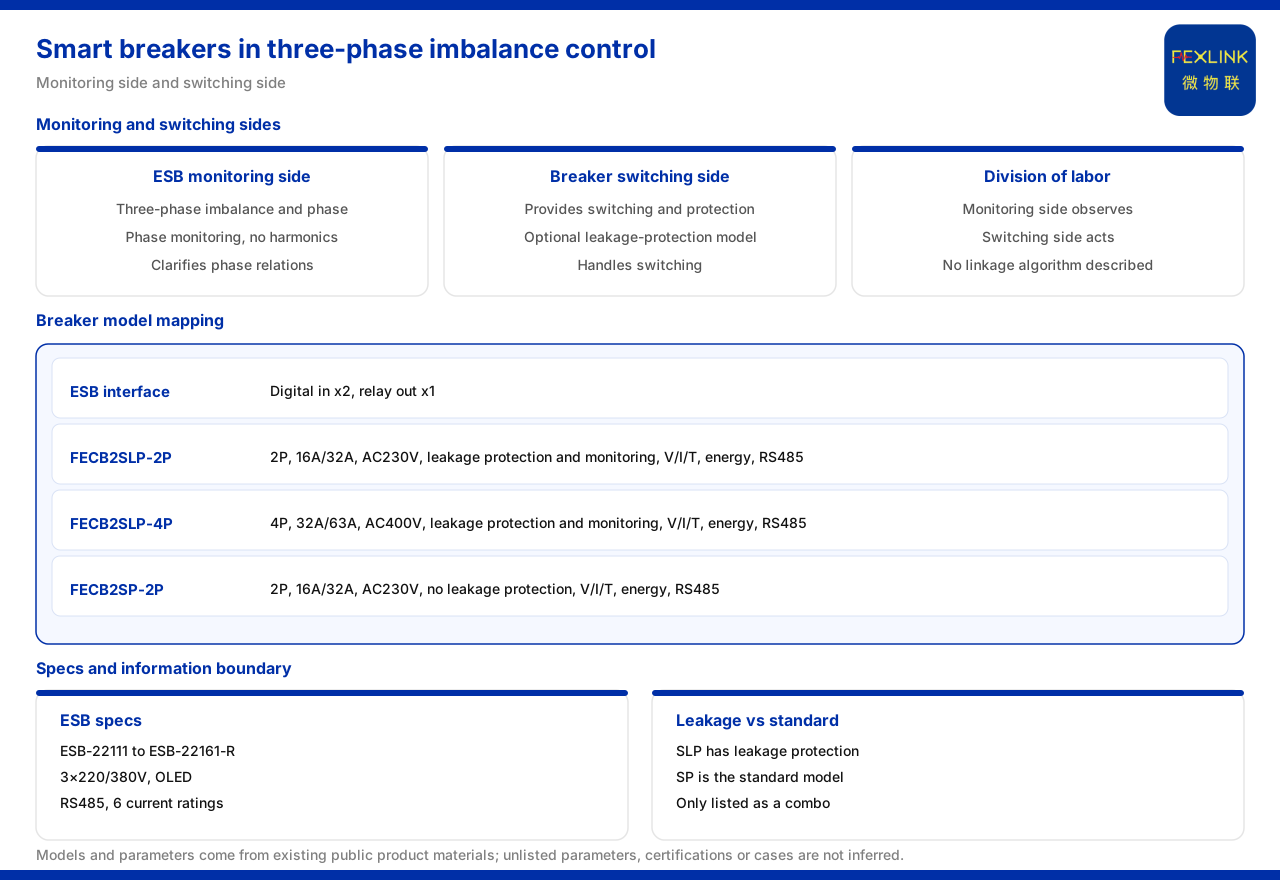
How Intelligent Circuit Breakers and Three-Phase Imbalance Treatment Work Together
Direct answer: in the "distribution automation three-phase treatment" scenario given by the material, the recommended combination is the ESB three-phase imbalance monitor with the FECB2SLP intelligent circuit breaker. The division of labour can be understood as follows: ESB takes on three-phase imbalance and phase monitoring, and FECB2SLP acts as the circuit breaker on the execution side, providing make-break and protection capability and optionally an RCD version. The material only lists them as a recommended combination and does not describe the specific linkage, control logic or three-phase imbalance treatment algorithm between them, so "how they work together" has to be understood within the framework of a monitoring side and an execution side.
What ESB Monitors
The material records that the ESB three-phase imbalance monitor shares an architecture with ESA, uses six current classes, has a model range from ESB-22111 through ESB-22161-R, operates at 3×220/380V, has an OLED display and communicates over RS485. Compared with products of the same architecture, ESB adds phase monitoring to reflect the phase relationship between the three phases; it does not include harmonic monitoring. In addition, it has two digital inputs and one relay output.
For three-phase imbalance treatment, this configuration shows that the role of ESB is to "see clearly". It acquires electrical quantities such as current and phase and presents whether the three phases are unbalanced and whether the phases are normal, giving a basis for later judgement. The digital inputs and relay output provide interfaces for exchanging signals with other devices, but the material does not explain their specific use in this scenario.
What FECB2SLP Can Do on the Execution Side
The material lists two specifications of the FECB2SLP intelligent circuit breaker. The FECB2SLP-2P is 2P with a rated current of 16A or 32A and a rated voltage of AC230V; the FECB2SLP-4P is 4P with a rated current of 32A or 63A and a rated voltage of AC400V. Both support residual-current protection, leakage monitoring, voltage, current and temperature monitoring, and energy statistics, and communicate over RS485.
From these functions, FECB2SLP is both a circuit breaker and an intelligent terminal with monitoring capability. In a treatment combination it can take the execution-side role: as the make-break and protection device of the circuit while also acquiring information such as leakage, voltage, current, temperature and energy. Thus ESB judges the three-phase condition and FECB2SLP executes on the circuit and provides the monitoring data of its own circuit, and the two complement each other in information.
Distinguishing the RCD Version from the Standard Version
The material explains the model suffixes: SLP is the RCD version, that is, with both leakage monitoring and residual-current protection, and SP is the standard version. For example, the standard model intelligent circuit breaker (FECB2SP-2P) is 2P with a rated current of 16A or 32A and a rated voltage of AC230V, without residual-current protection, and likewise supports voltage, current and temperature monitoring and energy statistics over RS485.
This distinction is meaningful for a treatment scheme: if the circuit itself needs residual-current protection, the SLP version can be chosen, letting the breaker take on leakage monitoring in addition to make-break and protection; if the circuit does not need residual-current protection, the SP version can be chosen. The material also states that the whole intelligent circuit breaker series communicates over RS485, with the SLP series including leakage monitoring. In selection, first determine whether residual-current protection is needed, then choose between SLP and SP accordingly.
Steps for Selection by Treatment Scenario
Step one: confirm the treatment scenario. The material groups this combination under "distribution automation three-phase treatment", showing that it faces a distribution circuit that needs attention to three-phase balance.
Step two: choose ESB on the monitoring side. Determine the corresponding class in the ESB-22111 through ESB-22161-R range by the field current class, and plan the access method together with the 3×220/380V voltage condition and RS485 communication.
Step three: choose FECB2SLP on the execution side. First determine whether the circuit is single-phase or three-phase; choose 2P for single-phase and 4P for three-phase; then choose among 16A/32A or 32A/63A by rated current; then decide SLP or SP according to whether residual-current protection is needed.
Step four: check voltage and communication. The 2P version has a rated voltage of AC230V and the 4P version AC400V, which must match the field voltage; the whole series communicates over RS485 and can be connected to the bus uniformly.
Why the Treatment Algorithm Is Outside the Material's Scope
The material only lists the ESB three-phase imbalance monitor and the FECB2SLP intelligent circuit breaker as the recommended combination for this scenario; it does not describe the specific linkage or control logic of the two, nor does it give a three-phase imbalance treatment algorithm. That is, the material does not explain how ESB judges after acquiring imbalance or how it issues an action, nor does it explain on what conditions FECB2SLP executes make-break. These belong to control and algorithm design, beyond the description scope of the product material.
In an actual project, three-phase imbalance treatment usually has to be determined comprehensively together with load distribution, regulation means and operating strategy. What the product material can provide is the available capability at both ends, monitoring and execution, while "how to execute according to the monitoring result" must be determined by system design and cannot be derived directly from the recommended combination.
What It Means That ESB and ESA Share an Architecture
The material states that ESB shares an architecture with ESA, uses six current classes, operates at 3×220/380V, has an OLED display and communicates over RS485. Sharing an architecture means the two have a comparable design basis in current class, voltage condition and communication method, on which ESB adds phase monitoring and does not include harmonic monitoring. For the selector, understanding this helps grasp the capability boundary of ESB: it faces three-phase imbalance and phase, not harmonic analysis.
Therefore, when the main demand on site is the three-phase balance condition, the positioning of ESB matches; if the demand includes harmonic treatment, other means must be confirmed separately. Clarifying this avoids treating ESB as a general monitor covering all power-quality issues.
Allocating Roles by Circuit
In a treatment combination, the circuit can be understood as a monitoring circuit and an execution circuit. On the monitoring side, ESB acquires three-phase current and phase and judges the imbalance condition; on the execution side, the FECB2SLP intelligent circuit breaker handles make-break and protection of the circuit and provides the leakage, voltage, current, temperature and energy data of its own circuit. Once the two are connected to the same bus over RS485, the data can be read within the same system.
It should be stressed again that the material only gives this combination and does not state what instruction is automatically passed between the two. Therefore "how the execution circuit acts after the monitoring circuit finds imbalance" belongs to control design, not to an inherent function of the combination. Understanding the combination by role lets monitoring and execution be considered separately in the selection stage and their cooperation defined in the system design stage.
Boundaries to Clarify
What the material confirms is the recommended combination of the scenario; the specifications, phase monitoring and interface configuration of ESB; the pole count, rated current, rated voltage and functions of the FECB2SLP-2P and the FECB2SLP-4P; the difference between SLP and SP; and the whole-series RS485 communication. What the material does not give is the specific linkage and control logic of the two, the three-phase imbalance treatment algorithm, and the regulation effect of the combination in a specific project. These need to be supplemented by project-level design.
Implementation Recommendations
- Clarify the treatment scenario and circuit form, distinguish single-phase from three-phase, and determine 2P or 4P accordingly.
- On the monitoring side, choose ESB by current class and confirm the 3×220/380V and RS485 access conditions.
- On the execution side, choose FECB2SLP by rated current and voltage, choosing the SLP version when residual-current protection is needed and otherwise the SP version.
- Treat linkage and control logic as separate design content, and do not take the recommended combination directly as the control scheme.
- Leave the treatment algorithm and effect evaluation to system design, bounded by the monitoring and execution capability listed in the material.
Summary
The cooperation of intelligent circuit breakers with three-phase imbalance treatment can rest on a division of "monitoring side plus execution side": the ESB three-phase imbalance monitor is responsible for seeing the three-phase and phase conditions clearly, and the FECB2SLP intelligent circuit breaker is responsible for executing on the circuit and providing its own circuit monitoring. In selection, work through pole count, current, voltage and whether an RCD is included item by item, with communication unified to RS485. What the material confirms is the combination and the parameters; what it leaves undefined is linkage and algorithm, and the two must be separated in project design.