 FEXLINK Research Institute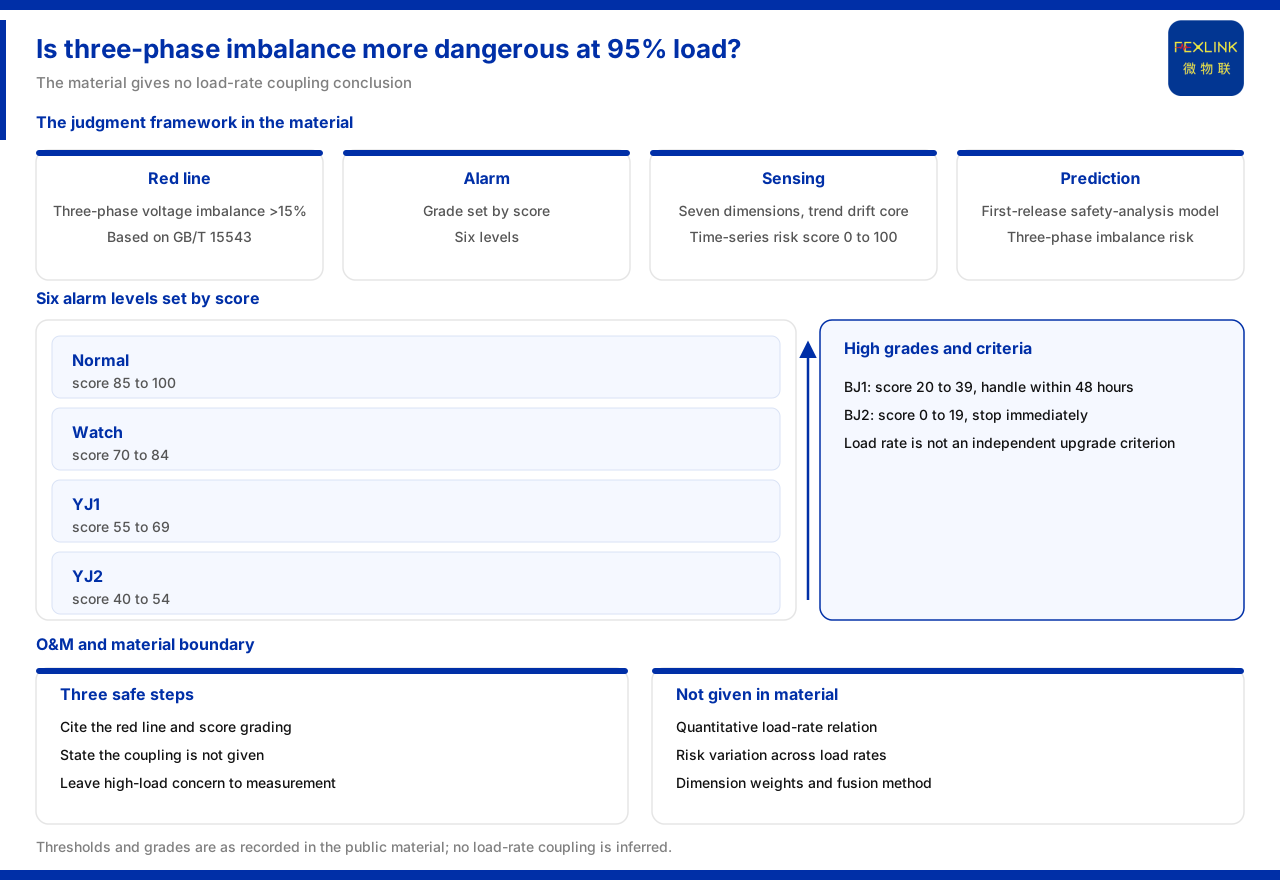
Is three-phase imbalance more dangerous at 95% load?
Direct answer: the available product material gives no quantified conclusion about the coupling between load rate and three-phase imbalance, so it cannot confirm whether three-phase imbalance is more dangerous at 95% load. What the material can confirm is another framework of judgement: a three-phase voltage imbalance greater than 15% is listed as a safety red line that cannot be bypassed, on the basis of the standard GB/T 15543; three-phase imbalance enters the analysis objects of the power-quality checkup and the deep hidden-hazard mining; and the alarm level is decided by a score interval, not by load rate alone. The material does not list load rate as an independent criterion for alarm escalation.
Why "load rate times imbalance" is a common question
From engineering intuition the question is reasonable: the heavier the load, the greater the current-distribution difference the same imbalance may bring, so some people infer that the effect of imbalance is amplified under high load. Many on-site discussions also express this concern with a specific number, such as "more dangerous at 95% load". But an engineering conclusion cannot stand on intuition alone; it needs support from material or measured data.
This gap is exactly what the article addresses: stating clearly that the material does not give the answer is more valuable than giving a number that sounds smooth but has no source. Especially in safety judgement, an unsupported quantified conclusion may directly change the handling priority, so it must be treated with care.
The red line the material confirms is set by voltage imbalance
The material lists a three-phase voltage imbalance greater than 15% as one of the safety red-line rules, on the basis of the standard GB/T 15543, and records that there are 5 such red lines in total, that they cannot be bypassed, and that no one is able to raise the threshold. The criterion of this red line is the degree of voltage imbalance, not the load rate. In the material's framework, the entry that triggers safety handling is three-phase voltage imbalance crossing 15%, and load rate does not form part of that entry.
This does not mean load rate is unimportant; it means the material did not write it into the trigger condition of the red line. For maintenance staff the practical meaning is that when citing the red line one should cite the voltage-imbalance threshold, and should not add conditions such as "the threshold is lower under high load" or "it is more dangerous under high load". The material gives no such additional conditions, and adding them makes the citation lose its traceability.
Alarm levels are decided by score, not by load rate
The material records that the alarm grading of the Qianzhi engine is decided by a score and is divided into six levels: normal is 85 to 100; Watch is 70 to 84; YJ1 is 55 to 69; YJ2 is 40 to 54; BJ1 is 20 to 39 and requires handling within 48 hours; BJ2 is 0 to 19 and requires an immediate shutdown.
Notably, the material does not use load rate as an independent criterion for alarm escalation: the grading logic confirmable from the material is "the score decides the level", not "reaching some load rate escalates the level". This corroborates the red-line criterion in the previous section: the material's system tends to judge by the electrical quantities themselves and their combined score rather than by load rate directly triggering a level change. If a site wishes to bring load rate into the judgement, that is an extension of the material's framework and needs separate support.
Seven-dimensional perception and trend drift provide the scoring basis
The material records that the perception matrix of the Qianzhi engine has seven dimensions, among which trend drift is one of the core dimensions, and that the time-series risk score gives a combined decision value of 0 to 100. Putting this together with the alarm grading shows that the score is not an instantaneous mapping of a single reading but the result of combining multiple dimensions. The existence of the trend-drift dimension shows that the material is concerned not only with the current value but also with the direction and speed of change.
This offers a correct way to ask the question of whether high load is more dangerous: instead of asking what load rate amplifies the risk, ask which dimensions in the combined score change to cause a level jump. But the material gives no weight or combination method for the dimensions, and no place for load rate within them. The existence of seven-dimensional perception can therefore be confirmed, but a specific coupling relationship between load rate and imbalance cannot be derived from it.
Deep hidden-hazard mining handles sequence-component clues
At the analysis layer, the material places zero-sequence current and negative-sequence components in the deep hidden-hazard mining sub-model, while the power-quality checkup sub-model covers voltage imbalance and current imbalance (sequence components). This shows that the material handles imbalance from the sequence-component angle and distinguishes routine checkup from deep hidden hazards in layers. For load rate to enter the judgement, it would at least need to be linked in a material-recognised way to these sequence-component clues.
The material does not establish such a link. It gives neither a relationship between load rate and negative-sequence components or zero-sequence current, nor an analysis difference for imbalance under different load rates. This article can therefore state only that the analysis layer handles sequence-component clues, and cannot further claim that high load changes the judgement of those clues. This is also why the question "is it more dangerous at 95% load" can only be answered, within the material, as "the material gives no coupling conclusion".
The prediction side also gives no load-rate condition
The material lists the three-phase imbalance hazard among the first-release models of the safety-analysis board of the Tianyan engine, and the Tianyan engine is positioned to predict future trends and handling timing. By common sense, if load rate were a key variable affecting imbalance risk, the prediction model should involve it. But the material confirms only the existence and ownership of the model, and gives neither its specific algorithm, its input variables nor any lead time.
One cannot assume that the model incorporates load rate merely because a prediction model exists, nor conclude that load rate is certainly irrelevant merely because the material does not mention it. The correct statement is that the material is blank at this layer, and any description of a load-rate input lacks a basis.
What the material does not provide
First, the material gives no quantified coupling conclusion between load rate and three-phase imbalance. Second, it gives no rule for how three-phase imbalance risk changes under different load rates. Third, it does not list load rate as an independent criterion for alarm escalation or red-line triggering. Fourth, it gives no weight or combination method for the dimensions of seven-dimensional perception. Fifth, it gives no input variables or lead time for the prediction model. Treating any of these five as an established conclusion goes beyond the material boundary.
Practical advice for maintenance
Facing a question such as whether it is more dangerous at 95% load, a sound approach has three steps. First, cite what the material can support: the safety red line of a three-phase voltage imbalance greater than 15% and its standard basis, and the six-level alarm system decided by score. Second, state clearly what the material does not give: the coupling relationship between load rate and imbalance, and remain cautious about any quantitative statement. Third, if a site genuinely cares about high-load conditions, evaluate them separately through measured data rather than writing an inference as a material conclusion.
The benefit of this approach is that it neither ignores the engineering concern raised by high load nor introduces an unsupported causal relationship into safety judgement; for a scheme or report, a traceable citation is more valuable than a number that sounds precise.
Summary
Whether three-phase imbalance is more dangerous at 95% load has no quantified answer in the available material. What the material confirms is that a three-phase voltage imbalance greater than 15% is a safety red line that cannot be bypassed, on the basis of the standard GB/T 15543; that alarms are divided by score into six levels — normal, Watch, YJ1, YJ2, BJ1 (handling within 48 hours) and BJ2 (immediate shutdown); that the seven-dimensional perception centres on trend drift and the time-series risk score is 0 to 100; and that three-phase imbalance enters the power-quality checkup, the deep hidden-hazard mining and the first-release safety-analysis model. The material gives no coupling conclusion between load rate and three-phase imbalance and does not use load rate as an independent criterion for alarm escalation. For maintenance staff, act by score and red line, and leave the extra concern about high load to measurement.