 FEXLINK Research Institute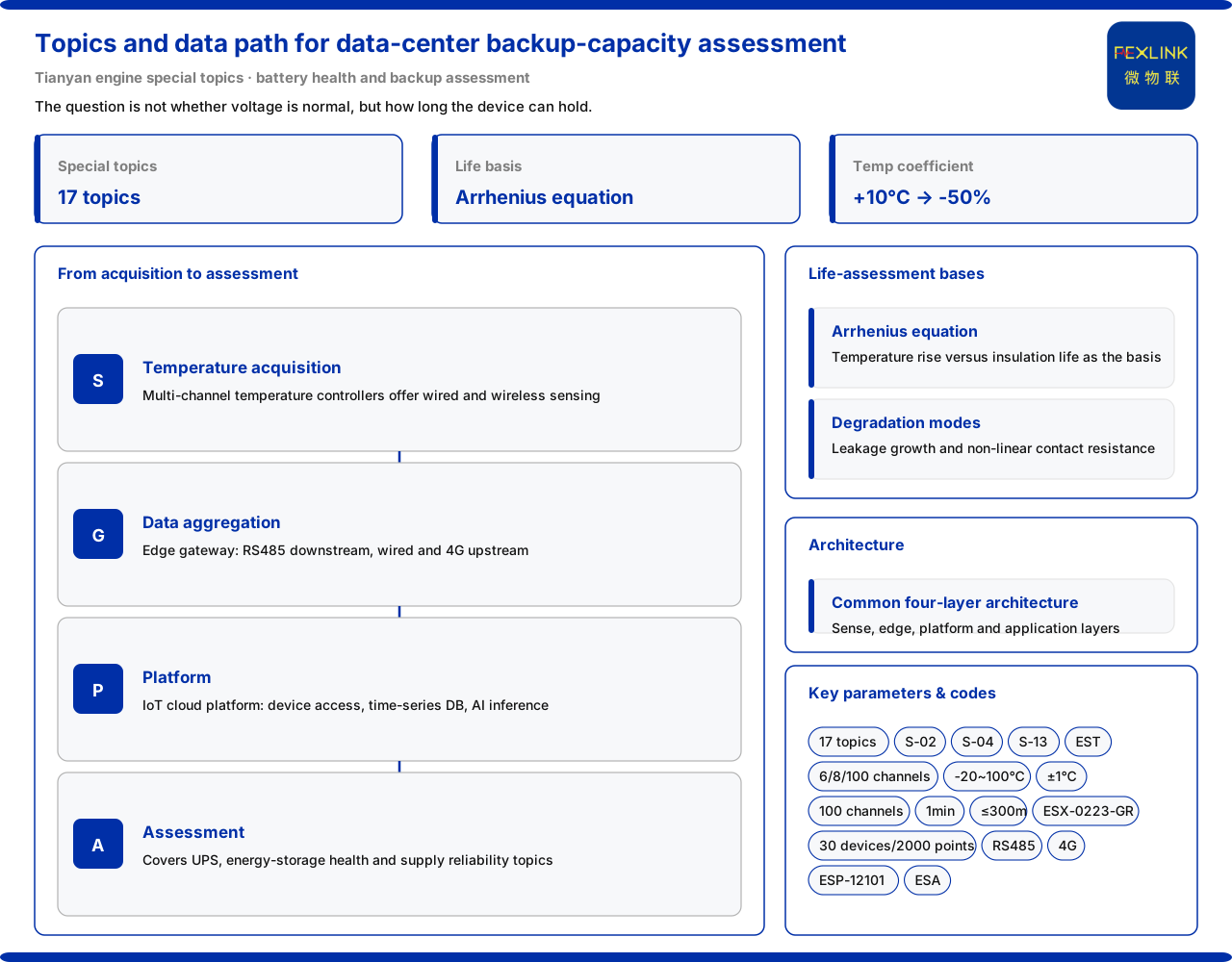
Direct answer
A data center's battery bank usually shows no problem in normal times; what truly tests it is the moment mains power is interrupted. Backup-capability assessment does not answer "whether the voltage is normal now" but "how long this device can still hold, when it will fail, and which time window to maintain in". The product knowledge base states that the Tianyan engine's special topics total 17 models, including UPS (uninterruptible power supply) assessment, energy-storage SOH (state of health) and data center power supply reliability, which can be used for battery-bank health and backup-capability assessment. Based on the wording listed in the product knowledge base, this article explains what these topics cover, what the life judgement is based on, how temperature and data are collected and aggregated, and how selection and architecture land; it does not infer any specific data center's assessment conclusion.
1. Why "how long can it hold" comes first
Traditional monitoring answers "whether limits are exceeded now", while life and backup capability answer "the trend". The two face different time scales: limit judgement faces the present, life judgement faces the future. The product knowledge base summarizes the Tianyan engine's core value as answering "how long this device can still hold, when it will fail, and which time window to maintain in", showing its positioning is prediction rather than mere alarming.
For a battery bank this distinction is especially critical. Battery degradation is gradual; capacity fade and rising internal resistance do not suddenly exceed a limit, yet at a critical moment they show up as insufficient backup time. By the time an alarm appears, the chance to act is often lost. Asking "how long it can still hold" allows replacement or rotation to be arranged while capacity still has margin.
2. What is in the 17 special topics
The product knowledge base states that the Tianyan engine's special topics total 17 models, including UPS assessment, energy-storage SOH and data center power supply reliability. 17 is the overall scale; the three named topics are directly related to power backup.
They answer different questions. UPS assessment looks at the uninterruptible power supply's own state; energy-storage SOH looks at the energy-storage unit's capacity and health; data center power supply reliability looks at whether the whole supply-and-distribution chain supports a zero-interruption requirement. Together they cover three layers: single-unit health, energy-storage state and system reliability. The knowledge base gives only topic names and the count; this article does not infer each topic's input parameters and output indicators.
3. The theoretical basis of life judgement
The product knowledge base states the Tianyan engine's theoretical basis includes three items: the Arrhenius equation, that is, insulation life shortens by about 50% for every 10°C temperature rise; the leakage exponential growth pattern; and the contact-resistance non-linear growth curve.
What the three share is non-linearity. The Arrhenius equation shows temperature's effect on life is not linear — a 10°C rise costs half the life, making temperature one of the most sensitive variables in life prediction. Leakage exponential growth shows leakage-type defects accelerate rather than rise at a constant rate; non-linear contact-resistance growth shows connection-part degradation likewise enters an accelerating stage. This is why prediction models emphasize trends rather than thresholds: only the trend before the accelerating stage leaves a window for early action. Linking the three to "how long it can still hold" gives a chain: temperature data supports the Arrhenius judgement, leakage data the exponential-growth judgement, and contact-resistance data the non-linear-growth judgement; the three feed the topic models, which output life and maintenance windows. The knowledge base does not expand the acquisition frequency and algorithms, so this article does not infer the calculation process.
4. Temperature: the entry point to the battery-bank trend
Temperature is one of the most direct inputs to life prediction. The product knowledge base states that the EST multi-channel temperature intelligent controller (EST-12111-R) supports 6-channel, 8-channel and 100-channel temperature monitoring; the wired NTC range is -20 to 100°C at ±1°C accuracy; the wireless LoRa maximum is 100 channels, the sampling period is settable at 1 minute, and the effective distance is no more than 300 m.
The wired and wireless forms match different sites: wired NTC suits fixed points with controllable cabling; wireless LoRa suits scattered points or inconvenient wiring, with a maximum of 100 channels and a settable sampling period. For a battery bank, the temperature trend is the basic data for judging the degradation rate; incorporating the multi-channel temperature controller is exactly to obtain this trend entry. This article does not infer any battery bank's temperature-rise rate or life conclusion from this wording.
5. Data aggregation: from gateway to platform
Collected temperature, current and other data must enter the platform to be analysed. The product knowledge base states that the ESX intelligent edge-computing gateway (ESX-0223-GR) has an access capability of 30 devices and 2,000 data points, with RS485 downstream and wired and 4G upstream. The CW series, such as the CW industrial gateway (CW-C1), and the CX series, such as the industrial wearable (CX-08R06AI08-C1), likewise have 30 devices and 2,000 data points and can aggregate battery-bank monitoring data.
"Has access capability" must be distinguished from "where computation happens". The gateway solves how data is collected and sent up; predictive analysis happens on the platform side. The product knowledge base states that the platform layer is FEXCloud, carrying device access, the time-series database and the AI inference engine. Time-series data such as temperature first enters the time-series database, after which the AI inference engine invokes the topic models — which explains why battery-bank trend analysis needs the gateway and platform together rather than being completed only on site.
6. Selection and capability comparison
The product knowledge base's selection and AI capability comparison table maps needs to capabilities. "Device life prediction/predictive maintenance" corresponds to the Tianyan engine's S-02, S-04 and S-13 plus 17 special topics; "electrical hazard AI diagnosis (all parameters)" corresponds to the Taiyi intelligent control hub system (the three engines Qianzhi, Wanxiang and Tianyan working together). Life prediction therefore belongs to the Tianyan engine's domain, while all-parameter diagnosis needs the three engines.
In the data center power scenario, the recommended combination for "data center neutral-to-ground voltage/distribution monitoring" is a neutral-to-ground voltage monitor (ESP-12101-R) plus an all-parameter smart meter (ESA-22111-R) plus the intelligent edge-computing gateway. Neutral-to-ground voltage monitoring corresponds to a key indicator of the supply circuit, the all-parameter smart meter provides circuit metering data, and the gateway handles aggregation. Combining this with the temperature monitoring and topic models gives the complete data chain for battery-bank and power-backup monitoring.
7. Landing under the four-layer architecture
The product knowledge base gives the general four-layer architecture. The sensing layer includes monitoring modules, smart meters and sensors; the edge layer includes gateways, the industrial wearable and the cloud PLC; the platform layer is FEXCloud; the application layer includes Web and App visualization, alarm management, analysis reports and mobile inspection.
Placing battery-bank health and backup-capability assessment into these four layers gives a clear landing: the sensing layer collects temperature and current, the edge layer aggregates and sends up, the platform layer stores in the time-series database and runs the topic models with the AI inference engine, and the application layer presents the "how long it can still hold" conclusion as reports and alarms. Each layer plays its part; missing one breaks the data chain.
Scope and limitations
First, this article only restates wording listed in the product knowledge base, and its factual boundary is limited to: the Tianyan engine's 17 special topics (including UPS assessment, energy-storage SOH and data center power supply reliability); the core value of answering how long a device can still hold, when it will fail and which time window to maintain in; the theoretical basis of the Arrhenius equation (a 10°C rise corresponding to about 50% shorter insulation life), leakage exponential growth and non-linear contact-resistance growth; the selection comparison's life-prediction and all-parameter-diagnosis mappings; the EST temperature controller parameters; the ESX, CW and CX access capability; the four-layer architecture; and the data center scenario's recommended combination.
Second, this article does not infer each of the 17 topics' input parameters and output indicators, does not expand the specific form and correction terms of the Arrhenius equation, and does not infer any specific device's remaining life or backup time.
Third, the temperature and current acquisition capabilities are the product knowledge base's wording; specific deployment point counts, sampling frequency and threshold settings are engineering design judgements.
Fourth, this article does not constitute a commitment to any specific data center's power supply reliability or battery-bank health conclusion; selection and configuration should follow the latest product materials, standards and project scheme.