 FEXLINK Research Institute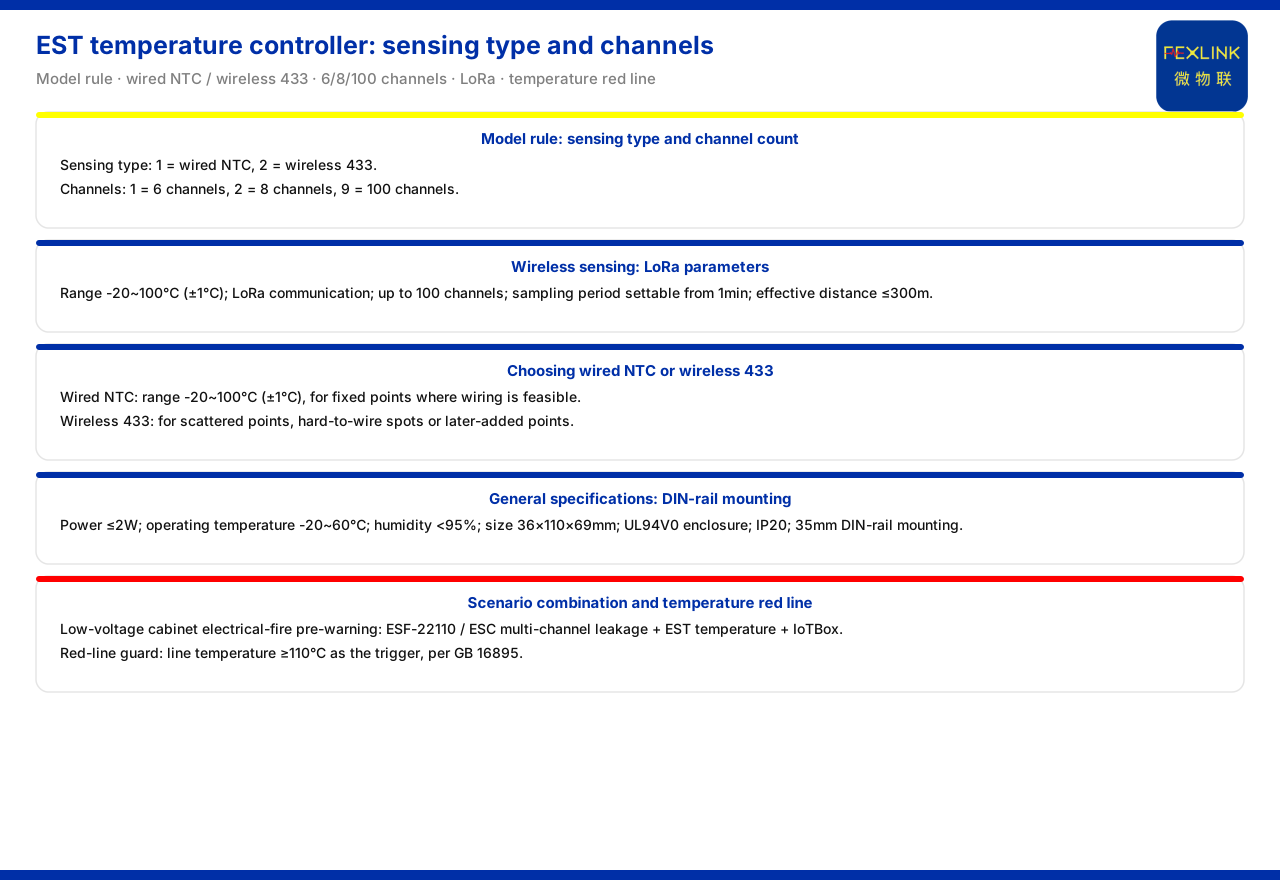
Direct answer
Whether temperature monitoring is done well depends first on two choices: whether the measuring point is wired or wireless, and how many channels one device carries. The product knowledge base writes both into the model rule of the EST multi-channel temperature intelligent controller: the temperature-measurement mode is divided into two classes, wired NTC and wireless 433, and the channel count into three grades, 6 channels, 8 channels and 100 channels. A wireless model communicates by LoRa, supports a maximum of 100 channels, has a measurement range of minus 20 to 100 degrees Celsius with an accuracy of plus or minus 1 degree Celsius, a sampling period settable to 1 minute, and an effective distance of no more than 300 metres; a wired NTC has the same measurement range and accuracy. The device consumes no more than 2 watts and uses 35 millimetre DIN-rail mounting. In the low-voltage distribution cabinet electrical fire early-warning scenario, temperature monitoring forms a recommended combination together with multi-channel leakage monitoring, electrical fire monitoring and control, and the IoTBox. This article explains how to read the model, how to use the parameters and the boundary of the temperature red line, and it marks the boundary of the material.
1. Model rule: temperature-measurement mode and channel count
The product knowledge base records that, in the model rule of the EST multi-channel temperature intelligent controller, the temperature-measurement mode is divided into two classes: 1 means wired NTC and 2 means wireless 433; the channel count is divided into three grades: 1 means 6 channels, 2 means 8 channels and 9 means 100 channels.
Putting these two fields together reveals what kind of site one device suits. A wired option is used where the measuring points are fixed and cabling is feasible; a wireless option is used where the measuring points are dispersed, cabling is inconvenient, or points must be added later. The channel count then determines the coverage of a single device: 6 and 8 channels suit a smaller cabinet or a local area, while 100 channels suit an occasion with densely packed points that need centralised acquisition. Fixing the mode first and the channel count second is the reading of this model rule.
2. Wireless temperature measurement: LoRa, range, distance and period
The key parameters of wireless temperature measurement are given by the product knowledge base: a measurement range of minus 20 to 100 degrees Celsius with an accuracy of plus or minus 1 degree Celsius; LoRa communication; a maximum of 100 channels; a sampling period settable to 1 minute; and an effective distance of no more than 300 metres.
Each of these parameters has its use. The accuracy of plus or minus 1 degree Celsius determines whether the reading can be used for trend comparison; the maximum of 100 channels determines the acquisition ceiling of one device; the 1 minute configurable sampling period means the data density can be adjusted as needed; and the effective distance of no more than 300 metres is a reminder that wireless coverage must be calculated against the actual point layout.
3. Wired temperature measurement: the NTC option
Wired temperature measurement uses the NTC mode. The product knowledge base records that the measurement range of a wired NTC is likewise minus 20 to 100 degrees Celsius, with an accuracy of plus or minus 1 degree Celsius.
Compared with the wireless option, the wired option differs mainly not in the measurement index but in the connection mode: the measuring point is connected by cable, and the data does not depend on a wireless link, so it is more stable where cabling is possible.
4. General parameters and mounting
The general parameters of the device itself determine whether it can be installed on site. The product knowledge base records that the EST series consumes no more than 2 watts, has an operating temperature of minus 20 to 60 degrees Celsius and a humidity below 95%, measures 36 by 110 by 69 millimetres, has a flame-retardant enclosure rating of UL94V0, an ingress protection rating of IP20, and uses 35 millimetre DIN-rail mounting.
These parameters face the installation and operating conditions. IP20 shows that it suits a cabinet environment and is not suitable for direct exposure to dust or splashing water; the UL94V0 enclosure corresponds to flame-retardant requirements.
5. Two 100-channel wireless models: choice of power supply
At the 100-channel grade, the model table of the product knowledge base gives two wireless LoRa models: the EST multi-channel temperature intelligent controller (EST-12920-R), powered at DC5V, and the EST multi-channel temperature intelligent controller (EST-22920-R), powered at AC220V, both with 100 channels and an OLED display.
The difference between the two models is concentrated in the power-supply mode. DC5V suits an occasion where low-voltage DC supply already exists in the cabinet, while AC220V suits a position that draws AC power directly. 100 channels and the OLED display are their common capabilities: the former shows the scale of measuring points one device can centrally access, the latter shows that readings can be checked locally on site without going all the way back to the platform side.
6. Scenario placement: low-voltage distribution cabinet electrical fire early warning
Temperature monitoring is not used in isolation. In the typical application scenarios and selection comparison, the product knowledge base gives the recommended combination for low-voltage distribution cabinet electrical fire early warning as the electrical fire monitoring and control device (ESF-22110), ESC multi-channel leakage monitoring, EST temperature monitoring and the IoTBox.
The division of work in this combination can be understood as follows: leakage monitoring watches the residual current, temperature monitoring watches the heating of joints and lines, the electrical fire monitoring and control handles monitoring and control within the scenario, and the IoTBox carries aggregation and networking. For a low-voltage distribution cabinet, the multi-channel capability of the EST multi-channel temperature intelligent controller fits the fine-grained measuring points exactly.
7. Temperature red line: the safety boundary of line temperature
Beyond monitoring and early warning there is a boundary that cannot be bypassed. The safety red line of the product knowledge base specifies that it triggers when the line temperature reaches 110 degrees Celsius or above, according to the standard GB 16895; this red line is one of the entries that cannot be bypassed.
The relationship between this red line and temperature monitoring is direct: monitoring is responsible for seeing the trend before the threshold is reached, and the red line is responsible for giving a definite conclusion when the threshold is crossed. The product knowledge base also states that such red lines are executed at the pre-stage and, once triggered, go directly into the disposal path. For the site this means the temperature reading is not only something to observe; it is connected to a clear line of action.
Scope and limitations
First, this article only restates the content listed in the product knowledge base; the factual boundary is limited to the model rule, model table and parameters of the EST multi-channel temperature intelligent controller, together with the selection comparison for low-voltage distribution cabinet electrical fire early warning and the line-temperature safety red line.
Second, the two temperature-measurement modes of wired NTC and wireless 433 and the three channel-count grades of 6, 8 and 100 in the EST model rule are quoted as recorded in the product knowledge base; this article does not infer unlisted combinations of measurement mode and channel count.
Third, the minus 20 to 100 degrees Celsius and plus or minus 1 degree Celsius accuracy, LoRa communication, maximum of 100 channels, 1 minute configurable sampling period and effective distance of no more than 300 metres of wireless temperature measurement, and the measurement range and accuracy of the wired NTC, are quoted as recorded in the product knowledge base; this article does not present 300 metres as a guarantee for a particular mounting position.
Fourth, the power consumption of no more than 2 watts, operating temperature of minus 20 to 60 degrees Celsius, humidity below 95%, size of 36 by 110 by 69 millimetres, UL94V0 enclosure, IP20 and 35 millimetre DIN-rail mounting of the EST series are quoted as recorded in the product knowledge base.
Fifth, that the EST multi-channel temperature intelligent controller (EST-12920-R) and the EST multi-channel temperature intelligent controller (EST-22920-R) both have 100 wireless LoRa channels with an OLED display and use DC5V and AC220V supply respectively is quoted as recorded in the product knowledge base; this article does not infer other power-supply modes or model performance.
Sixth, the recommended combination for low-voltage distribution cabinet electrical fire early warning, and the safety red line that the line temperature reaches 110 degrees Celsius or above according to GB 16895, are quoted as recorded in the product knowledge base; this article does not change their thresholds or trigger consequences, nor does it provide specific engineering point layout, setting or rectification schemes.