 FEXLINK Research Institute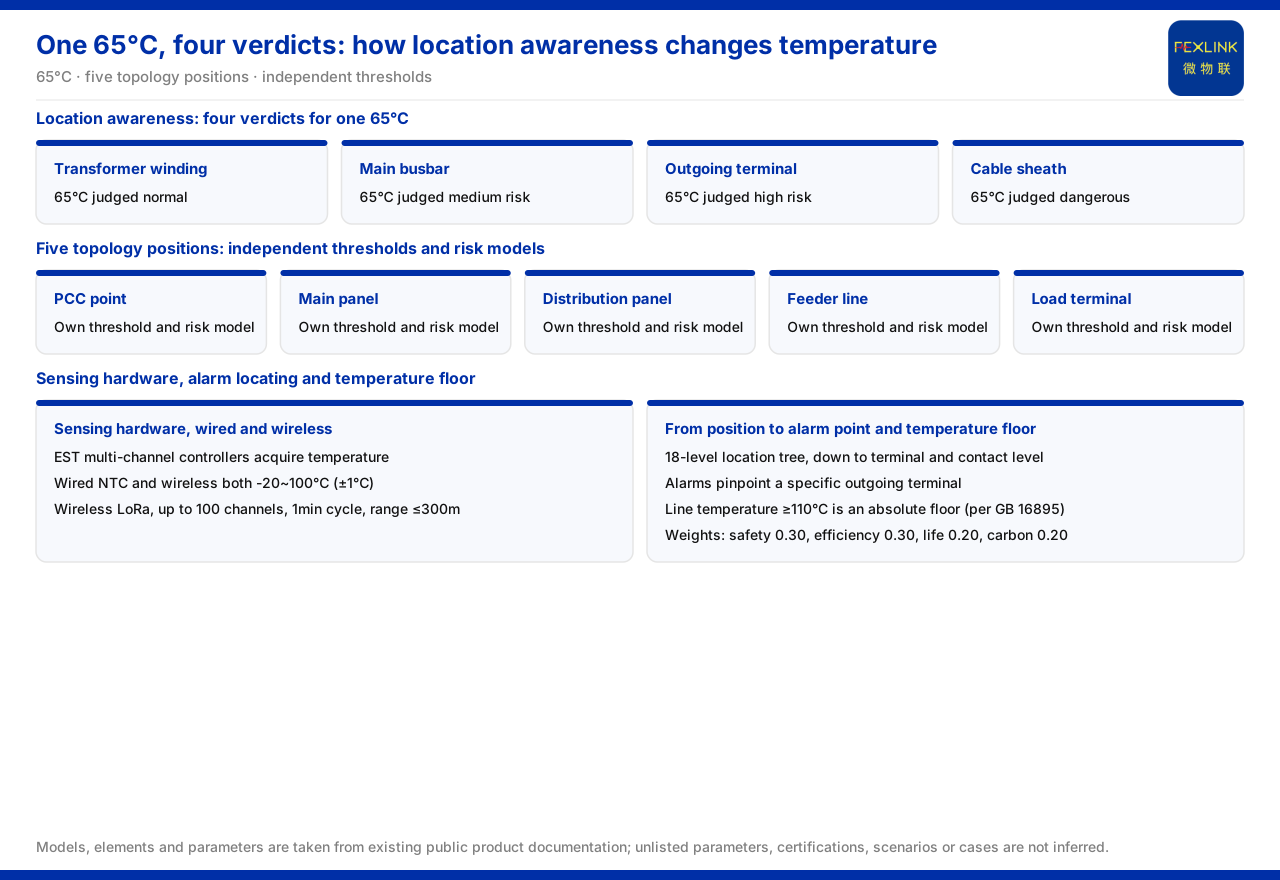
Direct Answer
The same temperature reading can mean entirely different things in different electrical locations. The product knowledge base's location-awareness capability gives the example: the same 65°C is normal at a transformer winding, a medium risk at the main busbar, a high risk at an outgoing terminal, and dangerous at a cable sheath. Judging whether a temperature is a problem therefore depends not only on the value itself but on which class of location it was measured at.
The knowledge base further states that the system maintains independent thresholds and risk models for five electrical topological location types, and that with graded scenario positioning it lands alarms on a specific terminal or contact point; temperature acquisition is carried by the multi-channel temperature intelligent controller, which supports both wired and wireless measurement. This article explains why location changes the meaning of temperature, what the hardware locus of temperature monitoring is, and which thresholds the material gives and which need separate confirmation.
I. Location Awareness: The Same 65°C, Four Verdicts
The knowledge base lists location awareness as a core capability, using exactly the example of the same temperature judged differently by location. The value 65°C does not change; what changes is where it sits: a transformer winding normally runs warm, so 65°C is normal; the main busbar has better heat dissipation, so the same 65°C calls for attention; once an outgoing terminal's contact loosens or oxidizes, the same temperature means higher fault risk; and a cable sheath has a small temperature margin, so 65°C is already close to dangerous. Temperature thresholds are therefore not a single horizontal line but a set of criteria bound to location.
The example is persuasive because it separates "absolute value" from "relative location." A common engineering approach sets one uniform upper limit and alarms above it; location awareness stresses that the same value represents a different level of health at locations differing in heat dissipation, insulation margin, and connection structure. Managing all points with one uniform limit either causes frequent false alarms at tolerant locations or misses early signs at sensitive ones.
These four verdicts are the knowledge base's illustration of the principle; they do not mean it can be copied to any site. Which band a site actually falls into still follows the system's verdict by location type.
II. Five Topological Positions and Independent Thresholds
The knowledge base maintains independent thresholds and risk models for five electrical topological location types: the public connection point, the main distribution panel, the distribution panel, the feeder line, and the load terminal. Different levels bring different mechanisms into focus: nearer the supply side, the ampacity and short-circuit capacity are larger and an abnormality affects a wider area; nearer the load side, there are more connections and contact-resistance hazards stand out. Setting thresholds and models separately for each location class is exactly what avoids measuring every point with one ruler.
Independent thresholds and independent risk models are two things. The threshold answers "at what value attention is needed," and the risk model answers "what an abnormality at this location would affect." The same value at different locations may trigger different levels of attention, and the same level of attention may correspond to different handling priorities. Separating the two avoids both over-alarming and missing key locations.
III. The Hardware Locus of Temperature Measurement
Location awareness needs temperature data, carried by the multi-channel temperature intelligent controller. The EST multi-channel temperature intelligent controller supports wired NTC and wireless measurement, both with a range of -20~100℃ (±1℃). The wireless method uses LoRa, supports up to 100 channels, has a settable 1-minute sampling period, and an effective distance of no more than 300 m.
Placing the parameters alongside location awareness yields a clear cooperation: the location type decides what a temperature at that location means, and the multi-channel temperature intelligent controller decides whether that temperature can be acquired stably. The two are criteria and data, and neither is dispensable.
IV. Choosing Between Wired and Wireless
The trade-off between wired NTC and wireless measurement depends on site placement conditions. Wired requires laying temperature cables and suits concentrated points with available routing, and is convenient for close placement inside a cabinet; wireless avoids much cabling and suits dispersed points, cross-area placement, or retrofit projects, but the 300 m effective distance and LoRa communication conditions must be considered. Both share the same measurement range, so the core choice is not range but whether placement and communication are feasible. Whichever is used, the locations to be monitored should first be sorted by the five topological types, and then the measurement method decided for each.
V. Reading the Model Rule
The knowledge base gives the model rule of the multi-channel temperature intelligent controller so capability can be checked during selection. The measurement-method digit distinguishes wired NTC (code 1) and wireless 433 (code 2); the channel digit distinguishes 6 channels (code 1), 8 channels (code 2), and 100 channels (code 9); the humidity digit can indicate one humidity channel (code 1). The model rule maps "wired or wireless, how many channels, and whether humidity is included" directly to a model, reducing ambiguity in selection.
When checking the model rule, first determine the channel digit from the required channel count, then the measurement-method digit from the placement method, and finally the humidity digit from whether humidity monitoring is needed.
VI. From Position to Alarm Point
For location awareness to land, positioning capability is also needed. The knowledge base records an 18-level scenario positioning tree, refining from the top-level scenario down to terminal-level and contact-point level, the terminal level being one of the finer levels and the contact-point level the finest, so that an alarm can be located at the outgoing terminal of a specific circuit. The location type answers "does this temperature count as a problem," and the positioning tree answers "where this temperature appears"; together they give temperature alarms engineering meaning.
For operations, knowing only that a point's temperature is high is not enough to arrange handling; knowing which workshop, cabinet, or terminal it is at lets staff reach the site directly. Location awareness plus graded positioning moves temperature data from value alarms to point alarms.
VII. Four-Dimension Impact Assessment and Dynamic Weights
The knowledge base maps location awareness to a dedicated location-awareness analysis engine and gives four-dimension impact-assessment weights: safety 0.30, efficiency 0.30, lifetime 0.20, and carbon 0.20. The weights are not fixed: in a hospital scenario the safety weight rises to 0.50, in a factory scenario the efficiency weight rises to 0.40, and in a carbon-assessment scenario the carbon weight rises to 0.35. This explains why two points with the same value may end up with different impact assessments in scenarios with different weights.
The four weights express that "the same anomaly has different emphasis in different scenarios": hospitals are most sensitive to supply safety, so the safety weight is raised; factories care more about production efficiency, so the efficiency weight is raised; scenarios entering carbon assessment raise the carbon weight. Location decides the criteria, and weight decides the priority.
VIII. The Temperature Red Line That Cannot Be Bypassed
Whatever the location and weight, one bottom line always holds. The knowledge base lists a line temperature of not less than 110°C as one of the non-negotiable safety red lines, based on the GB 16895 standard. This red line is not relaxed by location type or scenario weight. Location awareness adjusts the band of routine judgment, while the red line is a ceiling that must never be crossed.
Separating routine judgment from the red line avoids a misunderstanding — that location awareness means all thresholds can be flexibly adjusted by location. What is adjustable is the boundary of routine attention and risk level; the red line itself is a hard constraint. Location awareness makes routine judgment fit the site better; it does not make the bottom line negotiable.
Scope and Limits
First, this article restates only the content listed in the product knowledge base, and its factual boundary is limited to location awareness, the five topological location types, the multi-channel temperature intelligent controller parameters and model rule, the 18-level scenario positioning tree, the four-dimension impact assessment weights, and the line-temperature red line.
Second, the different verdicts of 65°C at transformer winding, main busbar, outgoing terminal, and cable sheath, and the four-dimension weights, are the knowledge base's positions; this article only restates them and does not commit to any specific site conclusion.
Third, the multi-channel temperature intelligent controller's -20~100℃, LoRa maximum of 100 channels, 1-minute sampling period, effective distance of no more than 300 m, and model rule are cited as listed; this article does not infer the specifications of unlisted models.
Fourth, the 110°C red line and GB 16895 are cited as listed; this article does not expand on the standard's clauses or scope.
Fifth, location judgment and alarm points must be determined with the site layout and scenario; this article does not provide a setting scheme for a specific project.