 FEXLINK Research Institute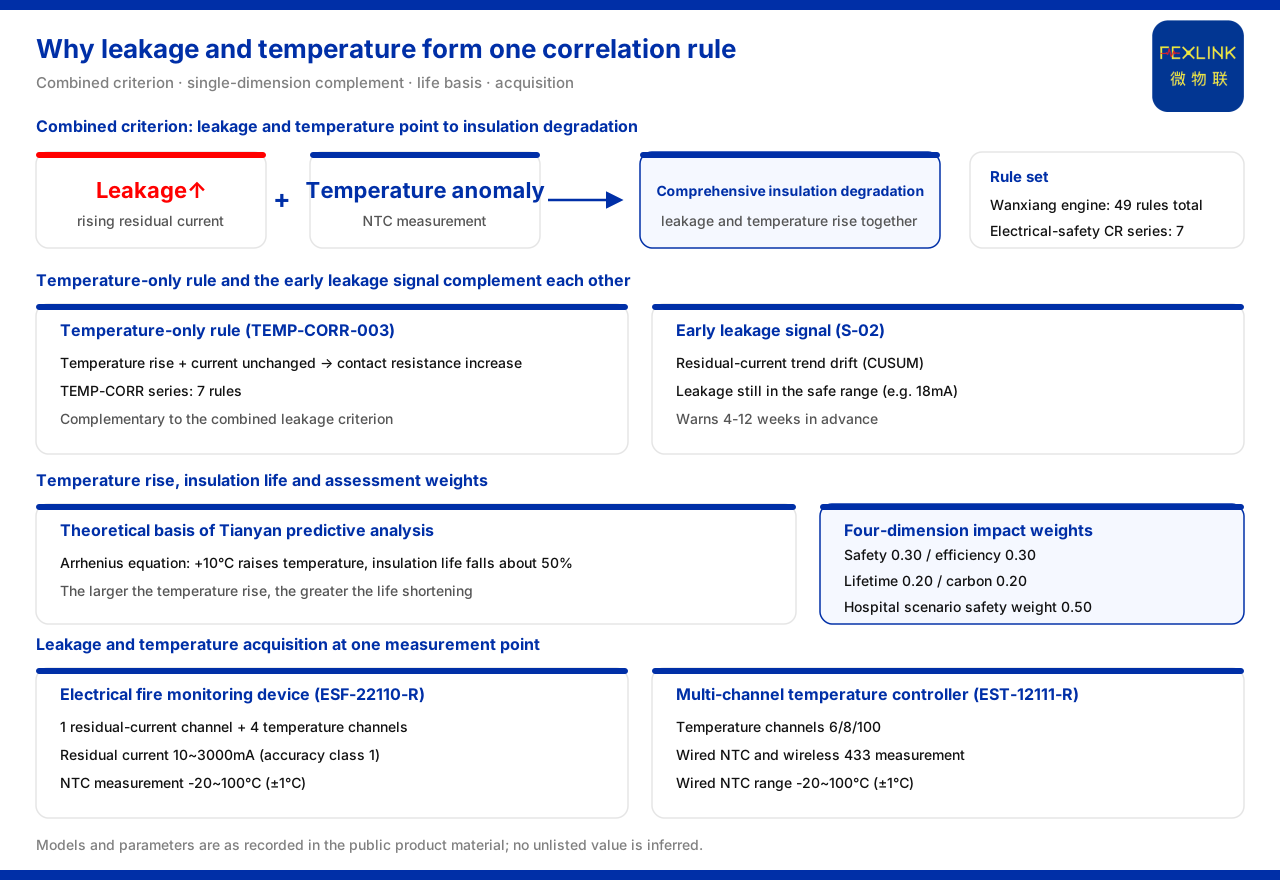
Direct answer
The product material states "leakage rise + temperature anomaly" explicitly as one correlation criterion: within the electrical-safety CR series among the 49 correlation rules of the Wanxiang engine, CR-001 is "leakage↑ + temperature anomaly → comprehensive insulation degradation". That is, the system does not alarm on the two quantities separately, but combines them to point to the common root cause of insulation degradation. What the material gives is the direction of the rule; it does not give a numerical model for that rule. The combination is the substance of the rule: either quantity alone may be unremarkable, while the two rising together is what carries the specific meaning.
1. The material lists leakage and temperature as one correlation rule
The product material records that the Wanxiang engine has 49 correlation rules in total, of which the electrical-safety CR series has 7, and CR-001 directly gives the criterion "leakage↑ + temperature anomaly → comprehensive insulation degradation". Leakage and temperature rising together is interpreted as a signal that the insulation is degrading comprehensively, which differs from looking at either quantity alone. Merging the two quantities into one rule also means that a single quantity crossing its line may not give the same direction; only the combination forms a more specific judgement. The rule therefore compresses two alarms into one conclusion, and in doing so it raises the accuracy of the root cause rather than merely adding another threshold.
2. A temperature-only anomaly also has its own rule
In the same material, the TEMP-CORR series has 7 rules in total, of which TEMP-CORR-003 is "temperature rise + current unchanged → contact resistance increase", giving a correlation criterion on the temperature dimension alone. It and the combined leakage-plus-temperature criterion complement each other: one points to contact resistance, the other to insulation degradation. The two conclusions are different faults, and the presence of both rules shows that the system does not collapse every temperature anomaly into insulation degradation; the presence or absence of the leakage term is what steers the conclusion.
3. The theoretical basis for temperature rise against insulation life
The product material lists the theoretical bases of the Tianyan engine's predictive analysis, among them the Arrhenius equation: for every +10°C rise in temperature, insulation life is shortened by about 50%. This explains why a temperature anomaly is brought into the judgement of insulation-type hazards: temperature is not only an instantaneous reading but is also related to the consumption of insulation life. The larger the temperature rise, the more pronounced the shortening of insulation life, so a temperature anomaly itself carries a time dimension. The equation is what links a present reading to a future consequence, and that link is why temperature belongs in a rule about degradation.
4. The early signal on the leakage dimension
Beyond temperature, the S-02 residual-current trend drift (CUSUM) recorded in the product material can detect a weak mean shift while the leakage is still in the safe range (e.g. 18mA) and warn 4-12 weeks in advance. It provides an early signal on the leakage dimension that can be observed together with the temperature-anomaly information. One looks at the trend, the other at the correlation, and together they buy time for handling insulation-type hazards. The two are complementary in kind as well as in timing: the correlation rule says what the combination means, while the trend method says that the combination is forming before either quantity reaches its limit.
5. The hardware acquisition basis for leakage and temperature
A coordinated judgement requires both classes of acquisition at the same site. The bases the product material gives include: the electrical fire monitoring & control device (e.g. ESF-22110-R) has 1 residual-current channel plus 4 temperature channels, with a residual current of 10~3000mA (accuracy class 1) and NTC temperature measurement of -20~100℃ (±1℃); the multi-channel temperature intelligent controller (e.g. EST-12111-R) supports wired NTC and wireless 433 temperature measurement, with 6/8/100 channels, and the wired NTC range is -20~100℃ (±1℃). Having both leakage and temperature data at the same measurement point is the premise on which the combined criterion holds. Without co-located acquisition, the two quantities would come from different places and could not be correlated to one point.
6. The weight of such hazards in the assessment
The four-dimensional impact assessment of the product material weights safety, efficiency, lifetime and carbon as 0.30, 0.30, 0.20 and 0.20, and supports dynamic weights, for example a safety weight of 0.50 in the hospital scenario. Insulation- and temperature-type hazards are weighted on the safety dimension, which shows that this class of combined signal belongs to the safety side in the assessment. Raising the safety weight to 0.50 in the hospital scenario also reflects that the handling priority of such hazards changes with the scenario. The weights are the mechanism by which a combined signal translates into an overall assessment, and the dynamic weighting is what lets the same signal rank differently in different settings. The default distribution places safety and efficiency at the same level and lifetime and carbon below them, so a hazard weighted on safety enters the assessment with the same base weight as an efficiency hazard until the scenario adjusts it. The hospital case is the clearest example of that adjustment, because it moves the safety weight upward and thereby raises the standing of exactly this class of insulation and temperature hazard.
Scope and limitations
First, this article explains only the correlation-rule direction corresponding to the combination of leakage and a temperature anomaly; the factual boundary is limited to the product material, and no standard clause, parameter, certification or case not listed there is introduced.
Second, the product material gives only the rule direction of CR-001, not a numerical model, threshold or confidence; "the combination points to insulation degradation" in this article is the material's existing rule statement and does not represent a diagnosis of a specific site.
Third, the models and parameters in this article are all as recorded in the material; this article does not infer the specifications of unlisted models from them, nor does it make performance or effect inferences.
Fourth, the actual judgement must be determined in conjunction with the on-site leakage and temperature data and load conditions; this article provides no diagnosis or threshold-setting calculation.