 微物联研究院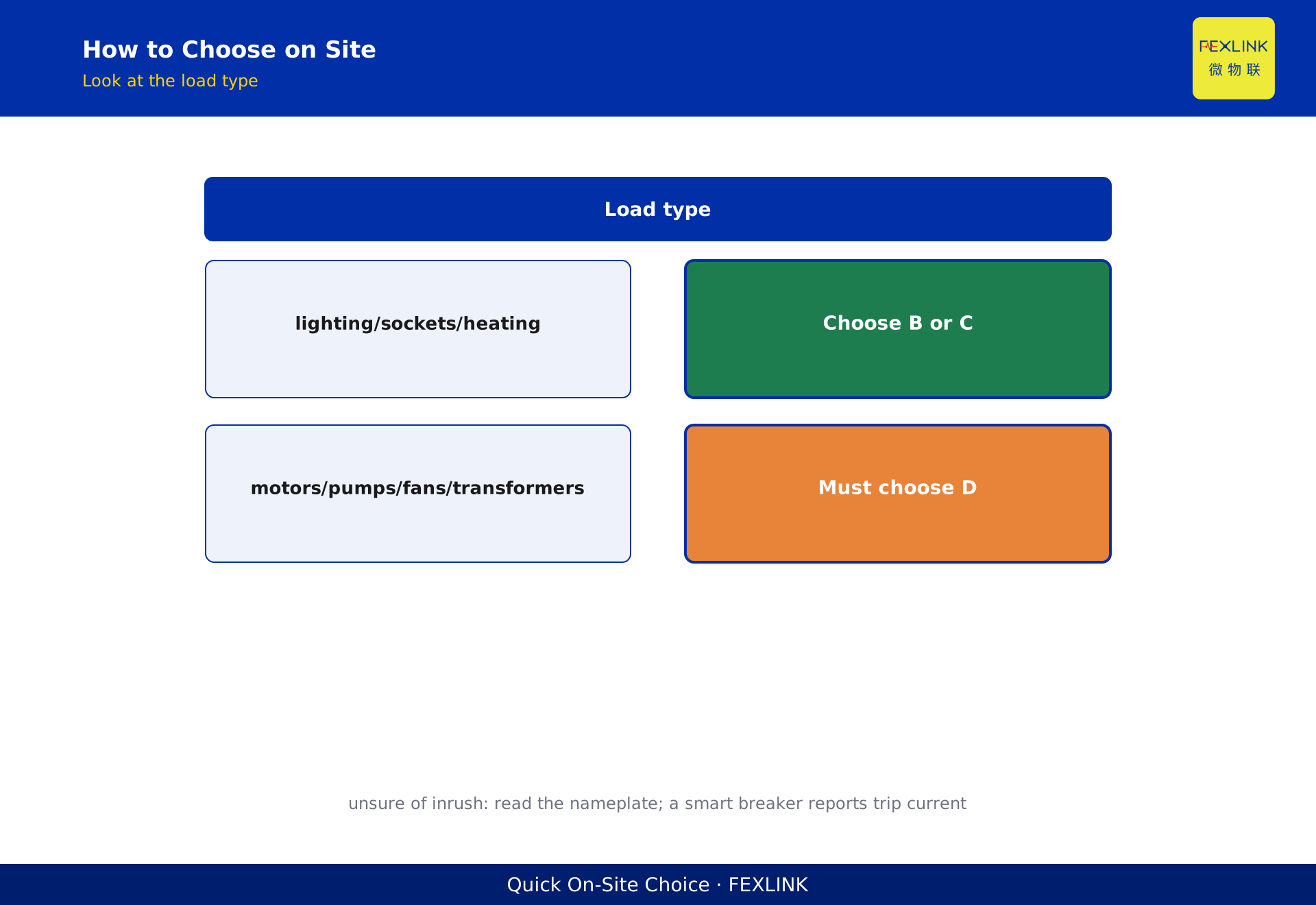
Direct Answer
B, C and D do not describe the frame size of a circuit breaker. They describe the instantaneous (short-circuit) tripping threshold. Type B trips instantly at 3–5 times rated current, Type C at 5–10 times, and Type D only at 10–20 times. Lighting and socket circuits use B or C; motors, transformers and capacitor banks with large inrush must use D. Choosing wrong leads to exactly two outcomes: nuisance trips on light loads, or failure to trip when it matters. A 7.5 kW fan at a plant used to trip on every start until a Type D was fitted — the breaker was not faulty, the curve was.
1. Two Tripping Stages: Long-Delay and Instantaneous
Every miniature circuit breaker (MCB) contains two tripping mechanisms for two fault types.
The long-delay (thermal) release uses a bimetal strip that bends under heat and responds to overload. The higher the current, the faster it heats and trips. It acts slowly, from seconds to minutes, and handles "current above rating but not a short" — for example, a few extra air conditioners on the line.
The instantaneous (magnetic) release uses a solenoid that snaps open within milliseconds when current crosses its threshold. It handles sudden short-circuit currents that jump to dozens of times rated value.
The letters B, C, D only move the instantaneous threshold; they do not change the long-delay curve. The long-delay portion is nearly identical across the three types; the difference lies on the steep instantaneous line on the right.
2. How Many Times Rated Current: B, C, D
GB/T 10963.1 fixes the instantaneous ranges for household and similar AC circuit breakers:
- Type B: 3 In – 5 In. Starts tripping instantaneously above 3 times rated current.
- Type C: 5 In – 10 In. Threshold raised; starts above 5 times.
- Type D: 10 In – 20 In. Highest threshold; starts only above 10 times.
In is rated current. A 16 A Type C breaker trips instantaneously roughly between 80 A and 160 A; the same frame in Type D moves that threshold to 160 A – 320 A.
The underlying difference is tolerance of normal inrush. The larger the starting surge, the higher the instantaneous threshold must be — otherwise the breaker trips on power-up.
3. Resistive Loads: B or C Are Enough
Lighting and ordinary socket circuits have no large starting current. An incandescent lamp is a resistor; inrush from an LED driver is modest. Once such a circuit sees 5–10 times In, it is most likely a real short and should trip immediately.
Type B is more sensitive and suits pure lighting where power-loss tolerance is low. Type C is the common all-rounder for office sockets and normal lighting. A standard floor of an office tower, all C16 and C10, follows exactly this logic.
4. Inductive Loads: Motors and Transformers Need D
A direct-on-line motor draws 5–7 times rated current at start, lasting hundreds of milliseconds to seconds. That surge is normal, but a Type C breaker with a 5–10 In threshold will read it as a short and trip on every start.
Type D raises the threshold to 10–20 In, clearing the starting surge and tripping only on a genuine short. Motor circuits, transformer inrush, capacitor-switching surge, and welder primaries all require Type D. A quay crane's power circuit at a port used C32 and tripped every time the crane travelled; switching to D32 stopped nuisance trips without weakening short-circuit protection.
5. What Happens When You Choose Wrong
Putting Type D on a lighting circuit means failure to trip: on a real short, the high threshold delays action until current exceeds 10 times, by which time the cable has overheated.
Putting Type C on a motor circuit means tripping when it should not: the motor trips on every start, or intermittently under load swings, causing downtime.
"Breaker keeps tripping" in the field — four times out of ten it is not a fault but a wrong curve.
6. How to Choose on Site
A one-line rule:
- Lighting, sockets, resistive heating → B or C.
- Motors, pumps, fans, transformers, capacitors → D.
- Unsure of starting current → read the nameplate power, estimate the starting multiple, and back-calculate the threshold.
- A smart breaker reports the tripping current to the platform. The FEXLINK FECB2SP records the peak current and clearing time at every trip, so the backend distinguishes a slow overload trip from an instantaneous short trip. Six months of running data tells you whether the curve was chosen correctly.
One campus power room exported trip records from all motor feeders and found three pumps sitting permanently near the instantaneous threshold — the Type D margin was too small, and the next upgrade raised them to D40. This kind of data-driven re-check is impossible with a conventional breaker.
7. Why Two Stages Instead of One Threshold
A reader may ask: why not just use a single threshold?
Because overload and short-circuit are two fundamentally different faults.
Overload means current is above rated but not by much — say a 30 A circuit drawing 40 A. This does not cause instant damage. Cable heating takes time, so protection can act slowly — seconds to minutes.
Short-circuit means current suddenly jumps to dozens of times rated — say a 30 A circuit shorted, drawing 1000 A in an instant. If this is not cleared immediately, the cable burns in a fraction of a second. Protection must act in milliseconds.
With one threshold:
- Set it low — nuisance trips on overload.
- Set it high — too slow on short-circuit.
With two thresholds (long-delay + instantaneous):
- Long-delay handles overload — slow.
- Instantaneous handles short-circuit — fast.
That is why they are separate: two fault types, two response speeds.
8. How to Estimate Motor Starting Current
How do you know how large the motor starting current is?
Direct-on-line start: starting current = rated current × 6.
Example: a motor rated 30 A → starting current 180 A.
Breaker selection:
- Rated current: 32 A (slightly above motor rating).
- Trip curve: Type D (instantaneous threshold 10–20× = 320–640 A).
- Starting current 180 A < instantaneous threshold 320 A — no nuisance trip.
If you chose Type C instead (instantaneous 5–10× = 160–320 A) — starting current 180 A > 160 A — nuisance trip on every start.
That is why motor circuits need Type D: it clears the starting surge.
9. Common Questions
Q: Can I just use a Type C breaker for everything? A: No. Type C works for lighting and sockets, but motor circuits will nuisance-trip on start. Type D is required for inductive loads.
Q: What if I am not sure which curve to choose? A: Check the load type first. Resistive loads (lighting, sockets, heaters) → B or C. Inductive loads (motors, transformers, capacitors) → D. If still unsure, use a smart breaker like the FECB2SP and review trip records after six months.
Q: Does choosing Type D weaken short-circuit protection? A: No. Type D still trips on a real short — just at a higher current level. The cable and breaker breaking capacity must be checked separately.
10. A Real-Life Lesson
A factory had a 7.5 kW exhaust fan on a C32 breaker. Every time the fan started, the breaker tripped. Maintenance thought the breaker was faulty and replaced it — same model, same problem.
The real issue was the curve. A direct-on-line 7.5 kW motor draws about 15 A rated, but starting current is 6× = 90 A. A C32 breaker has an instantaneous threshold of 5–10× = 160–320 A — wait, 90 A is below 160 A, so why did it trip?
The motor was actually larger — 11 kW, rated 22 A, starting current 132 A. Still below the C32 lower threshold of 160 A. But the starter was aging, and starting current had crept up to 170 A — just above the C curve lower limit.
The fix was not a bigger breaker, but a Type D. Switching to D32 (threshold 320–640 A) cleared the problem completely. Short-circuit protection remained intact.
Lesson: when a breaker keeps tripping, check the curve first — not the rating.
11. One Sentence to Remember
B/C/D is not about frame size — it is about how much starting surge you can tolerate. Choose the curve by load type, not by guesswork.
Scope and Limits
This article covers B/C/D instantaneous curves per GB/T 10963.1 for household and similar AC breakers. Rated current, instantaneous multiples and frame ratings follow the product catalog. Motor starting current and transformer inrush vary greatly with direct-on-line, soft-starter or VFD drive; large motor circuits must be evaluated together with the starting method, not by the breaker curve alone. The office tower, port and campus are anonymized. The FECB2SP covers 1P/2P 16A/32A AC230V and 3P/4P 32A/63A AC400V with RS485; certified curves and breaking capacity follow the latest catalog.