 FEXLINK Research Institute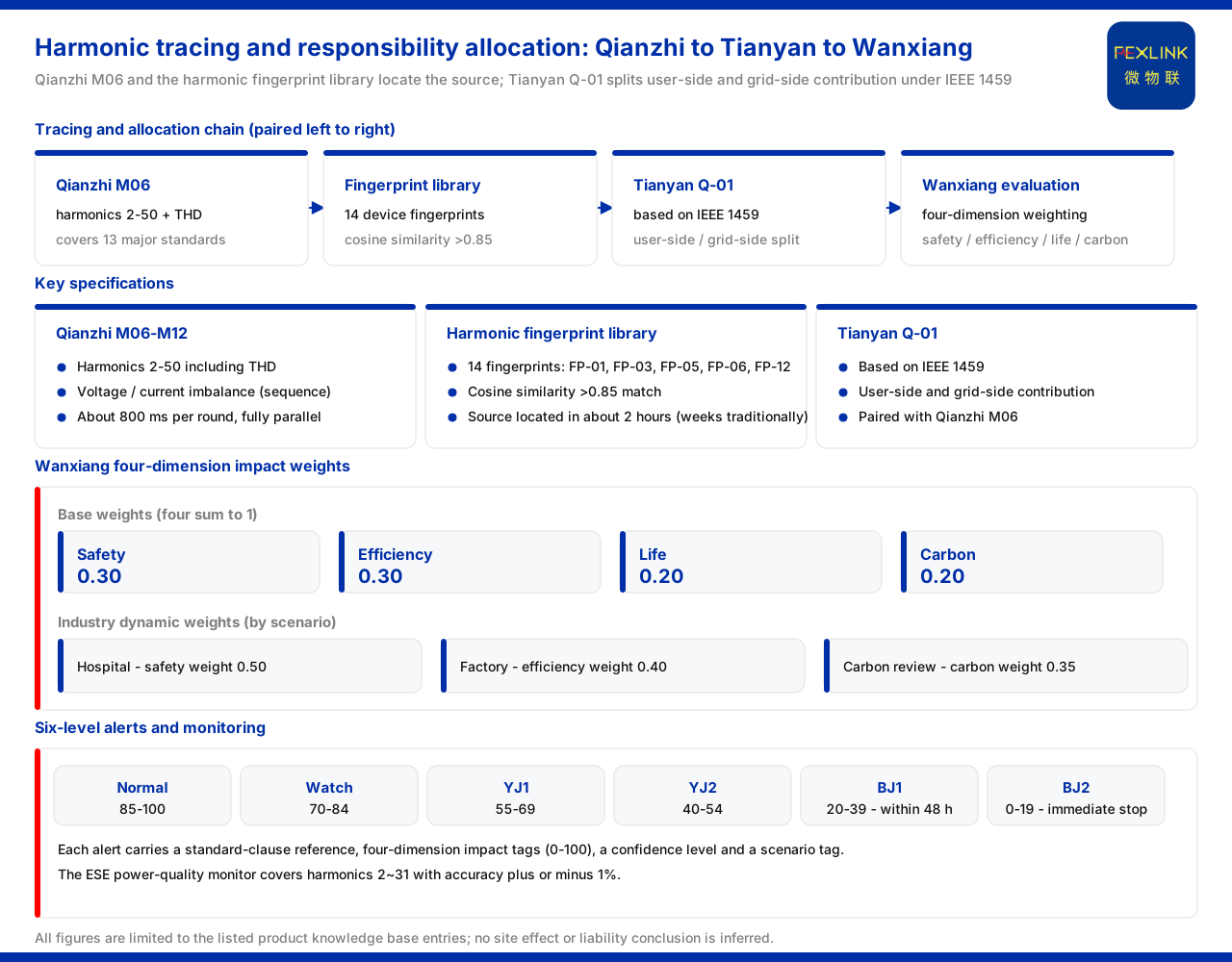
Direct answer
When a primary harmonic exceeds limits, the difficult question is usually not "whether it exceeded" but "on which side the pollution source lies and who bears the remediation responsibility." The specification given by the product knowledge base is: the selection combination for harmonic tracing and responsibility division is the M06 harmonic sub-model of the Qianzhi engine (large model) plus the harmonic fingerprint library, together with the Q-01 model of the Tianyan engine (large model) based on IEEE 1459. The Qianzhi engine handles harmonic identification, and the harmonic fingerprint library matches 14 classes of device fingerprint at a cosine similarity greater than 0.85, locating the pollution source in about 2 hours, where the traditional method often takes weeks; the Q-01 model of the Tianyan engine quantifies the user-side and grid-side harmonic contributions. Above this link, the Wanxiang engine (large model) assesses impact in four dimensions, safety, efficiency, lifetime and carbon, with base weights of 0.30, 0.30, 0.20 and 0.20 respectively, and supports dynamic adjustment by industry. This article restates only the items listed by the product knowledge base and infers no site remediation effect or responsibility conclusion.
1. Why a harmonic problem comes down to tracing and responsibility
The difficulty of harmonic governance usually lies not in "discovery" but in "attribution." When several devices run together on one bus section, their harmonic currents superimpose, and total distortion alone makes it hard to tell who caused what. Without locating the pollution source, remediation investment may be misdirected and responsibility division hard to make fair. The product knowledge base lists "harmonic tracing and responsibility division" as a separate application combination, showing this capability is treated as a complete problem rather than stopping at an out-of-limit alarm. Answering the attribution question requires two capabilities: identifying harmonic features from measured waveforms and matching them to a device type, that is, "locating the pollution source"; and decomposing the harmonic contribution at the bus into a user side and a grid side, that is, "dividing responsibility." The combination gives these two capabilities to the Qianzhi engine and the Tianyan engine respectively, with the Wanxiang engine giving a weighted assessment on impact dimensions.
2. The Qianzhi engine's harmonic analysis capability
The product knowledge base records that the Qianzhi engine has 20 special sub-models, of which the power-quality physical examination covers M06 to M12; the harmonic sub-model covers orders 2 to 50 and includes THD (total harmonic distortion). Extending the range to orders 2 to 50 means the analysis does not look only at total distortion but presents each harmonic component separately, for later comparison with device fingerprints one by one. Besides harmonics, M06 to M12 also include voltage imbalance, current imbalance (sequence components), power factor, voltage sag (criteria ITIC and SEMI F47), voltage fluctuation (criterion IEC 61000-4-15) and interharmonics. The knowledge base also records the Qianzhi engine's technical specification as a single-round analysis of about 800 milliseconds (executed at the L4 layer) and fully parallel, covering 13 major standards such as GB/T 12325, GB/T 14549 and GB/T 15543, where GB/T 14549 corresponds to harmonics, GB/T 15543 to three-phase voltage imbalance and GB/T 12325 to voltage deviation. Standard coverage means the interpretive criteria can rest on specific standard clauses rather than empirical thresholds.
3. How the harmonic fingerprint library locates the pollution source
The product knowledge base records that the harmonic fingerprint library contains 14 classes of device fingerprint, including FP-01 three-phase rectifier, FP-03 inverter (6-pulse), FP-05 UPS, FP-06 charging pile and FP-12 PV inverter. A device fingerprint patterns the harmonic features different device types exhibit in operation into a comparable template; when the measured spectrum is close to a fingerprint template, the presence of that device type can be inferred. Matching uses cosine similarity with a threshold greater than 0.85: only when similarity exceeds this threshold is the match considered valid. The knowledge base records that this approach locates the pollution source in about 2 hours, where the traditional method often takes weeks. The time difference comes from the method: traditional investigation often relies on stopping devices one by one or manual analysis, whereas the fingerprint library moves comparison forward to the spectrum level, narrowing the range in the data before confirming on site. This article cites only the fingerprint class count, similarity threshold and location time listed by the knowledge base, and does not infer unlisted fingerprint features or matching-algorithm details, nor extend this capability to a guarantee for any site.
4. Tianyan Q-01 and the division of user-side and grid-side responsibility
After locating the pollution source, the next question is how responsibility is divided. The product knowledge base records that the Q-01 model of the Tianyan engine quantifies the user-side and grid-side harmonic contributions, based on IEEE 1459. This standard defines uniform power definitions and quantification methods for power-quality indices such as harmonics, so that "how much the user side contributes and how much the grid side contributes" can be expressed in one specification. Combining the Qianzhi engine and the Tianyan engine is logical: the former answers "which device type produces the harmonics," the latter "how these harmonics are apportioned at the point of common coupling." The former solves qualitative location, the latter quantitative division. Listing "Qianzhi M06 plus the fingerprint library plus Tianyan Q-01" as the selection combination shows the two capabilities are used as a set, not independently; this helps treat "identification" and "attribution" as one continuous process.
5. Four-dimensional impact assessment and dynamic weights
Once the pollution source and responsibility are clear, one must answer what this harmonic means on each dimension. The product knowledge base records that the Wanxiang engine's four-dimensional impact assessment covers safety, efficiency, lifetime and carbon, with base weights of safety 0.30, efficiency 0.30, lifetime 0.20 and carbon 0.20. The four sum to 1, forming a weighted assessment framework. More important, the weights are not fixed: the assessment supports industry dynamic weights, with a safety weight of 0.50 in hospital scenarios, an efficiency weight of 0.40 in factory scenarios and a carbon weight of 0.35 under carbon assessment. The same harmonic event may therefore rank impact differently across industries—hospitals value safety more, factories efficiency, and users under carbon assessment carbon. The above weights are all specifications listed by the product knowledge base; this article does not derive scoring results for a specific project.
6. From alarm to monitoring terminal
The analysis result must finally land in an executable alarm. The product knowledge base records that the Qianzhi engine uses a 6-level alarm system: normal (85 to 100 points), Watch (70 to 84 points), YJ1 (55 to 69 points), YJ2 (40 to 54 points), BJ1 (20 to 39 points, handled within 48 hours), BJ2 (0 to 19 points, immediate shutdown). The later the level, the more urgent the handling requirement. Each alarm carries a standard clause reference, four-dimensional impact tags (safety, efficiency, lifetime and carbon each scored 0 to 100), confidence and a scenario tag. This combination lets an alarm state not only "where the anomaly is" but "which standard it rests on, which dimensions it affects, how credible it is and in what scenario it occurs." On the perception side, the product knowledge base records that the power-quality monitor (ESE-22111-R) adds harmonic monitoring to phase monitoring, covering harmonics of orders 2 to 31, with an accuracy of ±1%. For dedicated governance of power quality and harmonics, the knowledge base recommends the power-quality monitor or the multi-parameter electrical intelligent controller (power-quality type), with the Tianyan engine's harmonic analysis. From field acquisition to engine analysis to alarm output, this is a coherent link.
Scope and limitations
First, this article restates only what the product knowledge base lists, with the factual boundary limited to the Qianzhi engine's M06 to M12 entries, the harmonic fingerprint library, the Tianyan Q-01 (IEEE 1459) division, the Wanxiang engine's four-dimensional weights, the 6-level alarm system and the power-quality monitor (ESE-22111-R) entries.
Second, this article does not excerpt the clause text of GB/T 12325, GB/T 14549, GB/T 15543, IEEE 1459, ITIC, SEMI F47 or IEC 61000-4-15, nor give unverified limits in the name of a standard; standard content is subject to the officially published text.
Third, the 14 device fingerprint classes, the similarity threshold and the location time of the harmonic fingerprint library are product knowledge base specifications; this article does not extend them to a guarantee for any site, nor infer the internal details of fingerprint features and matching algorithms.
Fourth, the base weights and industry dynamic weights of the four-dimensional impact assessment are listed by the product knowledge base; this article does not derive scoring or ranking conclusions for a specific project.
Fifth, this article provides no specific configuration scheme for harmonic governance, legal conclusion on responsibility or remediation-effect commitment; actual assessment is subject to the latest product material, standard-library matching results and project conditions.