 FEXLINK Research Institute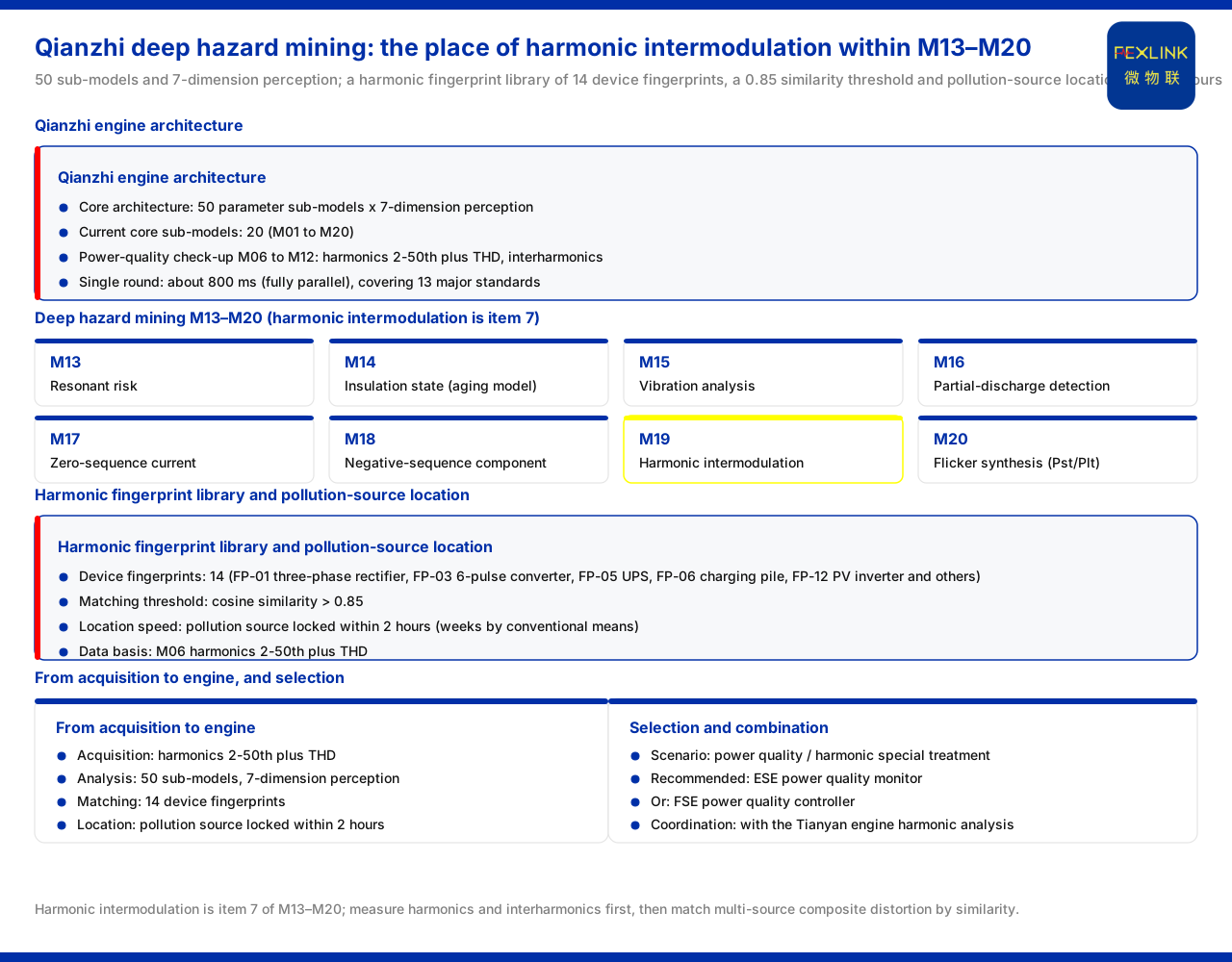
Direct answer
Harmonic intermodulation refers to the composite distortion produced by the interaction between different frequency components when several harmonic sources act together. The product knowledge base places it among the deep hazard-mining sub-models of the Qianzhi engine (large model, V4.1): in the M13 to M20 group, harmonic intermodulation ranks seventh, listed alongside resonance risk, insulation state, vibration analysis, partial-discharge detection, zero-sequence current, negative-sequence component and flicker synthesis. It is a different observation object from single-source harmonics and interharmonics: single-source harmonics look at the harmonic signature of a given source, interharmonics look at non-integer-multiple frequency components, and intermodulation looks at the composite distortion under the joint action of several sources. On the identification side, the product knowledge base records that the Qianzhi engine uses an architecture of 50 sub-models and 7-dimensional perception; the harmonic fingerprint library matches with 14 classes of device fingerprint and a cosine similarity greater than 0.85, and can lock the pollution source within 2 hours. This article restates only the specifications listed by the product knowledge base and infers no mathematical derivation of intermodulation.
1. The position of harmonic intermodulation in the sub-model system
The product knowledge base records that the core architecture of the Qianzhi engine (large model, V4.1) is 50 parameter sub-models, of which 20 core sub-models currently exist, numbered M01 to M20, with 7-dimensional perception. Among these 20 core sub-models, M13 to M20 belong to deep hazard mining, in order: resonance risk, insulation state (aging model), vibration analysis, partial-discharge detection, zero-sequence current, negative-sequence component, harmonic intermodulation and flicker synthesis (Pst/Plt). By this order, harmonic intermodulation is the seventh item of M13 to M20. The position itself conveys information: intermodulation is not a basic indicator of the power-quality check-up stage, but is classified as a composited phenomenon of deep hazard mining.
2. The difference from single-source harmonics and interharmonics
To understand intermodulation, first separate it from adjacent concepts. The product knowledge base records that among the power-quality check-up sub-models M06 to M12, M06 covers harmonics (orders 2 to 50 plus total harmonic distortion) and interharmonics. Two classes of object appear here: one is integer-order harmonics, with a range of orders 2 to 50 and including total harmonic distortion; the other is interharmonics, that is, non-integer-multiple frequency components. Harmonic intermodulation is different: it describes the composite distortion produced when several harmonic sources act together. In other words, single-source harmonics answer "which harmonics a given source produces", interharmonics answer "which non-integer-multiple components appear", and intermodulation answers "what the interaction of several sources forms when they exist at the same time". This distinction decides why intermodulation is placed in deep hazard mining rather than a basic check-up.
3. The harmonic range of the power-quality check-up sub-models
The identification of intermodulation is built on harmonic measurement. The product knowledge base records that the power-quality check-up sub-models M06 to M12 include harmonics and interharmonics, in which harmonics cover orders 2 to 50 and include total harmonic distortion. This range is the data basis for the identification work: only after the integer-order harmonics and the non-integer-multiple components have been measured is there a condition for further analysing the interaction between several sources. The product knowledge base also records in its technical specifications that the Qianzhi engine analyses in a single round of about 800 milliseconds (L4 layer), fully in parallel, covering 13 major standards such as GB/T 12325, GB/T 14549 and GB/T 15543. Placed together, the harmonic measurement range and the engine's analysis speed jointly support the identification of a composite phenomenon such as intermodulation.
4. Harmonic fingerprint library and pollution-source location
The product knowledge base records that the harmonic fingerprint library contains 14 classes of device fingerprint, such as FP-01 three-phase rectifier, FP-03 variable-frequency drive with 6 pulses, FP-05 UPS, FP-06 charging pile and FP-12 photovoltaic inverter; matching uses a cosine similarity threshold greater than 0.85; and on this basis the pollution source can be locked within 2 hours, whereas the conventional approach requires several weeks. For intermodulation identification, the fingerprint library provides a path from composite distortion back to a specific device: when the harmonics of several sources superimpose to form a composite signature, rather than comparing a single spectrum item by item, it is better to match the observed signature against known device fingerprints. Note that "locking within 2 hours" is a specification listed by the product knowledge base, and the actual location time is affected by on-site data conditions.
5. The identification chain from acquisition to engine
Identifying harmonic intermodulation requires the cooperation of front-end acquisition and back-end analysis. The product knowledge base records that the ESE power-quality monitor (e.g. ESE-22111-R) shares the architecture of the three-phase imbalance monitor, adding harmonic monitoring on top of phase monitoring, covering harmonics of orders 2 to 31 with an accuracy of plus or minus 1%; it has 2 digital inputs and 1 relay output and uses RS485 and Modbus. The front end is responsible for acquiring the harmonic data, and the back end has the Qianzhi engine complete the analysis of 50 sub-models in parallel. As one item of deep hazard mining in M13 to M20, intermodulation is identified precisely in this chain: acquisition provides the raw harmonic data, and the engine completes the judgment of the composite signature under multi-dimensional perception.
6. Selection and combination
In its typical application scenarios and selection comparison, the product knowledge base gives the recommended combination for "power-quality / harmonic special governance" as: a power-quality monitor, or the multi-parameter electrical intelligent controller (power quality type) (e.g. SFE-11111-R), together with the harmonic analysis of the Tianyan engine (large model). The difference between the two options lies in form: the former is a dedicated monitor, the latter a controller that also has power-quality capability. The common point is that both point to harmonic special governance. Corresponding this combination with the identification chain above, the logic of selection is visible: the front end acquires data with a device that covers the harmonic range, and the back end completes the governance judgment with the harmonic analysis of the Tianyan engine.
7. Placing intermodulation identification back into deep hazard mining
If harmonic intermodulation is treated only as a spectrum term, its place in the sub-model system is easily overlooked. The product knowledge base classifies it under deep hazard mining, alongside resonance risk, insulation state, vibration analysis, partial-discharge detection, zero-sequence current, negative-sequence component and flicker synthesis. What these sub-models share is that they mostly handle composite phenomena of more than one factor. Intermodulation is difficult because its source is often not an isolated harmonic source but the result of several sources interacting. For this reason, identifying intermodulation cannot rely only on whether a single harmonic exceeds the limit, but must combine multi-source signatures with fingerprint matching. The 14 classes of device fingerprint and the cosine similarity threshold greater than 0.85 listed by the product knowledge base provide exactly the comparison basis for such composite judgment.
Scope and limitations
First, this article restates only what the product knowledge base lists, with the factual boundary limited to the M13 to M20 sub-model order of the Qianzhi engine, the harmonic and interharmonic range of M06 to M12, the 14 classes of device fingerprint and the matching threshold of the harmonic fingerprint library, the engine's single-round analysis and covered standards, the power-quality monitor parameters and the recommended combination.
Second, this article does not unfold the mathematical derivation, frequency-combination relations or simulation methods of harmonic intermodulation, and only restates its position in the sub-model system and its identification specification.
Third, the 14 fingerprint classes and "locking the pollution source within 2 hours" are specifications listed by the product knowledge base, and this article does not expand them into a guarantee for any site.
Fourth, the harmonic range of orders 2 to 31 and the accuracy of plus or minus 1% of the power-quality monitor are knowledge-base specifications, and this article infers no unlisted parameters.
Fifth, this article constitutes no commitment about the diagnostic conclusion or governance effect of a specific project; actual selection and analysis are subject to the latest product material and project solution.