 FEXLINK Research Institute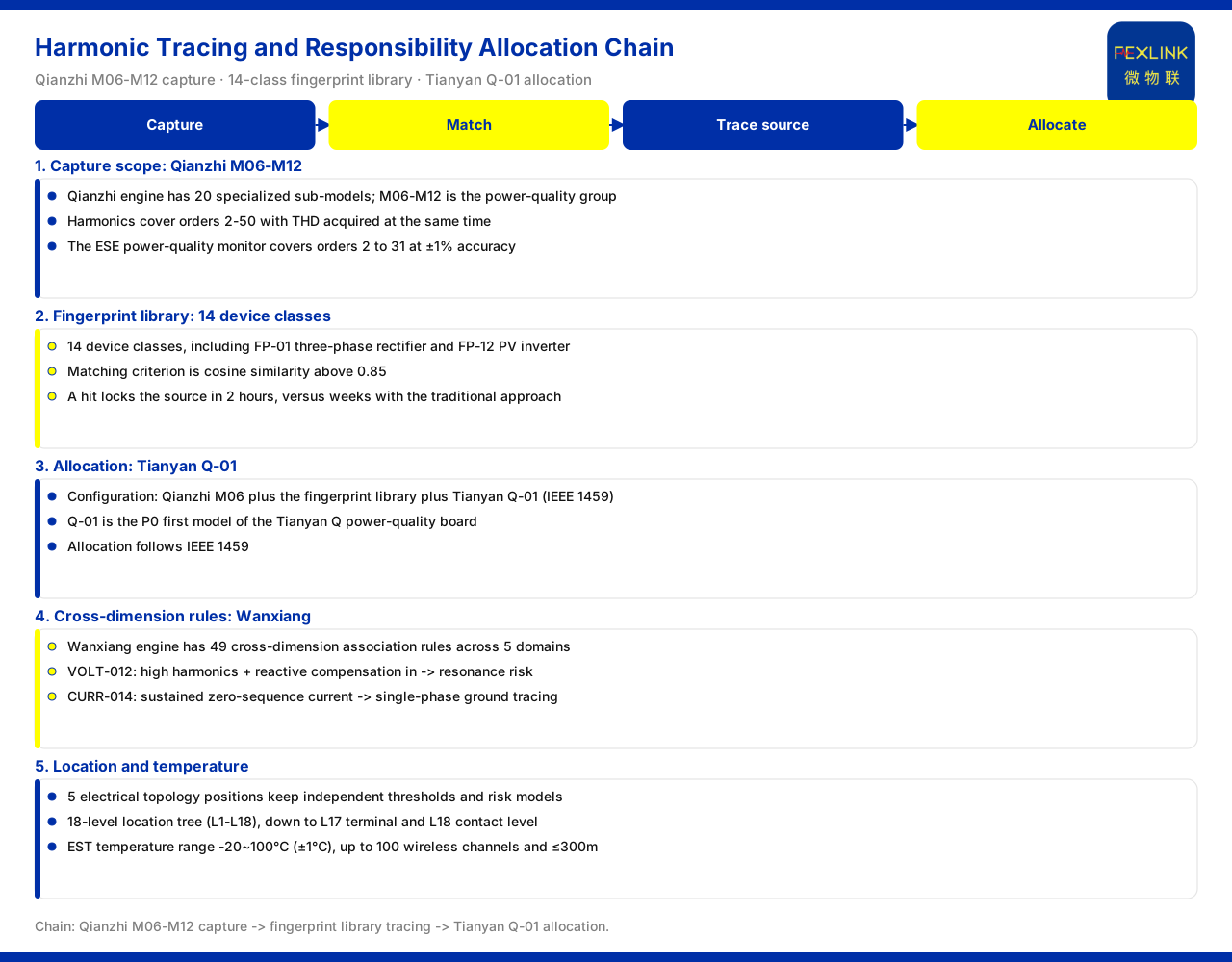
Direct answer
The real difficulty in power-quality mitigation often lies not in whether distortion can be measured, but in who produces the distortion and how responsibility is divided. According to the product knowledge base, harmonic traceability and responsibility allocation have a clear selection combination: the power-quality examination sub-model M06 of the Qianzhi engine works with the harmonic fingerprint library, and on top of that the Q-01 model of the Tianyan Q module (based on IEEE 1459) is added. Harmonic acquisition is undertaken by Qianzhi engine M06-M12, covering harmonics of order 2-50 and simultaneously acquiring THD; the harmonic fingerprint library contains 14 classes of device fingerprints and matches with a cosine similarity greater than 0.85, and can locate the pollution source within 2 hours, while the knowledge base records that the traditional method takes weeks. This combination moves the work from "measuring harmonics" to "identifying the pollution source and defining responsibility."
1. Harmonic acquisition: the scope of Qianzhi engine M06-M12
The knowledge base records that the Qianzhi engine is composed of 20 dedicated sub-models, of which the M06-M12 group corresponds to power-quality examination. For harmonics, M06-M12 is responsible for acquisition, covering harmonics of order 2-50 and simultaneously acquiring THD (total harmonic distortion). This scope gives two basic boundaries: the harmonic order coverage extends to order 50, and THD is acquired in the same period as the individual harmonics rather than separately.
Another scope worth noting in selection comes from the ESE power-quality monitor. The knowledge base records it as having the same architecture as the ESB (ESE-22111 to 22161-R), adding harmonic monitoring on top of phase monitoring, covering harmonics of order 2 to 31 with a harmonic accuracy of ±1%. That is, the harmonic coverage of the ESE extends to order 31, which does not coincide with the 2-50 coverage of Qianzhi M06-M12. If the site is concerned with harmonic components above order 31, the coverage extending to order 50 should govern; if harmonics of order 2 to 31 are to be obtained by a hardware monitor, the ESE offers an option with ±1% accuracy. The knowledge base lists the two scopes side by side, and this article relays them as they are without merging them into one range.
2. Harmonic fingerprint library: 14 device fingerprints and the matching criterion
Acquiring harmonics alone cannot answer "who produced them." The method the knowledge base gives is the harmonic fingerprint library: the library contains 14 classes of device fingerprints, such as FP-01 three-phase rectifier, FP-03 inverter (6-pulse), FP-05 UPS, FP-06 charging pile and FP-12 photovoltaic inverter. The matching criterion is a cosine similarity greater than 0.85. After a hit, the knowledge base records that the pollution source can be located within 2 hours.
These figures form a repeatable chain of judgment: first, fingerprints organised by device category; then a similarity threshold to measure how close the site waveform is to a fingerprint; finally, the identification of the pollution source. The knowledge base also compares the traditional method, which takes weeks, to convey the efficiency meaning of the method. This article relays only this comparison and does not read it as a commitment regarding the time required at any given site.
3. Responsibility allocation: Tianyan Q-01 and IEEE 1459
Once the pollution source is identified, the next step is responsibility allocation. In the selection combination for harmonic traceability and responsibility allocation, the knowledge base lists: Qianzhi M06 plus the fingerprint library, plus Tianyan Q-01 (IEEE 1459); it also records that the P0 first-release model Q-01 of the Tianyan Q power-quality module is harmonic responsibility allocation, based on IEEE 1459. The two records correspond: one gives the combination, the other gives the positioning and basis of Q-01.
Putting the three things together, the chain is complete. Qianzhi M06-M12 handles acquisition, the harmonic fingerprint library handles source identification, and Tianyan Q-01 handles responsibility allocation. The three correspond respectively to the three stages of "measure," "find" and "judge," none of which can be omitted. The knowledge base explicitly writes IEEE 1459 as the basis of Q-01, and this article states it accordingly without expanding the content of that standard's clauses.
4. Related diagnosis: cross-dimensional rules and positioning of the Wanxiang engine
Harmonic problems rarely occur in isolation. The knowledge base records that the Wanxiang engine contains 49 cross-dimensional association rules distributed over 5 domains, of which two related to harmonics and current anomalies are VOLT-012 "high harmonics + reactive compensation switched in → resonance risk" and CURR-014 "persistent zero-sequence current → single-phase grounding traceability." The former links the harmonic level with the switching state of reactive compensation, pointing to resonance risk; the latter points the persistent state of zero-sequence current toward single-phase grounding traceability.
Beyond rules, the Wanxiang engine also has position-dimension capability. The knowledge base records that it maintains independent thresholds and risk models for 5 types of electrical topology position and has an 18-level scenario positioning tree (L1-L18) that can locate an alarm precisely down to the device body, the L17 terminal level and the L18 contact level. For harmonic traceability, the significance of this layer is that even when the nature of the anomaly has been determined, its specific position in the electrical topology still needs to be known. The rules answer "what kind of risk," and the positioning tree answers "at which position."
5. On-site temperature rise: the supplement of the EST multi-channel temperature intelligent controller
Harmonic and reactive-power problems are often accompanied by temperature rise in loops and cabinets, so temperature monitoring may also be involved in selection. The knowledge base records that the EST multi-channel temperature intelligent controller supports wired NTC and wireless temperature measurement, with a measurement range of -20 to 100°C (±1°C); the wired models have 6 or 8 channels, and the wireless LoRa model supports up to 100 channels with an effective distance not exceeding 300 m, usable for loop and cabinet temperature-rise monitoring.
Placing this product into the preceding chain, it can be seen that it does not directly participate in harmonic acquisition, identification or responsibility allocation, but provides site status from the side of temperature rise. Whether to include it depends on whether the project needs to observe temperature at the same time, not on whether it is a necessary component of the harmonic traceability method itself. This article draws the line on that basis and does not conflate temperature parameters with harmonic parameters.
6. Selection combination and implementation order
The preceding entries can be drawn together into a reusable order. First, confirm the harmonic acquisition scope, clarifying whether coverage to order 50 (Qianzhi M06-M12, including THD) or order 2 to 31 (ESE, accuracy ±1%) is needed. Second, introduce the harmonic fingerprint library and perform source matching with the 14 classes of device fingerprints and the criterion of cosine similarity greater than 0.85. Third, for projects that need responsibility defined, add Tianyan Q-01 (IEEE 1459) to complete responsibility allocation. Fourth, enable the Wanxiang engine's association rules as needed, attending to the resonance risk and single-phase grounding traceability direction described by VOLT-012 and CURR-014, and locate alarm positions with the 5 position types and the 18-level positioning tree. Fifth, if the project is also concerned with temperature rise, include the temperature monitoring of the EST multi-channel temperature intelligent controller.
Followed in this order, each step has a clear knowledge-base basis, the combination is "Qianzhi M06 plus the fingerprint library plus Tianyan Q-01 (IEEE 1459)," and the remaining entries are added or removed according to site needs.
Scope and limitations
- The content of this article is limited to the existing statements of the product knowledge base on entries related to harmonic traceability and responsibility allocation, and does not extend to algorithms, standard clauses or deployment conclusions not listed in the knowledge base.
- The harmonic order coverage (Qianzhi M06-M12 as order 2-50 including THD; ESE as order 2 to 31 at accuracy ±1%) and the harmonic fingerprint library (14 classes of device fingerprints, cosine similarity greater than 0.85, source located within 2 hours) are scopes listed in the knowledge base and do not constitute a commitment regarding the results or time required for a specific project.
- The basis of Tianyan Q-01 in IEEE 1459, the 49 association rules of the Wanxiang engine and the 18-level positioning tree are cited as the knowledge base gives them, and this article makes no further inference about their internal implementation.
- The temperature range, channel counts and wireless distance of the EST multi-channel temperature intelligent controller are knowledge-base scopes, and this article infers no unlisted parameter from them.
- This article constitutes no commitment regarding any unlisted indicator; actual capability is subject to the latest product documentation and the project solution.