 FEXLINK Research Institute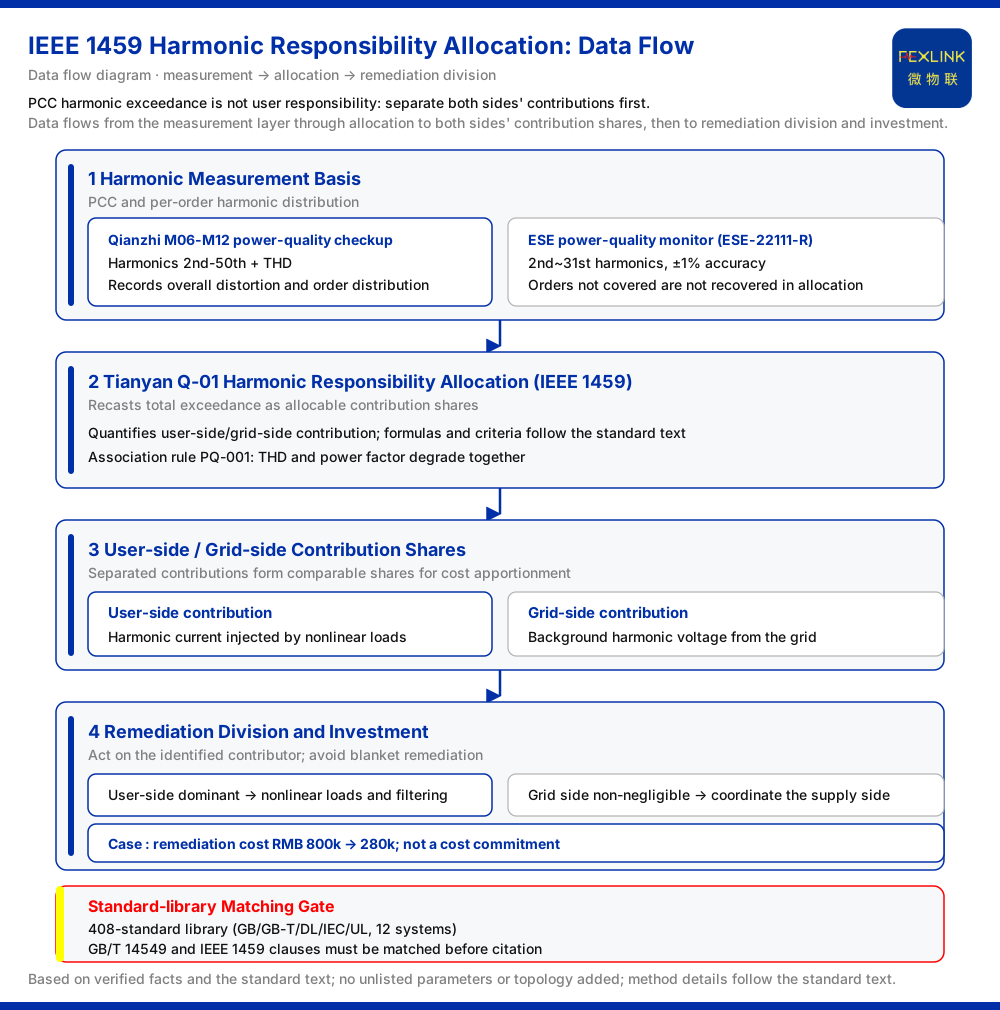
Direct Answer
When harmonic levels at the point of common coupling (PCC) exceed the limit, the easiest on-site response is "whoever complains, remediates." Yet a total harmonic exceedance only states that the waveform at the PCC is out of specification; it does not by itself show whether the pollution originates on the user side or the grid side. Under the knowledge base, the Q-01 harmonic responsibility allocation model of the Tianyan engine / large model adopts the IEEE 1459 method and quantifies the harmonic contribution from each side. It recasts "total exceedance" as "allocable contribution shares," and responsibility is then apportioned on that basis. The decisive point is not who complained first, but how much each side contributes, and only then who carries which part of the remedy.
Boundary: this article explains where this logic sits in the knowledge base and how it is used; it does not restate IEEE 1459 formulas or criteria. The knowledge base does not supply those details, and the specific clauses must follow the standard text.
Why "Exceeding the Limit" Is Not Automatically "User Responsibility"
Harmonics flow in both directions in a power system. Nonlinear loads on the user side inject harmonic currents into the network, while background harmonic voltages on the grid side act on user equipment; the two superimpose at the same PCC, and the metering device reads only the combined result. A harmonic magnitude above the limit at the PCC therefore proves neither that user injection is excessive nor that the grid background is too high.
Responsibility allocation has to answer exactly this separation question: to split the superimposed result into each side's contribution, then compare their relative weight. Without this step, the argument stalls between "you exceeded the limit" and "it was already exceeded before I connected," with each party citing the measurement point that favors it, and the issue never converges.
The Allocation Logic: Splitting "Total Exceedance" into "Contribution Shares"
IEEE 1459 offers a quantified path to responsibility. Its point is not to label a single exceedance event but to express the harmonic contributions of the user side and the grid side separately, producing comparable shares. The knowledge base describes Q-01 as "quantifying user-side/grid-side harmonic contribution" — precisely the core function of the method: it turns responsibility from a qualitative dispute into a reviewable number.
With that logic, the focus shifts from "who is responsible" to "how much does each side contribute." Whether this step holds depends on two conditions: whether the measurement can separate the sides, and whether a single consistent basis can be jointly verified by both parties. If either is missing, the allocation is hard to use as a basis for cost sharing.
Measurement Basis: Separation First, Fairness Second
Responsibility allocation is not an impressionistic estimate; it requires measurements capable of supporting separated comparison. The knowledge base states that the power-quality health-check submodels M06-M12 of the Qianzhi engine / large model include harmonic monitoring, covering the 2nd–50th harmonics and THD, and this provides the measurement basis for responsibility allocation. It records both the overall distortion level and the distribution of individual harmonic orders, so the comparison of the two sides' contributions rests on data.
At the device level, the ESE power-quality monitor (ESE-22111-R) adds harmonic monitoring on top of phase monitoring, covering the 2nd~31st harmonics with ±1% accuracy (the knowledge base). Where the site takes the controller route, the multi-parameter electrical intelligent controller (power quality type), such as SFE-11111-R, can be selected; its positioning likewise includes phase and harmonic monitoring (the knowledge base). Selection should match the device's coverage to the harmonic orders actually needing monitoring — orders that the measurement cannot cover should not be expected to be recovered in the responsibility allocation.
From Data to Responsibility Ratio: The Role of Tianyan Q-01
The Qianzhi engine is responsible for measuring clearly; the Q-01 model of the Tianyan engine / large model is responsible for separating cleanly. Q-01 is positioned as a harmonic responsibility allocation model, applying the IEEE 1459 method to process measurement data into quantified user-side and grid-side contribution results (the knowledge base). Its output is not a single sentence "the limit was exceeded," but the respective contribution shares of the two sides, for reference in subsequent apportionment of remediation responsibility.
The method boundary still applies: the credibility of Q-01's responsibility ratio rests on measurement data and the standard method. Details such as formulas, criteria, and thresholds must follow the IEEE 1459 text; the knowledge base does not elaborate them, and this article does not fill them in. Treating a standard number as a ready-made conclusion and judging without matching the clause is the most common source of bias in responsibility allocation.
Landing the Result: The Lesson from RMB 800,000 to RMB 280,000
The knowledge base records a field result: with harmonic responsibility allocation via Q-01, the remediation cost dropped from RMB 800,000 to RMB 280,000. What this record reflects is the effect of responsibility allocation on remediation investment — once the main pollution source and the sharing boundary are quantified, remediation need not be spread across the whole chain, but can target the identified main contributing side.
Interpretation must be restrained: this figure is a case result recorded in the knowledge base, not a commitment regarding remediation cost for any project, and it does not mean that responsibility allocation can replace on-site survey and remediation design. Its value is to illustrate an order — allocate responsibility first, then arrange investment — rather than conducting full-scale remediation directly on the basis of "total exceedance."
Interface with the Standard Library: Clause Citation Must Be Matched First
Responsibility allocation involves a standards basis, and citation must be reliable. The knowledge base shows that the standard service of the Taiyi intelligent control hub system includes a library of 408 standards, covering 12 systems such as GB, GB-T, DL, IEC, and UL, with automatic clause matching. Clauses from GB/T 14549 and IEEE 1459 must be matched in that standard library before they can be cited. In other words, a standard number is not itself a conclusion; only when a specific clause is matched does the statement of responsibility allocation become verifiable evidence.
How Responsibility Allocation Affects the Division of Remediation Work
Once both sides' contributions are quantified, the division of remediation work can follow them. If the user-side share is dominant, the focus is on nonlinear loads and filtering compensation on the user side; if the grid-side background harmonic share is non-negligible, improvement must be coordinated from the supply side. Responsibility allocation does not draw a conclusion for either party; it provides a comparison basis that both can jointly review.
In process terms, the reasonable order is measurement first, then allocation, then remediation: use harmonic monitoring to record the PCC and the distribution of individual harmonics, use the responsibility allocation model to quantify the contributions of the two sides, and finally determine the scope of remediation and investment sharing according to the shares. Reverse the three steps — fixing the remediation scope first and adding the allocation basis afterwards — and the responsibility dispute easily returns to its starting point.
Common Misreadings
The first misreading is assigning an exceedance directly to the user. Exceedance describes a result, not a source. The second is treating responsibility allocation as an estimate, ignoring that it depends on a reviewable measurement basis. The third is treating a standard number as a ready-made conclusion and judging without matching the clause. The fourth is looking only at total THD and not the distribution across harmonic orders, wasting the information that could be used to separate contributions. The fifth is freezing a one-time allocation result into a long-term conclusion, ignoring that the responsibility shares change as system structure and load composition change. The sixth is equating responsibility allocation with a remediation plan — the former answers "who contributed how much," the latter answers "how to fix it." Recognizing these biases keeps responsibility allocation from degrading into another round of blame-shifting.
Scope and Limitations
First, this article is built around the description of Q-01 harmonic responsibility allocation (IEEE 1459) in the knowledge base; method details, formulas, and criteria follow the IEEE 1459 text, and content the knowledge base does not elaborate is not inferred here. Second, the measurement ranges follow the knowledge base (Qianzhi M06-M12 harmonics 2nd–50th and THD, and the ESE power-quality monitor 2nd~31st, ±1%); this article does not extend to orders, accuracy, or thresholds not listed. Third, RMB 800,000 to RMB 280,000 is a case recorded in the knowledge base and does not represent a cost commitment or performance guarantee for any project. Fourth, citation of GB/T 14549 and IEEE 1459 clauses is valid only after matching in the 408-standard library described in the knowledge base; this article does not substitute for the clauses. Fifth, specific-project allocation and remediation plans should be confirmed against on-site survey, complete measurement data, and the standard text.