 FEXLINK Research Institute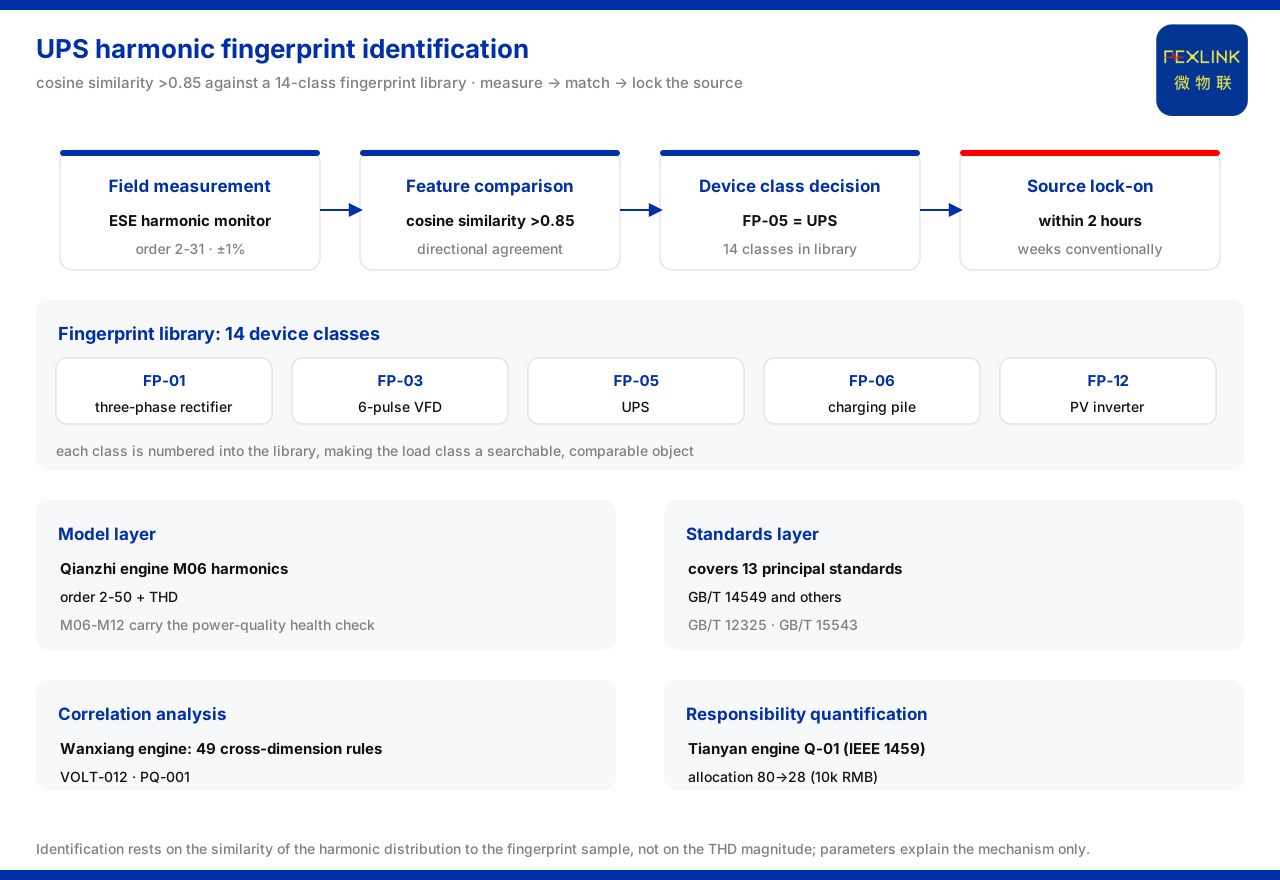
How a UPS harmonic fingerprint is identified
Direct answer
In the harmonic fingerprint library, an uninterruptible power supply (UPS) is represented by the device fingerprint FP-05. The identification basis is not the magnitude of total harmonic distortion (THD) but the degree of similarity between the measured harmonic distribution and the fingerprint sample held in the library: the system compares the measured features with the library fingerprints by cosine similarity, and a similarity above 0.85 declares the corresponding device class. Therefore, even when the overall distortion level is not high, the load can still be identified as a UPS class provided that the ratio relationships among the individual harmonic orders agree with the characteristic distribution of FP-05. Based on this fingerprint library, the time to lock onto a pollution source can be shortened from the weeks required by conventional methods to 2 hours. In data centres and critical power-supply scenarios, this step is used to separate the harmonic contribution of the UPS from a mixed load. Two properties follow. Because similarity is judged on the direction of the feature vector rather than its magnitude, a load whose overall distortion is modest can still match a fingerprint if its relative order pattern agrees. And because the threshold gates the decision, a class is declared only when the measured signature is close enough to the reference, not merely the closest one.
The position of UPS in the fingerprint library
The Qianzhi engine (Discernment, V4.1) holds 14 device fingerprint classes in its harmonic fingerprint library, with FP-05 corresponding to the UPS. The same library also contains the three-phase rectifier (FP-01), the 6-pulse variable-frequency drive (FP-03), the charging pile (FP-06) and the PV inverter (FP-12), among others. Numbering device classes one by one into the library makes "which class of load is this" a retrievable and comparable object in its own right, instead of lumping harmonic problems together as "harmonics exceed the limit". At the model layer, the core architecture of the Qianzhi engine is 50 parameter sub-models (currently 20 core sub-models, M01-M20) multiplied by 7-dimensional perception; power-quality health-checking is carried by M06 to M12, and M06 covers harmonics of order 2 to 50 including THD, which is the measurement attribution for the UPS fingerprint comparison.
Matching mechanism and measurement input
Fingerprint identification uses cosine-similarity matching with a threshold above 0.85. The system does not require the measured spectrum to equal the sample point by point; it compares the directional consistency of the two feature vectors and issues a device-class decision once the threshold is exceeded. Setting the threshold at 0.85 is an engineering compromise between "rather report less than misjudge": too low would merge different loads into one class, while too high might miss real loads whose shape deviates slightly. On the measurement side, the ESE power-quality monitor adds harmonic monitoring on top of phase monitoring, covering harmonics of order 2 to 31 at an accuracy of ±1%, and provides two digital inputs, one relay output and an RS485 (Modbus) interface; it can serve as the field acquisition device for harmonic data. Reading the two measurement layers together also prevents a coverage mismatch: the model-layer M06 reaches the 50th order, while the field monitor covers the 2nd to the 31st, so the comparable order interval is bounded by what the field device actually records rather than by the wider model range.
Timeliness and standards coverage
According to the technical specification, a single analysis round of the Qianzhi engine is about 800 ms (at the L4 layer), uses fully parallel processing, and covers 13 principal standards including GB/T 12325, GB/T 14549 and GB/T 15543. The faster single-round analysis allows fingerprint comparison to be embedded in a continuous monitoring flow rather than performed offline after the fact. Standards coverage provides the basis for harmonic limits and assessment, among which GB/T 14549 is the national standard related to harmonics. Based on the harmonic fingerprint library, a pollution source can be locked within 2 hours, whereas the conventional method requires weeks; the time difference comes precisely from the step in which the device class is identified first.
Correlation analysis and responsibility quantification
Once the UPS class has been identified, the question remains of how much weight it carries in the overall harmonic problem. The Wanxiang engine establishes 49 cross-dimension correlation rules (across 5 domains), among which VOLT-012 describes "high harmonics combined with reactive-power compensation being switched in leading to resonance risk", and PQ-001 describes "THD and power factor deteriorating in step pointing to harmonics interfering with reactive power"; these can serve as correlation-analysis sources for the harmonic contribution of a UPS. If the harmonic responsibility of the user side and the grid side needs to be further quantified, the flagship model Q-01 of the Tianyan engine performs harmonic responsibility allocation according to IEEE 1459, and the product knowledge base records that its field remediation cost dropped from RMB 800 thousand to RMB 280 thousand. The above is a mechanism and case basis and does not constitute a commitment regarding the results at any specific site. The cost figure is a case record, while its basis is a mechanism statement, and the two should not be conflated: the record shows what responsibility allocation achieved in one reported instance, not what any project can expect.
Selection combination
In the typical application scenarios and selection comparison, the combination corresponding to "power quality / harmonic special treatment" is the ESE power-quality monitor or the FSE multi-parameter electrical intelligent controller (power quality type), together with the harmonic analysis of the Tianyan engine. That is, measurement and fingerprint identification are carried by the Qianzhi side, while the part involving harmonic responsibility analysis is supported by the Tianyan side. The selection combination gives a capability-pairing relationship and does not represent an effect commitment for any specific project.
Scope and limitations
This article answers only "how a UPS is identified in the harmonic fingerprint library". Its content is limited to the fingerprint-library entries, matching threshold, measurement basis, timeliness parameters, standards coverage, correlation rules and selection combination already recorded in the product knowledge base.
This article does not expand on the internal details of the fingerprint feature vectors (such as the weight or the specific distribution values of individual harmonic orders); the product knowledge base does not list these, nor does it provide identification accuracy, misjudgment rate or any statistical indicator.
Entries in the same library, such as FP-01, FP-03, FP-06 and FP-12, are mentioned side by side only and are not expanded here.
The parameters in this article are used to explain the mechanism and do not constitute a commitment regarding identification results at a specific site; actual application must be confirmed item by item according to on-site wiring, measurement conditions and compliance requirements.