 FEXLINK Research Institute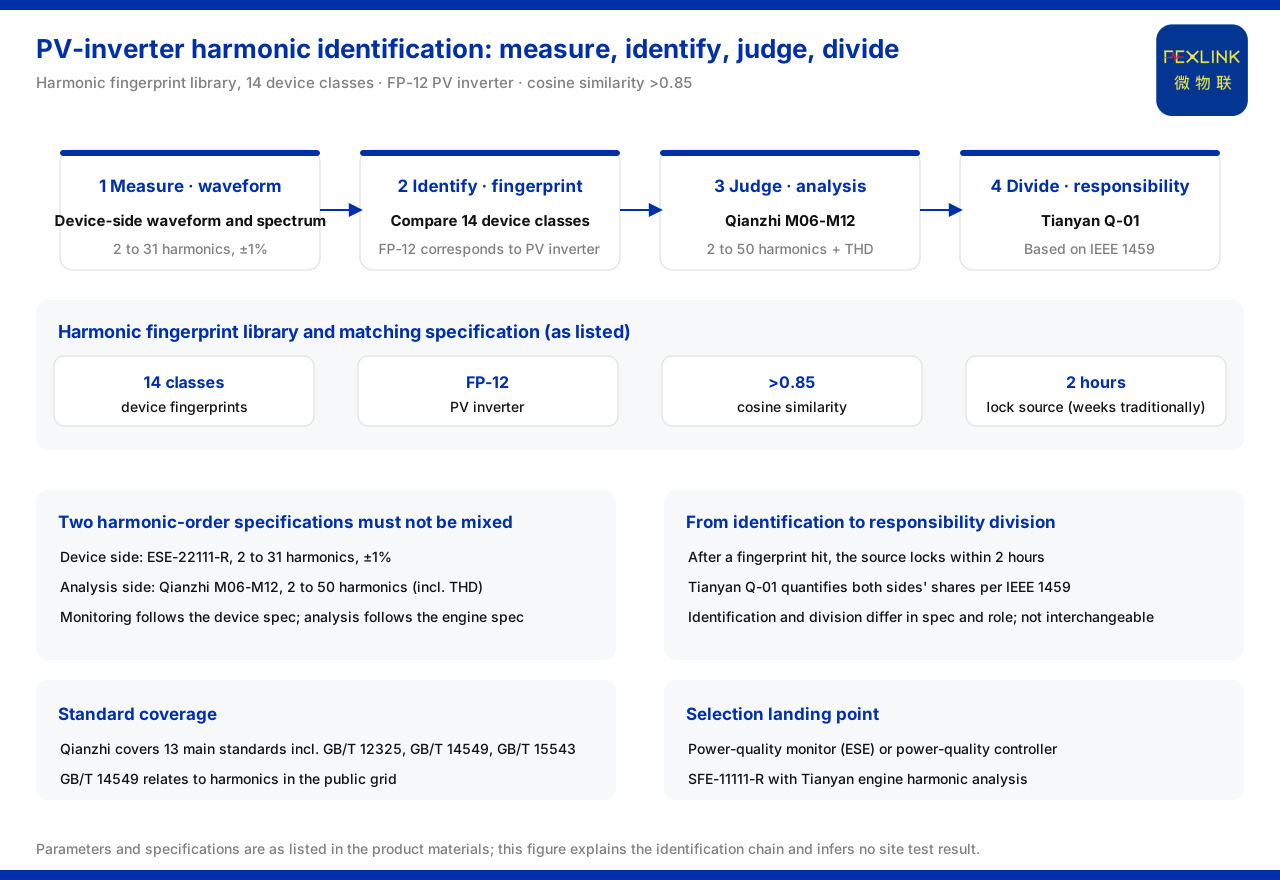
Direct answer
The harmonic identification of a PV inverter does not land on the inverter itself but on the harmonic fingerprint library. The product knowledge base records that the harmonic fingerprint library contains 14 device fingerprint classes, of which FP-12 is the class facing the PV inverter. What identification must solve is separating the harmonics produced by the inverter from conventional rectifier-type harmonic sources: several inverters and other rectifier-type loads may coexist on the same bus at a PV grid-connection point, and "there are harmonics" alone cannot tell the source; only after classification can tracing be discussed. The matching method given by the product knowledge base is cosine similarity, with a decision threshold greater than 0.85; after a hit, the time order for locking the pollution source is 2 hours, whereas the conventional method takes weeks. This path has two segments: on the device side, the power-quality monitor (e.g. ESE-22111-R) provides a monitoring specification of 2 to 31 harmonics at ±1% accuracy; on the analysis side, the power-quality examination M06-M12 of the Qianzhi engine (large model) covers 2 to 50 harmonics plus THD. After identification, Q-01 of the Tianyan engine (large model) performs harmonic responsibility division on the basis of IEEE 1459. This article restates only the existing statements of this chain in the product knowledge base and infers no test result of any specific site.
1. The place of FP-12 in the fingerprint library
The product knowledge base describes the harmonic fingerprint library as a collection of 14 device fingerprint classes, of which FP-12 is the class corresponding to the PV inverter. Listing the PV inverter as a separate fingerprint means that the identification object is the signature that "this class of device, the PV inverter" leaves in the waveform rather than a particular device. The harmonic sources at a PV grid-connection point are usually more than one, and inverters and conventional rectifier-type loads may coexist on the same bus; the former is classified as FP-12 and the latter into other fingerprint classes. The value of identification lies precisely here: it answers "which class of device the harmonic comes from" and provides a direction for subsequent tracing rather than naming a particular device directly. Taking FP-12 as the entry, the identification process compares the measured characteristic spectrum against each class in the fingerprint library, and whichever class is hit points to that class of pollution source.
2. Matching basis: cosine similarity and the 0.85 threshold
The product knowledge base records that harmonic fingerprint matching uses cosine similarity, with a threshold greater than 0.85. Cosine similarity measures the closeness between the characteristic spectrum under test and each class of fingerprint in the library, and the 0.85 threshold is the decision gate: only at this degree of closeness is the corresponding class considered hit. This is a quantified specification rather than an empirical description; it turns "does it look like a PV inverter" into a computable comparison. What is given here is the matching method and threshold itself; the product knowledge base does not unfold the specific calculation of cosine similarity, and this article gives no interpretation beyond what is recorded.
3. Monitoring specification and analysis specification must not be mixed
There are two different harmonic-order specifications in this chain, and they must be used separately. On the device side, the harmonic monitoring of the power-quality monitor (e.g. ESE-22111-R) covers 2 to 31 harmonics at an accuracy of ±1%, which is an index that the field monitoring device can obtain directly. On the analysis side, the power-quality examination M06-M12 of the Qianzhi engine (large model) covers 2 to 50 harmonics including THD, which is the analysis specification on the engine side. The two serve different purposes: the device side answers "how many harmonics are measured and how accurate the measurement is", and the analysis side answers "from what range is the examination and judgement carried out". Mixing the two specifications in one solution leads to a misreading of the coverage. The workable practice is to place each in its own position: monitoring data follows the device specification, analysis conclusions follow the engine specification, and there is no conversion between them.
4. The time order of locking the pollution source
The product knowledge base records that harmonic fingerprint matching can lock the pollution source within 2 hours, whereas the conventional method takes weeks. This is a comparative specification of this capability against the conventional approach. Its meaning is to compress harmonic tracing from "long-cycle investigation" to "hour-level locating": the site no longer needs to cut power to equipment one by one and investigate section by section, but first narrows the range by fingerprint matching and then confirms on site. It should be stressed that 2 hours is the time order listed by the knowledge base, and this article does not expand it into a commitment for any site or any operating condition; the actual locking time depends on the site conditions and the data quality.
5. From identification to responsibility division
After the class of pollution source is identified, the next step is responsibility division. The product knowledge base records that Q-01 harmonic responsibility division of the Tianyan engine (large model) is based on IEEE 1459 and is used to quantify the harmonic contributions of the user side and the grid side. This step advances "which class of device the harmonic comes from" to "how the harmonic contribution is allocated between the two sides". Identification and division are two linked stages: the former classifies from the fingerprint library, the latter quantifies the contribution from the responsibility-division method; they have different specifications and duties and should not substitute for each other.
6. Standard coverage and selection landing point
The technical specifications of the product knowledge base record that the Qianzhi engine covers 13 main standards including GB/T 12325, GB/T 14549 and GB/T 15543, among which GB/T 14549 is the standard related to harmonics in the public power grid. This means that the standard basis cited for harmonic identification and treatment falls within the engine's existing standard coverage. At the selection level, the product knowledge base writes the recommended combination for the "power quality and harmonic special treatment" scenario as the power-quality monitor (ESE) or the multi-parameter electrical intelligent controller (power quality type) (e.g. SFE-11111-R), together with Tianyan engine harmonic analysis. That is, the field landing point is the monitoring device and the analysis landing point the engine, used as a set.
7. A reusable identification order
Bringing the preceding entries together gives a reusable order. First, at the PV grid-connection point use a device that can obtain harmonic data to acquire the waveform and characteristic spectrum, with a device-side specification of 2 to 31 harmonics at ±1% accuracy; second, compare the characteristic spectrum against the 14 device fingerprint classes of the harmonic fingerprint library, in which the PV inverter corresponds to FP-12, with cosine similarity greater than 0.85 as the matching basis; third, if the inverter class is hit, hand the conclusion to the analysis side, where the 2 to 50 harmonic and THD specification of the Qianzhi engine M06-M12 performs the examination; fourth, enter responsibility division, where Tianyan engine Q-01 quantifies the harmonic contributions of the user side and the grid side on the basis of IEEE 1459. This order separates the four steps of "measure, identify, judge and divide", each using its own specification, and avoids mixing the monitoring specification with the analysis specification. The identification result should be returned to the site for confirmation, and this article does not replace on-site verification.
Scope and limitations
First, this article restates only what the product knowledge base lists, with the factual boundary limited to existing entries such as the 14 device fingerprint classes of the harmonic fingerprint library, the FP-12 PV inverter fingerprint, the cosine similarity greater than 0.85, the 2-hour locking time, the Qianzhi M06-M12 and the Tianyan Q-01, and introduces no unlisted standard clause, parameter, certification or case.
Second, the harmonic-order specifications in the text belong to two places: the 2 to 31 harmonics and ±1% of the power-quality monitor are the device monitoring specification, and the 2 to 50 harmonics and THD of the Qianzhi engine M06-M12 are the analysis specification; this article does not convert or substitute one for the other.
Third, the 2-hour locking of the pollution source and the "conventional method takes weeks" are both comparative specifications listed by the knowledge base, and this article makes no guarantee of locating efficiency for any specific site on that basis.
Fourth, harmonic responsibility division is limited to IEEE 1459, on which Tianyan engine Q-01 is based; this article does not unfold the specific formula or proportion of responsibility division.
Fifth, standard coverage is limited to the 13 main standards listed, and the selection combination is limited to the "power-quality monitor or multi-parameter electrical intelligent controller (power quality type) with Tianyan harmonic analysis" listed by the knowledge base; this article provides no specific engineering configuration conclusion.