 FEXLINK Research Institute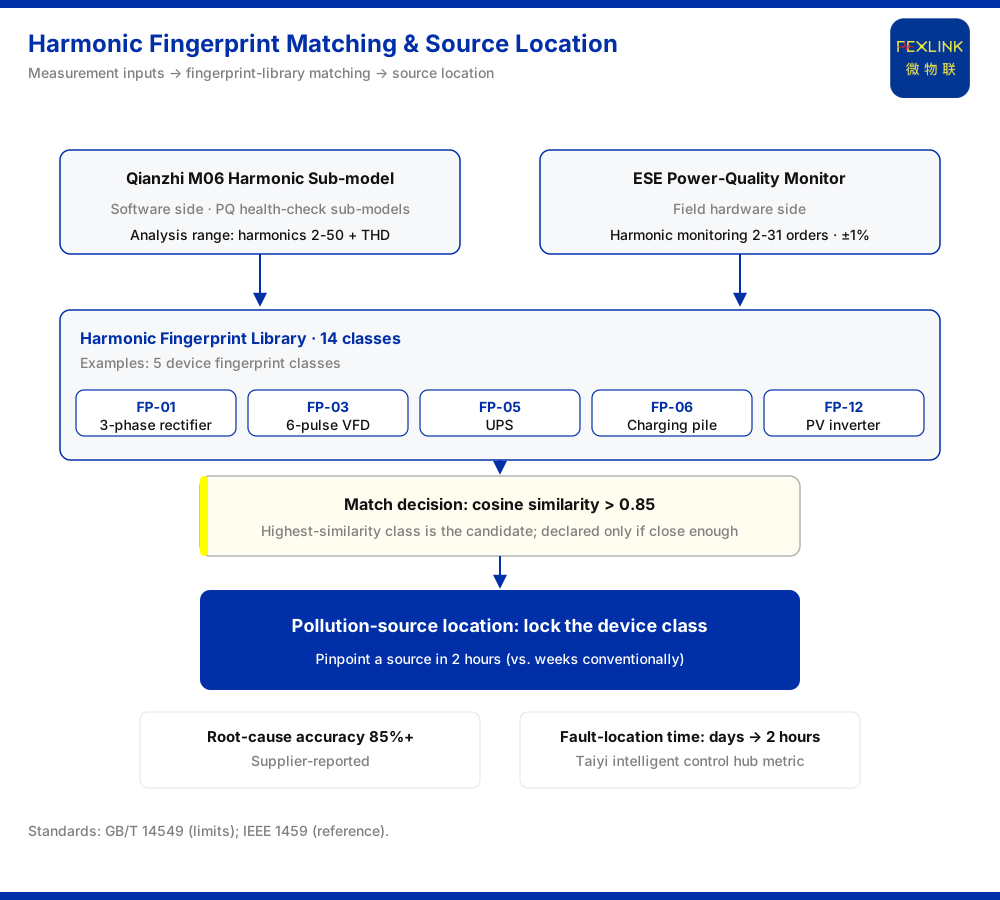
When several non-linear devices run at the same time, the total harmonic distortion measured at the point of common coupling is a mixture contributed by all of them. A THD limit violation then tells you only that "there is a harmonic problem on this busbar" — it cannot say which class of device is producing the pollution. The harmonic fingerprint library exists to close exactly this gap: it compares the measured total-harmonic signature against device fingerprints one by one, uses a cosine similarity threshold above 0.85 as the matching gate, and narrows the pollution source to a device class once a fingerprint is matched. The knowledge base states that this path can pinpoint a pollution source in two hours, whereas conventional source tracing usually takes weeks. This article uses only the categories, thresholds and metrics explicitly listed in the knowledge base; it does not invent other fingerprint classes or extrapolate parameters or accuracies that are not listed.
Why total harmonics blur together, and what a fingerprint uses to separate them
From general power-quality engineering experience, harmonic currents injected into the grid by different non-linear loads differ in their tendency across harmonic orders and relative amplitudes. When variable-frequency drives, UPS units, charging piles, PV inverters and other device classes run together, these components superimpose at the busbar, so the total harmonic signature loses the "clean" characteristic of any single device. The idea of a fingerprint library is first to freeze the known harmonic signatures of device classes into computable reference templates, then compare the on-site harmonic vector against them.
The concrete scope given by the knowledge base is: the harmonic fingerprint library contains 14 device fingerprint classes and completes matching at a cosine similarity above 0.85. It lists 5 of them by way of example — the three-phase rectifier (FP-01), the 6-pulse variable-frequency drive (FP-03), the UPS (FP-05), the charging pile (FP-06), and the PV inverter (FP-12). These 5 are the portion currently nameable; the numbers and signatures of the remaining classes are outside what the knowledge base develops, so this article does not infer them or fabricate thresholds.
Measurement inputs: the Qianzhi engine M06 and the power-quality monitor
Fingerprint matching presupposes harmonic data fine enough to work with. There are two layers of measurement input.
The first layer comes from the software side. Within the power-quality health-check sub-model group of the Qianzhi engine (Qianzhi engine / large model), the M06 harmonic sub-model has an analysis range of harmonics 2–50 plus THD, providing measurement input for fingerprint matching. In other words, 2–50 orders + THD is one of the harmonic-dimension sources available to the fingerprint algorithm.
The second layer comes from the field hardware side. The power-quality monitor (ESE-22111-R) adds harmonic monitoring on top of phase monitoring, covering harmonics 2–31 at an accuracy of ±1%. The field device first measures these order components accurately at the busbar, feeder or load terminal; the data then travels upward into the analysis chain and finally participates in fingerprint comparison.
Placed side by side, the two coverage ranges do not fully overlap: the M06 harmonic sub-model reaches the 50th order, while the power-quality monitor reaches the 31st. When designing a source-tracing scheme, the usable range of harmonic evidence should be defined by the order interval the field device actually covers, and matching should be discussed only after that — rather than assuming the two ranges are equivalent.
The matching decision: what the 0.85 gate and the two hours mean
Cosine similarity measures how close two vectors are in direction. The similarity is computed between the on-site measurement vector and each device reference template; the class with the highest similarity is taken as the candidate, and a value above 0.85 serves as the decision gate — this is the matching condition given by the knowledge base. The meaning of the gate is that a class is declared only when the on-site harmonic signature is close enough to that device fingerprint, rather than treating "most similar" directly as "is".
This mechanism advances the granularity of the conclusion by one step: from a state description such as "harmonics exceed limits" to an executable conclusion such as "this is the class of device causing the pollution". The knowledge base also gives a timeliness figure — pinpointing a pollution source in two hours, against weeks for conventional source tracing. For scenarios such as industrial parks and data centres, where many devices run together and outage windows are limited, the order-of-magnitude difference in tracing time directly determines whether remediation can start before the next production window.
Quantified value and the boundaries of the figures
At the quantified-value level, the knowledge base gives two metrics: root-cause accuracy above 85%; and fault-location time shortened from days to 2 hours, the latter sourced from the quantified-value metrics of the Taiyi intelligent control hub system. These two numbers point in the same direction as the fingerprint library's statement of pinning down a pollution source in two hours, and can be read together.
The basis must be noted, however: these metrics are supplier self-reported and have not been independently verified. They are suitable for citation as vendor capability claims; they should not be treated as third-party measured conclusions, nor used directly as verified data in project acceptance or compliance evidence.
Division of labour with harmonic responsibility allocation
In harmonic source tracing it is easy to conflate two things: first, "which class of device"; second, "who is responsible and for what share". This article addresses the former; the latter corresponds to harmonic responsibility allocation, which the knowledge base associates with IEEE 1459 as a separate problem line. The two use a similar measurement basis, but their decision objects differ — one points to a device class, the other to responsibility attribution and contribution share — and they cannot substitute for each other.
At the standards level, GB/T 14549 is the domestic standard that this topic needs to link to within the harmonic-limit framework; IEEE 1459 appears in the knowledge base as a reference. It must be stressed that any clause-level citation must first be matched within the knowledge base's 408-standard library; this article does not quote clause content directly, nor does it give limits or measurement methods under the name of a standard without such matching.
A few checkpoints when reading field results
Before using fingerprint-matching results for field decisions, it is advisable to confirm that three things have been made clear.
The first is measurement coverage: how many harmonic orders the field device covers directly determines which fingerprint features are comparable. If the features of the target pollution source concentrate outside the device's covered interval, the reliability of the matching conclusion is constrained.
The second is the gate and the candidates: similarity above 0.85 is the decision condition, but in actual operation attention should still be paid to the relative gap between candidates, to avoid treating a borderline hit as a settled conclusion.
The third is the data boundary: 2–50 orders + THD is the measurement range of the M06 harmonic sub-model, and 2–31 orders, ±1% is the coverage and accuracy of the power-quality monitor. Neither equals a complete description of all 14 fingerprint classes in the library — the knowledge base lists only 5 fingerprints by example.
Applicability and limits
- This article answers only "when several devices run together, how to identify from the total harmonics which class of device causes the pollution and locate it quickly". It does not address harmonic responsibility allocation, share calculation or remediation cost.
- All categories, thresholds and metrics are bounded by the corresponding entries in the knowledge base: 14 device fingerprint classes, cosine similarity above 0.85, and pinpointing a pollution source in two hours. Of these, only the 5 classes — three-phase rectifier (FP-01), 6-pulse variable-frequency drive (FP-03), UPS (FP-05), charging pile (FP-06) and PV inverter (FP-12) — are nameable; the remaining classes and signatures are not inferred.
- Root-cause accuracy above 85% and fault-location time from days to 2 hours are supplier self-reported metrics and have not been independently verified; the two hours is a knowledge-base figure and does not mean every site can complete source tracing in the same time.
- The Qianzhi M06 harmonic sub-model covers harmonics 2–50 plus THD; the power-quality monitor's harmonic monitoring covers 2–31 orders at ±1%. Their coverage ranges cannot be interchanged or extrapolated.
- Clause-level citations of GB/T 14549 and IEEE 1459 must be matched within the knowledge base's 408-standard library before use; this article does not quote clauses, nor does it give limits or measurement methods on that basis.
- This article claims no product parameters, certifications, cases or accuracies not listed in the knowledge base, and makes no extrapolation beyond that scope.