 微物联研究院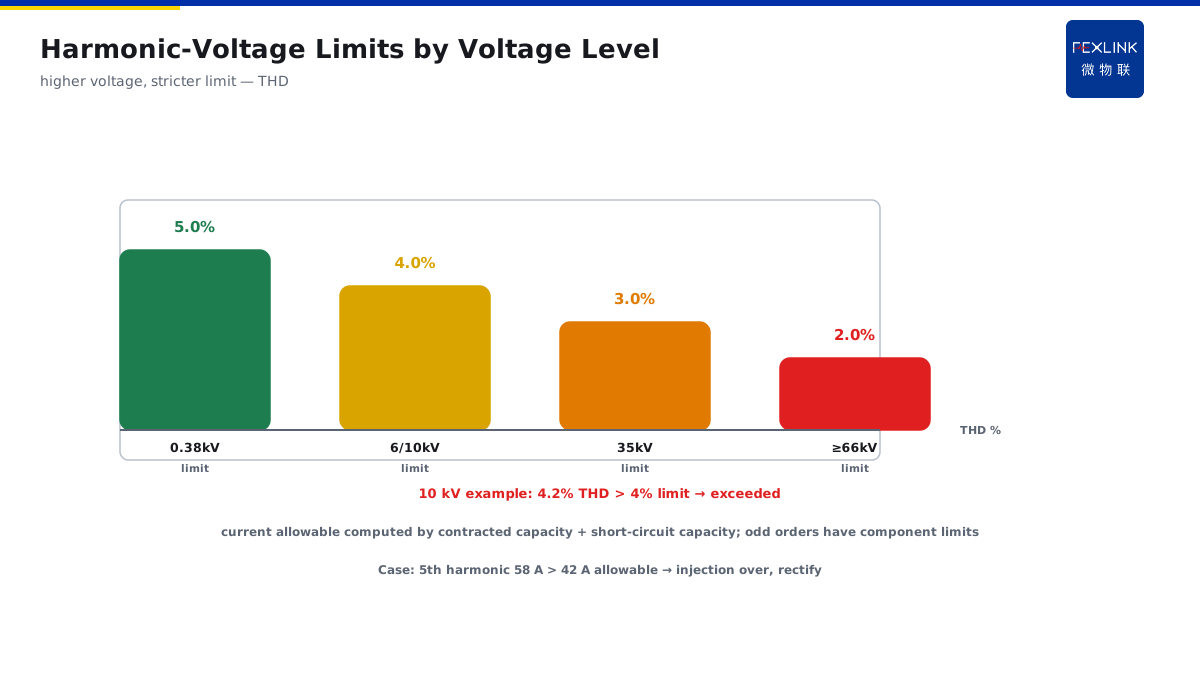
Direct Answer
A plant's harmonic levels exceed limits and it is required to rectify, but the enterprise is unclear about what the standard actually specifies and how responsibility is divided. The answer: GB/T 14549 specifies harmonic-voltage limits for each voltage level of the public supply network and allowable values for harmonic current injected by users; responsibility is divided at the point of common coupling (PCC) — if a user's injected current exceeds the allowable value, that user must rectify. The standard's value is to provide the benchmark for "whether limits are exceeded" and "what the limits are"; specific rectification measures require on-site assessment.
At one plant, the harmonic current injected at the 10 kV incomer exceeded the limit (5th harmonic current above the allowable value), and the utility required rectification per GB/T 14549. Checked against the standard: the PCC is the 10 kV busbar; the 5th harmonic voltage distortion was 4.2% (limit 4.0% — exceeded); the 5th harmonic current was 58 A (allowable computed by contracted capacity about 42 A — exceeded). Conclusion: install mitigation equipment (active/passive filter) to reduce injected current; close out after re-test passes. The core of GB/T 14549 is "limits + responsibility": the harmonic-voltage limit governs public-network quality, the harmonic-current allowable value governs user injection — whether limits are exceeded is judged by the values, who rectifies is decided by the PCC.
Because:
- The standard is the judgment benchmark: whether limits are exceeded and what they are, with concrete figures to check;
- Responsibility is divided at the PCC: injected current above the allowable value means that user rectifies;
- The voltage limit protects the public network: total-network harmonic voltage stays within limits, other users unaffected;
- Rectification needs a basis: judge the exceeded items first, then rectify targeted.
Key insight: GB/T 14549 is the referee of harmonic rectification. Voltage limit + current allowable value + PCC — exceeded or not, and who is responsible, decided by the standard.
At one campus, after multiple VFDs were commissioned together, 5th/7th harmonic currents at the 10 kV busbar rose significantly. Checked against the standard: harmonic-voltage distortion approached the limit and injected current exceeded the allowable value — judged exceeded; after installing an active filter, injected current dropped within the allowable value and the re-test passed. Standard landing: judge the exceeded items by limits first, then rectify the injection source — judgment and rectification are separated, responsibility is clear.
1. Standard Scope and Voltage Levels
Step one: where the standard applies.
Scope:
- GB/T 14549 "Power quality — Harmonics in public supply networks";
- Applies to AC 50 Hz public supply networks;
- Covers 110 kV and below at all voltage levels;
- Used for network harmonic assessment and user harmonic evaluation.
Voltage levels:
- 0.38 kV (LV): total harmonic-voltage distortion limit 5%;
- 6/10 kV (MV): total distortion limit 4%;
- 35 kV: total distortion limit 3%;
- 66 kV and above: total distortion limit 2%.
What the standard governs:
- Harmonic-voltage limits (public-network quality indicators);
- Harmonic-current allowable values (user injection limits);
- Harmonic assessment methods at the PCC;
- Exceedance judgment and responsibility division.
What the standard does not govern:
- Does not specify mitigation equipment (active/passive filtering chosen by the user);
- Does not specify in-plant harmonic standards (a plant may be stricter per equipment requirements);
- Does not address non-public systems (isolated plant supply systems are separate).
Key insight: the standard first defines where it applies. Public networks 110 kV and below, limits per voltage level — define the judgment scope first.
2. Harmonic-Voltage and Harmonic-Current Limits
Step two: what exactly the limits are.
Harmonic-voltage limits:
- 0.38 kV: total distortion ≤5%;
- 6/10 kV: total distortion ≤4%;
- 35 kV: total distortion ≤3%;
- 66 kV and above: total distortion ≤2%;
- Odd harmonic-voltage components each have component limits (5th, 7th, etc.).
Harmonic-current allowable values:
- Computed from the PCC supply voltage level, minimum short-circuit capacity, and contracted capacity;
- Per-order allowable currents (5th/7th/11th, etc.);
- Allowable value proportional to the user's contracted capacity (larger capacity, more allowed);
- Multiple users share by contracted-capacity ratio.
Meaning of the limits:
- Voltage limit: protects public-network quality (visible network-wide);
- Current limit: constrains user injection (source control);
- Together: both a quality indicator and a source constraint;
- Exceedance judgment: any over-limit item fails.
Judgment example:
- 10 kV busbar harmonic-voltage distortion 4.2% (limit 4%) → exceeded;
- 5th harmonic current 58 A (allowable 42 A) → exceeded;
- Any over-limit item requires rectification (per the strictest item).
Key insight: the limits are the judgment ruler. Voltage total distortion by level, current allowable by capacity — exceeded or not, decided by numbers.
3. Responsibility Division at the PCC
Step three: who is responsible.
Point of common coupling (PCC):
- Definition: the connection point between the user's supply line and the public network (generally the incomer busbar/metering point);
- Meaning: the boundary for harmonic responsibility;
- Judgment: injected current at the PCC above the allowable value → that user is responsible;
- Multiple users at one point: responsibility shared by contracted-capacity ratio.
Responsibility division:
- User's injected current above the allowable value → user rectifies (source);
- PCC voltage over limit but no single user over → multi-user superposition, joint rectification;
- High background harmonics from the supply system → grid-side cooperation (rarer);
- Rectification responsibility: whoever exceeds rectifies; superposition means joint rectification.
Judgment process:
- Step 1: identify the PCC (incomer busbar/metering point);
- Step 2: measure harmonic currents at the PCC (per order);
- Step 3: compare with the allowable value (computed by contracted capacity);
- Step 4: over limit → that user must rectify;
- Step 5: re-test (verification after rectification).
Key insight: the PCC is the responsibility boundary. Over-limit injection means that user is responsible; superposition means joint rectification — responsibility clear, rectification without disputes.
4. Exceedance Judgment and Re-Test Requirements
Step four: how to judge and how to verify.
Exceedance judgment:
- Harmonic voltage over limit (voltage distortion at the PCC over the limit);
- Harmonic current over limit (injected current at the PCC over the allowable value);
- Judgment period: continuous monitoring (throughout the assessment);
- Data requirement: typical conditions (normal production periods).
Re-test requirements:
- Re-test after rectification: same PCC, same conditions;
- Re-test period: continuous monitoring (generally 1 week or more);
- Pass criteria: neither voltage nor current over limit;
- Failed re-test: continue rectification (adjust device parameters/capacity).
Monitoring points:
- Measurement location: PCC (incomer metering point);
- Measurement equipment: compliant with power-quality measurement standards (Class B or better);
- Data recording: per-order harmonics (5/7/11/13th, etc.);
- Time synchronization: consistent with the utility's assessment period.
Common dispute handling:
- "Exceedance is grid background": requires data proof (background harmonics measured separately);
- "Multiple-user superposition": shared by contracted-capacity ratio;
- "Instrument differences": unified standard instrument for re-test.
Equipment impact of harmonic exceedance (rectification motivation):
- Transformers: harmonic currents increase copper/iron losses, temperature rise (derating);
- Motors: harmonics cause additional losses and vibration, lower efficiency;
- Capacitors: harmonic amplification causes overcurrent/overheating (even swelling, bursting);
- Cables/busbars: skin effect increases losses, joint overheating;
- Metering/protection: harmonics disturb metering accuracy and risk protection misoperation;
- Meaning: untreated exceedance accumulates equipment loss and failure risk.
Key insight: judgment + re-test is the closed loop. Exceedance judged by limits, re-test after rectification — rectification has criteria, results verifiable.
5. Connection to Enterprise Rectification
Step five: how the standard lands in rectification.
Rectification process:
- Step 1: exceedance diagnosis (PCC monitoring confirms the exceeded items);
- Step 2: harmonic-source analysis (VFDs/rectifiers/nonlinear loads);
- Step 3: mitigation scheme (active power filter APF / passive filter / VFD retrofit);
- Step 4: implementation (device installation + parameter configuration);
- Step 5: re-test and close out (PCC re-test passes).
Mitigation selection:
- Active power filter (APF): dynamic compensation, adapts to varying loads (recommended);
- Passive filter: lower cost, fixed frequency (for stable harmonic sources);
- VFD retrofit: add filter/reactor (source-side treatment);
- Combined scheme: chosen by harmonic composition.
Rectification interface points:
- Judge first, then rectify (avoid blind installation);
- Mitigation capacity designed by overage + margin;
- Close out only after the re-test passes (installing is not enough);
- Long-term monitoring (prevent recurrence from source changes).
Key insight: the standard and rectification connect back to front. Judge over-limit → analyze sources → rectify → re-test — the standard governs judgment, rectification governs landing.
6. Product Landing: Harmonic Monitoring and Rectification Support
FEXLINK products bring the standard to the field:
- ESE Power-Quality Monitor: continuous harmonic voltage/current monitoring at the PCC (exceedance judgment);
- FSE Power-Quality Measuring Controller: per-order harmonic monitoring + trend records (before/after comparison);
- Platform analysis: limit comparison, exceedance alerts, re-test reports;
- Data support: evidence basis for utility evaluation (responsibility judgment).
Design principle in one sentence: turn "harmonic exceedance" into "data-based judgment." Standard limits + field monitoring + re-test verification — exceeded or not, and who rectifies, decided by data.
7. Common Misconceptions in Standard Interpretation
- Voltage only, ignoring current: looking only at voltage distortion. Consequence: the injection-source responsibility is missed. Correct: judge both voltage and current.
- Ignoring contracted capacity: reading the current limit directly from the standard table. Consequence: wrong allowable value (capacity affects the limit). Correct: compute by contracted capacity + short-circuit capacity.
- Wrong PCC location: measuring inside the plant. Consequence: wrong responsibility division. Correct: measure at the PCC (incomer metering point).
- Rectifying without source analysis: blindly installing filters. Consequence: mismatched capacity, poor effect. Correct: analyze harmonic sources before choosing a mitigation scheme.
- Installing counts as close-out: no re-test. Consequence: compliance unverified. Correct: close out after the re-test passes (same PCC, same conditions).
Scope and Limitations
This article provides a framework for interpreting and landing GB/T 14549 (scope and voltage levels, voltage/current limits, PCC responsibility division, exceedance judgment and re-test, rectification interface) for harmonic-overlimit rectification, utility evaluation response, and power-quality project pre-assessment. Specific allowable values must be computed with the actual contracted capacity and PCC short-circuit capacity; measurements must comply with power-quality standards (instrument class, measurement location, monitoring period); mitigation schemes (APF/passive filters, etc.) must be designed by qualified personnel with harmonic-source analysis and site conditions. All cases are anonymized (a certain plant / a certain campus) and do not refer to any specific customer.