 FEXLINK Research Institute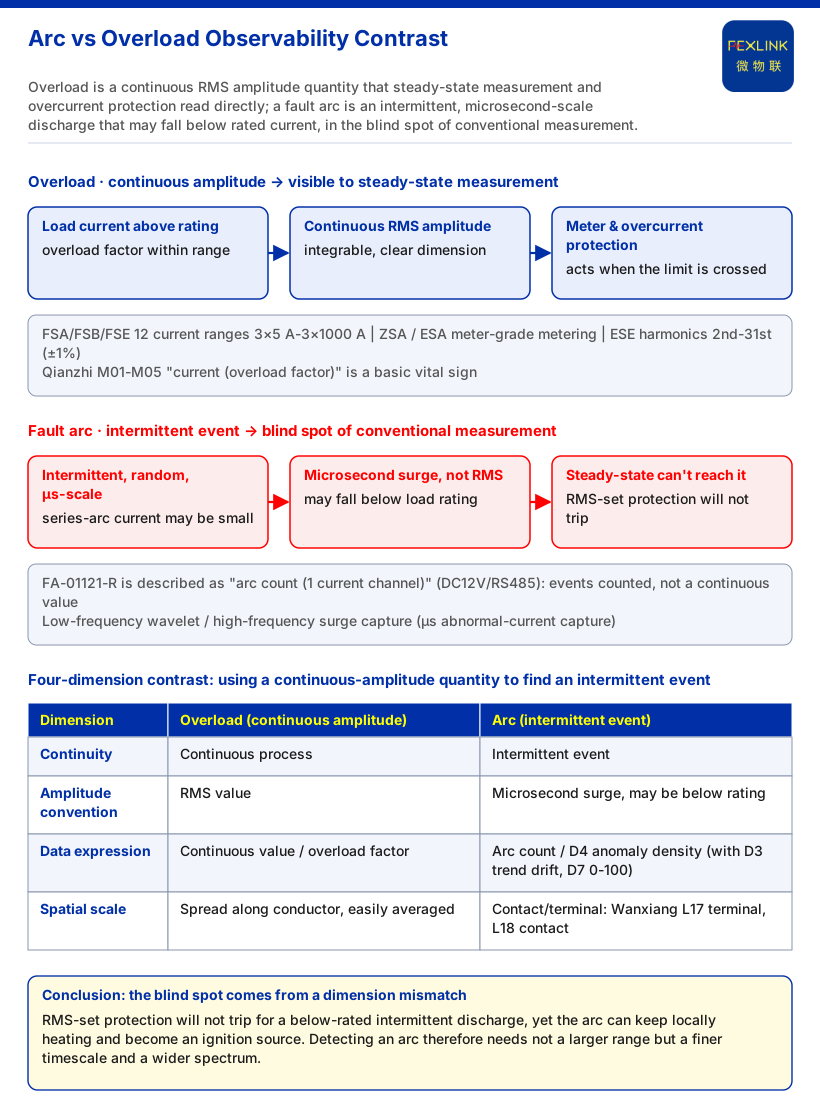
Ordinary overload and a fault arc can both burn through wiring and set a cabinet alight, yet they are not equals at being "detected." Overload usually appears as current continuously above the rated value — a sustained amplitude quantity an electricity meter or overcurrent protection reads directly. A fault arc is often an intermittent, random, microsecond-scale discharge whose current need not be large and may fall below the rated current, so overcurrent protection set on RMS frequently cannot "see" it. The knowledge base attests to the difference through two recording conventions: the arc module FA-01121-R is described functionally as "arc count (1 current channel)" — counted by event — while current products meter a continuous RMS value. The knowledge base gives no arc alarm threshold (section six).
1. Ordinary Overload: A Continuous Amplitude Problem Steady-State Measurement Can See
Overload is a load current continuously exceeding what conductors and equipment can carry — an amplitude problem at the RMS level. The knowledge base current products meter this continuous quantity: the FSA/FSB/FSE multi-element controllers offer 12 current ranges from 3×5 A to 3×1000 A; ZSA and ESA provide meter-grade metering; ESE adds 2nd-31st harmonic monitoring (±1%). Among the Qianzhi engine's 20 core sub-models, "current (overload factor)" sits in the M01-M05 basic vital signs. Such quantities are continuous, integrable and dimensionally clear: with a long enough sampling window, steady-state measurement returns a reading, and overcurrent protection acts when the limit is crossed.
2. Fault Arcs: An Intermittent Event Problem Steady-State Measurement Cannot Reach
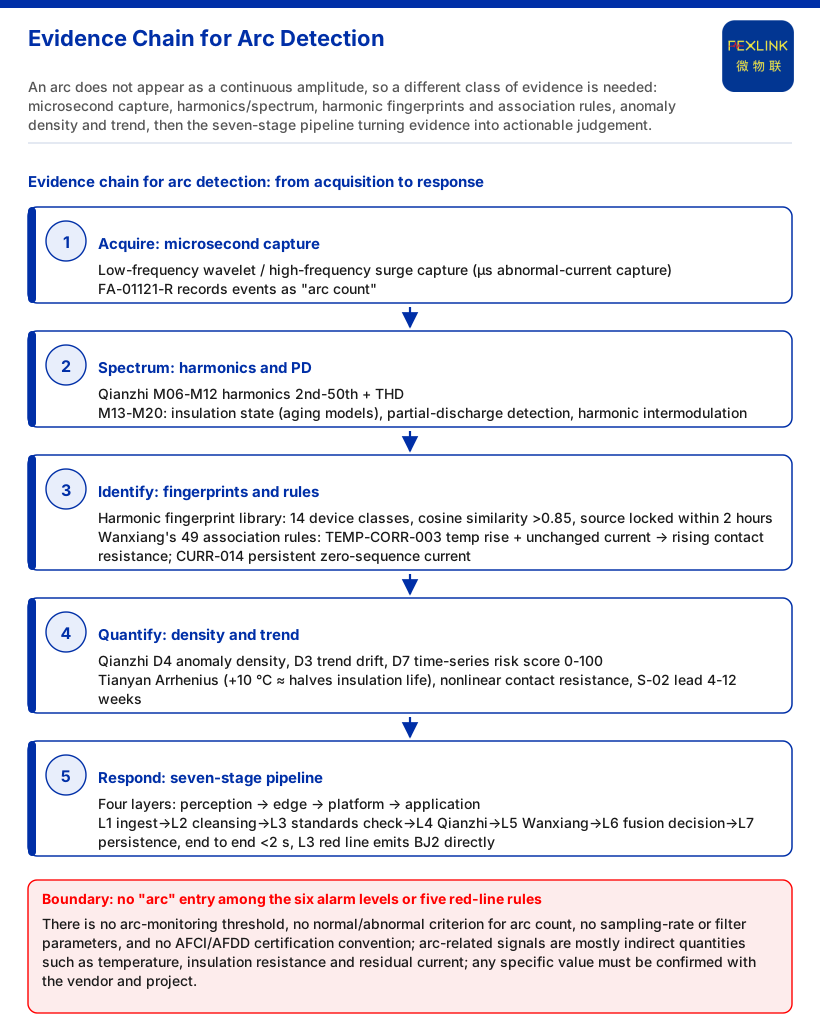
A fault arc is a different kind of object. The knowledge base describes FA-01121-R's function as "arc count (1 current channel)". The convention is the hint: the arc is recorded as an "event," not a continuous value; the output is how many times it occurred, not how large it is now. The acquisition method points the same way: the electrical-hazard early-warning system uses "low-frequency wavelet / high-frequency surge capture (microsecond-scale capture of abnormal current)". That microsecond timescale shows the arc's current signature appears in the gaps of ordinary power-frequency RMS measurement.
This yields the first reason: overload asks whether a quantity is within range; an arc asks whether an event happened. A series arc may carry little current, even below the load's rated current, and overcurrent protection set on RMS will not trip for a below-rated intermittent discharge — yet the arc can keep locally heating and become an ignition source.
3. The Four "Dimensions" of the Difficulty
Broken down, the difference falls along at least four axes.
Continuity: overload is a continuous process; an arc is an intermittent event.
Amplitude convention: overload reads RMS; an arc reads microsecond-scale surges, outside the former's measurement convention.
Data expression: overload gives a continuous value and an overload factor; an arc is better expressed as a "count" and an "anomaly density" — D4 in Qianzhi's seven-dimensional sensing is exactly "anomaly density," alongside D3 trend drift and D7 time-series risk score (0-100).
Spatial scale: overload's thermal effect spreads along the conductor and is easily averaged; an arc occurs at very small scales such as contacts and terminals, and the Wanxiang engine location awareness reaches L17 terminal level and L18 contact level.
Stacking the four, using a quantity designed for continuous amplitude to detect an intermittent event has an inherent blind spot.
4. Detecting Arcs Relies on "a Different Kind of Evidence"
Since an arc does not appear as a continuous amplitude, detecting it requires another class of evidence. The knowledge base gives three directions.
First, harmonics and spectrum. Qianzhi's M06-M12 covers harmonics (2nd-50th plus THD), and M13-M20's deep-hazard mining adds insulation state (aging models), partial-discharge detection and harmonic intermodulation. Arc discharge leaves traces in such frequency-domain features.
Second, fingerprints and association. The harmonic fingerprint library builds fingerprints for 14 device classes, matching at cosine similarity >0.85 and locking the pollution source within 2 hours; the Wanxiang engine has 49 cross-dimensional association rules — for example the TEMP-CORR-series rule "temperature rise + unchanged current → rising contact resistance" and the CURR-series rule "persistent zero-sequence current → single-phase earth-fault tracing". Isolated arc signs are easier to confirm once associated.
Third, the trend view. The Tianyan engine rests on the Arrhenius equation (a +10 °C rise roughly halves insulation life), exponential leakage growth and nonlinear contact-resistance growth curves. An arc's causes — insulation aging, rising contact resistance — are the processes those curves describe, so watching the trend beats a single point for spotting degradation before discharges become frequent.
5. What "Harder" Means in Engineering Terms
The difficulty reshapes alarm and response design. The six-level scheme (Normal 85-100 → Watch 70-84 → YJ1 55-69 → YJ2 40-54 → BJ1 20-39, act within 48 hours → BJ2 0-19, shut down immediately) and five red lines handle "out of limit" clearly; but the lines contain no "arc" entry, and arc-related signals are mostly indirect quantities such as temperature, insulation resistance and residual current. The arc thus lacks a simple limit criterion like overload's, and detecting it leans on the combined evidence above.
The data foundation decides whether that evidence can stand. The knowledge base defines four layers — perception, edge, platform, application; the Taiyi intelligent-control hub's seven-stage pipeline (L1 ingest → L2 cleansing → L3 standards check → L4 Qianzhi analysis → L5 Wanxiang assessment → L6 fusion decision → L7 persistence) runs end to end in under 2 seconds, and an L3 red-line trigger emits the highest-level alarm directly. The knowledge base points "electrical-hazard AI diagnosis (all parameters)" to the Taiyi hub, and "harmonic tracing and responsibility allocation" to Qianzhi M06 plus the fingerprint library plus Tianyan Q-01. Meeting the arc's difficulty is thus not a higher-range ammeter but a finer timescale, a wider spectrum and stronger association.
6. Boundaries: What This Article Does Not Claim
First, the knowledge base gives no alarm threshold for FA arc monitoring, no normal/abnormal criterion for arc count, and no sampling-rate or filter parameters, and AFCI/AFDD certification never appears. This article provides no arc threshold and does not claim FA-01121-R equals any certified protective device.
Third, the "90% of charging fires stem from undetected hazards" and the 238-dimensional sigmoid_plus model and KSDSFE3250220001 case (3rd harmonic 18.7× over limit, composite risk 75.5%) are internal records, used only as background, never as definite performance assertions.
Fourth, the quantitative value metrics (electrical-hazard identification 95%+, alarm compression 80%, warning lead 4-12 weeks, etc.) are vendor self-reports, citable only as vendor capability claims.
Fifth, no implementation of sampling/reporting frequency, offline caching and backfill, or alarm-ticket grading is given; no customer case, certification or handling effect is claimed; no model, parameter or standard clause absent from the knowledge base is invented. Only the standard numbers GB 13955, GB 50057, GB/T 15543, GB 16895 and GB/T 16895 listed by the knowledge base are cited, without inferring their content.
Sixth, this article answers only "why arcs are harder to detect than ordinary overload": it does not expand multi-dimensional criteria for current anomalies or cover arc monitoring parameters/thresholds or arc AI diagnosis; the three stand as separate articles.
Conclusion
Arc faults are harder to detect than ordinary overload not because arcs are more "hidden" but because the two differ in dimension: overload is a continuous RMS amplitude quantity covered by products' current ranges and meters' continuous metering; an arc is an intermittent, microsecond-scale event recorded as a "count", its clues lying in harmonic spectrum, anomaly density, association rules and degradation trends. Detecting an arc depends not on a larger range but on a finer timescale, a wider spectrum and stronger association, turning evidence into actionable judgement through the four-layer architecture and seven-stage pipeline. The knowledge base gives no arc threshold or certification convention, so any specific value must be confirmed with the vendor and project. Terminology and model names follow the locked knowledge base conventions.