 微物联研究院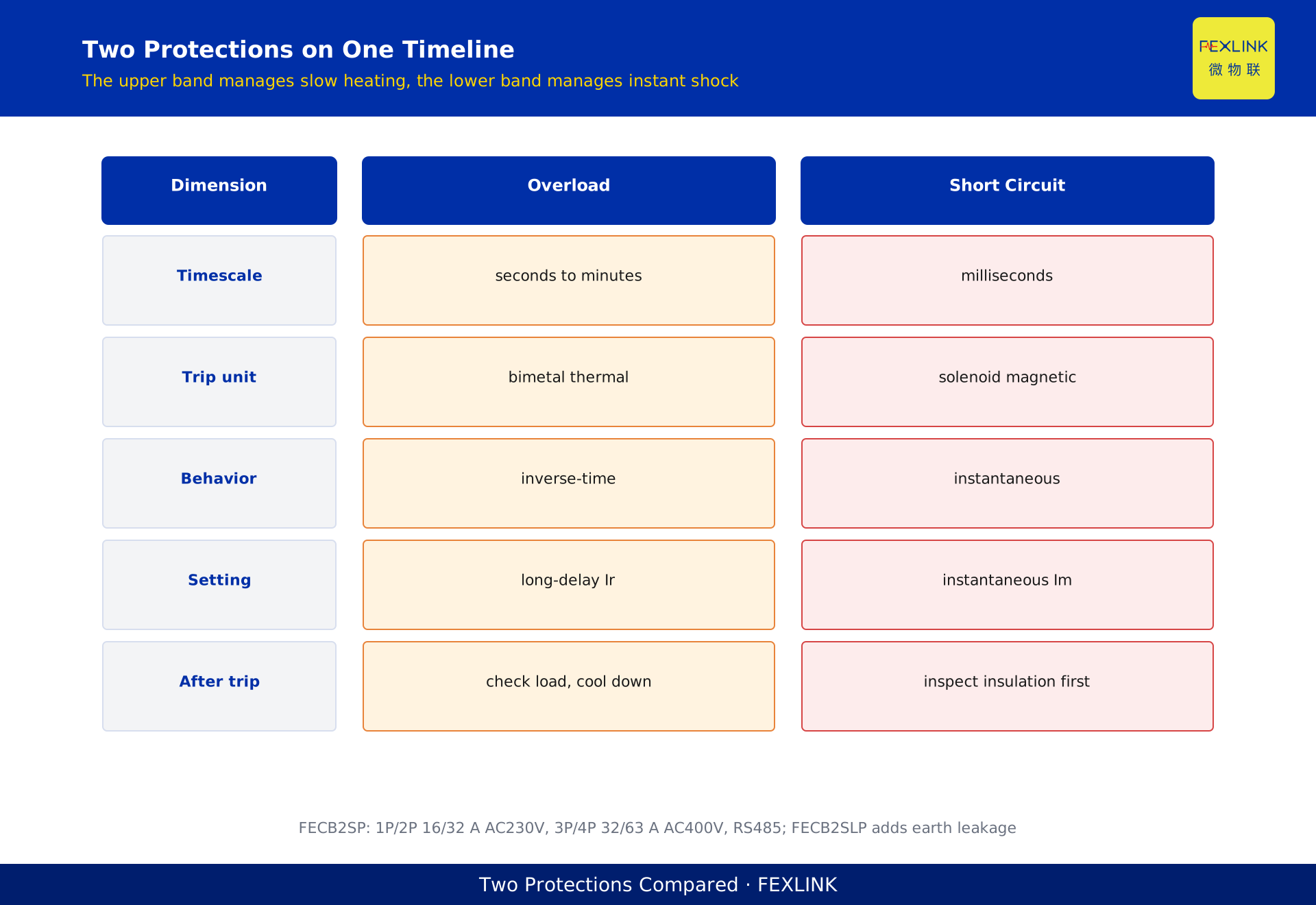
Direct Answer
When a switchbreaker trips, operators often ask: was that a short circuit? Most of the time it was not — it was overload protection, a completely independent device in the same breaker. Overload protection handles "current is a bit high for a bit too long," using an inverse-time long-delay thermal trip that acts in seconds to minutes. Short-circuit protection handles "current is enormous and instantaneous," using an instantaneous electromagnetic trip that acts in milliseconds. They are set separately, do different jobs, and confusing them leads to wrong diagnosis and wrong settings.
The practical consequence: after an overload trip you can usually reset once the fault is cleared; after a short-circuit trip, blindly resetting risks a second incident. A smart breaker like the FECB2SP records and uploads the two trips separately, so the platform shows not just "it tripped" but "it tripped on overload" or "it tripped on a short circuit."
1. Why Two Devices, Not One
How much current a conductor can carry is constrained two different ways.
The first is thermal. When current exceeds rating, the wire and insulation heat up; a modest overload for a short time balances against cooling and is tolerable, but sustained overload accumulates heat and degrades insulation. This demands a trip that is "faster as current rises, but gives the equipment some time" — the inverse-time thermal trip.
The second is mechanical and dielectric shock. A short circuit can jump to ten to forty times rating; busbar forces scale with the square of current, and cable heat damage arrives in milliseconds. This demands a trip "as fast as possible" — the instantaneous electromagnetic trip.
One device must be slow enough to tolerate normal peaks, the other fast enough to survive a fault. Physically they cannot be the same part. That is why low-voltage breakers under GB/T 14048.2 separate the thermal and magnetic trip units behind a common contact system.
2. Overload: Inverse-Time Long Delay
The signature of overload protection is inverse time: the more current exceeds rating, the faster it acts, but even a mild overload will eventually trip.
A typical distribution breaker sets the long-delay current Ir at 0.8 to 1.0 times the rated In; at 1.05 In it conventionly does not trip, at 1.3 In it trips within the convention time (often tens of minutes to an hour depending on type). Higher current trips sooner, down to tens of seconds near 3 In.
Why so slow? Because much of field "overload" is normal short peaks — motor starts, capacitor charging, several devices starting together. A breaker that trips the moment it sees 1.1 In cannot run a plant. The inverse-time curve is the balance between protecting insulation and tolerating normal peaks.
A real generic-plant case: a 63 A feeder in an injection shop tripped every evening, initially suspected to be a short circuit. The platform curve showed the peak was only 1.4 In and lasted forty-plus minutes — five injection machines preheating together on night shift, overloading the long-term ampacity of that segment; the thermal unit acted on its inverse-time curve. The fix was not a bigger breaker but staggered startup and resetting Ir against the actual cable cross-section. Treating it as a short circuit would have meant days of unnecessary shutdown.
3. Short Circuit: Instantaneous
The signature of short-circuit protection is instantaneous: once current crosses the pickup Im, the solenoid directly pulls the contacts open, in milliseconds.
Distribution breakers set Im at some multiple of In (often 5 In, 10 In, or adjustable). The principle: ride through the largest normal peak (a motor start can reach 6 to 8 times rating), yet trip instantly on a true fault. Too low and a motor start nuisance-trips; too high and a nearby short may not clear.
Coordination also adds a short-delay step (0.1 to 0.4 s) so that close-by faults clear at the lower breaker and far faults at the upper one, avoiding a whole-board trip. But for a single end breaker, short-circuit protection is millisecond instantaneous.
Riding through motor starts is the subtle part. A direct-on-line cage motor starts at 6 to 8 times rating for hundreds of milliseconds to seconds. Set Im too low (5 In) and the motor start trips the breaker; set it too high (15 In) and a smaller fault near the far end of the line may fail to trip, causing upstream over-trip. Engineers calculate Im between the two boundaries — above the start peak, below the minimum short-circuit current at the line end.
4. Three Common Setting Mistakes
First, mixing long-delay and instantaneous settings. Long delay sets "how much current can run long term"; instantaneous sets "how much counts as a short." People raise Im to stop motor-start trips, and then a real short fails to clear.
Second, looking only at In. A 63 A breaker does not mean the wires, switches, and contactors are all rated 63 A; overload settings must match the smallest conductor's ampacity, not the breaker body.
Third, resetting blind after a trip. An overload trip (thermal) can be reset after the device cools; a short-circuit trip (magnetic) means enormous current flowed, and resetting before finding the cause risks arcing contacts or burning the busbar. Smart breakers record the trip type precisely to prevent this mistake.
5. How a Smart Breaker Logs the Two Separately
A traditional breaker only says "tripped." A smart breaker like the FECB2SP records trip type, peak current, and action time, and uploads them over RS485. The platform shows structured events: a long-delay overload trip with peak and duration, or an instantaneous short trip with the transient current.
Two benefits follow. Diagnosis is faster: "overload 1.3 In" sends operators to check added load and cable ampacity; "instantaneous 12 In" sends them straight into the short-circuit procedure. Coordination is better: with historical trip curves, the platform can reverse-check whether long-delay and instantaneous settings make sense, and flag "always nuisance-tripping" or "fails to act when it should."
The FECB2SP covers 1P/2P 16 A and 32 A at AC 230 V, and 3P/4P 32 A and 63 A at AC 400 V, with RS485. The residual-current version FECB2SLP adds an earth-fault trip on top of overload and short circuit — three protections, logged and alarmed separately on the platform.
Reset decisions become evidence-based. The platform advises by trip type: after a long-delay overload with no visible scorching, wait for cooling then re-energize while watching the curve; after an instantaneous short, isolate the circuit first, test insulation and overlaps, and re-energize only when no residual fault remains. This used to live only in senior technicians' heads; now it is a standardized procedure on the platform.
One more coordination point matters as systems grow. In a selectivity scheme, the upstream breaker often uses a short delay instead of pure instantaneous, so that a fault near the end of a line is cleared by the lower breaker while a fault on the bus trips the upper one — without dropping every feeder at once. Setting the instantaneous pickup too high on the lower breaker, or too low on the upper one, breaks this selectivity and causes nuisance upstream trips. The platform can compare actual trip records across levels to expose exactly this: repeated trips at the upper breaker without a matching lower event are a sign the coordination curve is off, not a sign that the upstream device is faulty. Rather than swapping breakers on intuition, operators can read the logged peak currents and adjust the long-delay and instantaneous settings so that close faults clear locally and only genuine upstream faults reach the main breaker.
6. The Side-by-Side
Protection target: overload manages heat accumulation, short circuit manages instantaneous current. Trip element: bimetal thermal versus solenoid magnetic. Trip time: seconds to minutes versus milliseconds. Setting: long-delay Ir versus instantaneous Im. Post-trip action: reset after cooling versus investigate before re-energizing. Platform record: two separate events, never merged.
Remember one line: the slow unit keeps equipment from slowly burning up, the fast unit keeps it from instantly being destroyed; set them apart, and read which unit tripped before you reset.
Scope and Limits
This page covers low-voltage AC end and distribution breaker protection coordination under GB/T 14048.2, 0.4 kV and below. Inverse-time and instantaneous ranges and trip times follow product catalogs and on-site calculation; FECB2SP ratings (1P/2P 16 A/32 A AC 230 V, 3P/4P 32 A/63 A AC 400 V, RS485, FECB2SLP residual-current) come from the product knowledge base. High-voltage breakers, DC systems, fuses, and relay coordination are out of scope; real work must be done by a qualified electrician under GB 50054.