 FEXLINK Research Institute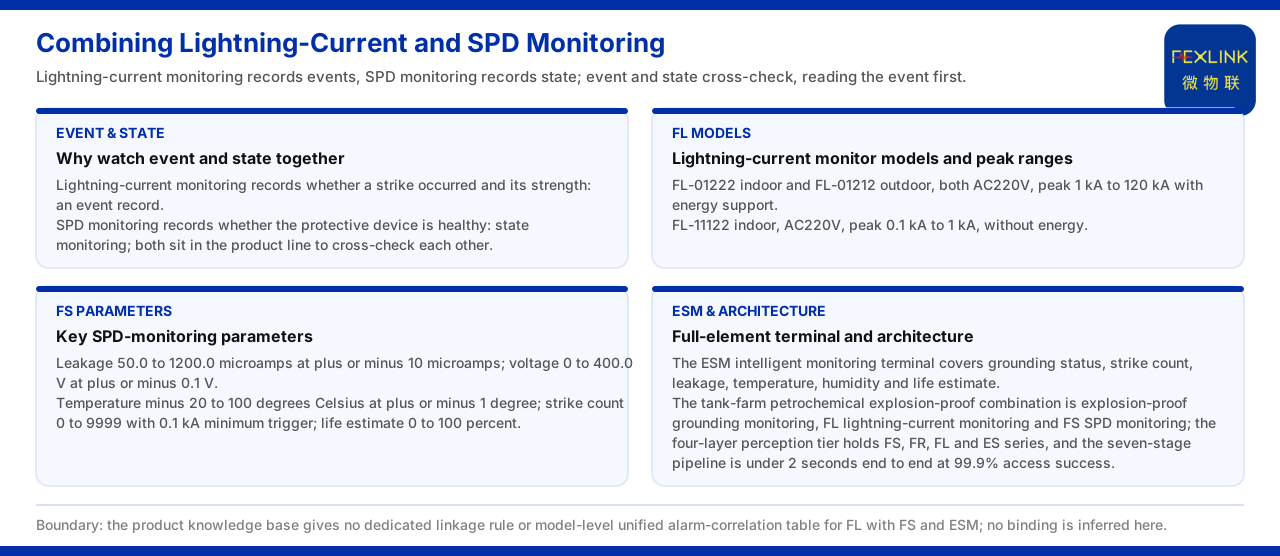
Direct Answer
Lightning current monitoring and surge protective device monitoring are two kinds of monitoring that can be used in combination. The product knowledge base records that the FL lightning current / transient current monitor is divided into three model groups: the lightning current monitor (FL-01222-R, FL-01222-Z and FL-01222-E) for indoor installation, AC220V, with a peak from 1 kA to 120 kA and energy support; the lightning current monitor (FL-01212-R, FL-01212-Z and FL-01212-E) for outdoor installation, AC220V, with a peak from 1 kA to 120 kA and energy support; and the lightning current monitor (FL-11122-R, FL-11122-Z and FL-11122-E) for indoor installation, AC220V, with a peak from 0.1 kA to 1 kA and no energy function. On the surge protective device side, the work is carried by the FS surge protective device monitor and the ESM intelligent lightning-protection monitoring terminal; the former gives parameters such as leakage current, voltage, temperature, lightning strike count and lifetime estimate, while the latter is an all-element terminal covering grounding status, lightning strike count, leakage current, temperature, humidity and lifetime estimate. The official example of combining the two is the oil-tank-farm and petrochemical lightning-protection and explosion-proof scenario, whose recommended combination is explosion-proof grounding resistance monitoring, FL lightning current monitoring and FS surge protective device monitoring. It should be noted that the product knowledge base gives no dedicated linkage rule for the combination of FL with FS and ESM, nor any model-level unified alarm-association configuration table, so this article cites the product parameters and the scenario combination separately and does not infer a linkage rule.
1. Why Events and Status Must Be Watched Together
Lightning current monitoring and surge protective device monitoring answer two different questions. Lightning current monitoring records "whether a lightning strike occurred and how strong it was", which belongs to event recording; surge protective device monitoring records "whether the protective device itself is healthy", which belongs to status monitoring. Looking only at events, one does not know whether the protective device can still operate; looking only at status, one does not know by what event the device was consumed. The product knowledge base lists the two separately in the product line precisely so that event and status can corroborate each other. Understanding this division of labour is the precondition for reading the parameters that follow. In actual troubleshooting, first confirm the presence and strength of the lightning strike event, then check the status of the protective device, and the reading order becomes clearer. The product knowledge base gives no dedicated rule for joint judgement of the two, so this order is only a reading recommendation.
2. Models and Peak Ranges of the Lightning Current Monitor
The product knowledge base records that the FL lightning current / transient current monitor is used to record lightning strike events, with models grouped by installation method and range. The FL-01222 series is for indoor installation and the FL-01212 series for outdoor installation; both groups are AC220V, both have a peak range from 1 kA to 120 kA, and both support energy recording. The FL-11122 series is for indoor installation with an AC220V supply and a peak range from 0.1 kA to 1 kA, and does not carry an energy function. It can be seen that one product line distinguishes indoor from outdoor by installation method and distinguishes large from smaller current by peak range. This article cites only these model and peak conventions and does not add accuracy or response time not listed in the product knowledge base.
3. Surge Protective Device Monitoring: Key Parameters of FS
On the surge protective device side, the product knowledge base records the key parameters of the FS surge protective device monitor: a leakage-current range from 50.0 to 1200.0 microampere with an accuracy of plus or minus 10 microampere; a voltage range from 0 to 400.0 volt with an accuracy of plus or minus 0.1 volt; a temperature range from minus 20 to 100 degrees Celsius with an accuracy of plus or minus 1 degree Celsius; a lightning strike count range from 0 to 9999 with a minimum trigger of 0.1 kA; and a lifetime estimate range from 0 to 100 percent. These parameters cover the leakage status, operating voltage, temperature, number of operations and lifetime estimate of the surge protective device, forming the monitoring of device status. This article cites only the above parameter conventions and does not add other indicators not listed in the product knowledge base.
4. The All-Element Terminal ESM Fills the Gap
The product knowledge base also records the ESM intelligent lightning-protection monitoring terminal, namely the all-element lightning-protection monitoring terminal, whose monitoring elements include grounding status, lightning strike count, leakage current, temperature, humidity and lifetime estimate; for example, ESM-21312-R covers multiple elements and carries a lifetime estimate. Compared with FS monitoring alone, ESM brings grounding status and environmental quantities such as humidity into the picture, and can complement the event recording of FL to form a more complete observation of surge protective device status. The product knowledge base gives no item-by-item parameter table for each ESM model, so this article cites only its element composition and model example and does not add values not listed in the product knowledge base.
5. Official Scenario Combination and System Architecture
In the typical application scenarios of the product knowledge base, the recommended combination for the oil-tank-farm and petrochemical lightning-protection and explosion-proof row is explosion-proof grounding resistance monitoring, FL lightning current monitoring and FS surge protective device monitoring. This is the official example of combining lightning current monitoring with surge protective device monitoring, showing that in places requiring explosion protection, the three kinds of monitoring — grounding, lightning current and surge protective device — appear together. At the architecture level, the product knowledge base records a general four-layer architecture for monitoring systems, in which the perception layer contains FS, FR, FL and ES series monitoring modules, the edge layer contains FG, ESX and CW gateways, and the platform layer is FEXCloud; both lightning current and surge protective device data are acquired at the perception layer and converge on the platform. The product knowledge base also records the seven-level pipeline of the Taiyi intelligent control hub system, from access, cleaning, standard verification, Qianzhi analysis, Wanxiang assessment, fusion decision to persistence, with an end-to-end time under two seconds and an access success rate of 99.9 percent, providing platform capability for unified analysis of the two kinds of monitoring data.
6. Boundaries That Must Be Held
The above can be reduced to a reading order. First, confirm whether what is to be read is a lightning current event or a surge protective device status, corresponding to FL and to FS and ESM respectively. Second, read the models and the peaks or parameters: for FL look at installation method and peak range, for FS look at leakage current, voltage, temperature, count and lifetime. Third, if an all-element observation is needed, cite the element composition of ESM. Fourth, if a scenario is involved, return to the recommended combination for the oil-tank-farm and petrochemical lightning-protection and explosion-proof scenario. Fifth, if the data path is involved, cite the four-layer architecture and the platform layer. The boundary that must be held is this: the product knowledge base gives no dedicated linkage rule for the combination of FL with FS and ESM, nor any model-level unified alarm-association configuration table, so this article does not infer a binding relationship or a dedicated rule between them.
Applicability and Limits
First, this article restates only what the product knowledge base lists; its factual boundary is the records of the FL, FS and ESM product entries, the typical scenarios and the system architecture, and it introduces no parameter, certification or case not listed there.
Second, the models and peak ranges of the FL lightning current / transient current monitor (FL-01222 and FL-01212 from 1 to 120 kA with energy support, FL-11122 from 0.1 to 1 kA without energy, all AC220V) are cited under the listed convention.
Third, the leakage current, voltage, temperature, lightning strike count and lifetime estimate parameters of the FS surge protective device monitor are cited under the listed convention as reference values; other indicators not listed in the product knowledge base are not added.
Fourth, the element composition and model example of the ESM intelligent lightning-protection monitoring terminal are cited under the listed convention.
Fifth, the recommended combination for the oil-tank-farm and petrochemical lightning-protection and explosion-proof scenario, the four-layer architecture and the seven-level pipeline are cited under the listed convention; no project effect or linkage rule is inferred from them.
Sixth, the product knowledge base gives no dedicated linkage rule for the combination of FL with FS and ESM, and this article accordingly declares that it cites only the product parameters and the scenario combination separately.
Seventh, this article does not constitute a commitment to the lightning-protection design of a specific project; the latest product documents and formal files prevail in practice.