 微物联研究院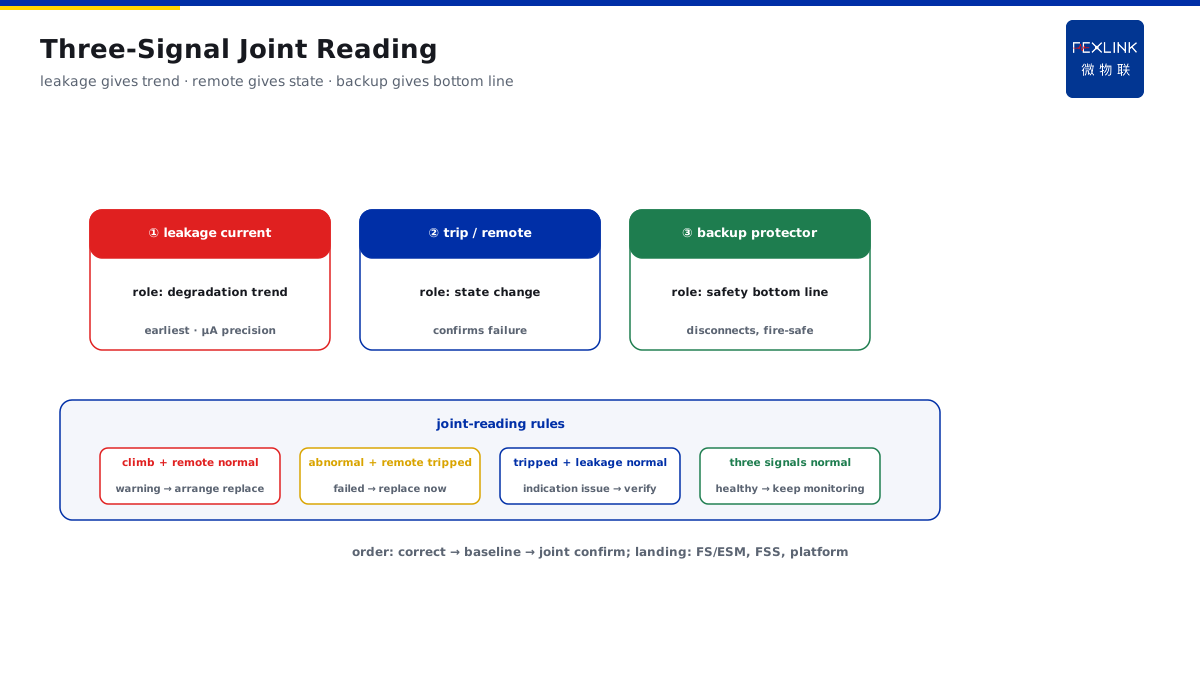
Direct Answer
O&M staff see SPD leakage currents of tens to hundreds of μA on the monitoring screen — is this value large, and at what point should they be alerted? The answer: SPD leakage current is a microamp-level current superimposed on the power-frequency voltage; you must first build a baseline for the same-model SPDs at this station, then look at the trend — a slow climb (e.g., from tens of μA toward the hundreds-of-μA level) that remains rising after decoupling from seasonal temperature/voltage fluctuations is the MOV-degradation signal; looking at the absolute value at a single moment has limited meaning.
At one power distribution room, 4 same-model SPDs were monitored on-line: Group A 45μA, Group B 52μA, Group C 38μA, Group D 180μA — by absolute value alone, D looked worst. After building a baseline, it was found that Group D sat on an outdoor high-temperature phase (ambient 15°C hotter than indoors) with higher phase voltage; after temperature/voltage correction, Group D's equivalent leakage was about 55μA — normal range. Three months later, Group D's leakage climbed to 140μA under equivalent conditions (others stable) — degradation confirmed and replaced early. Reading core: build the baseline first, then look at the trend — absolute values deceive (temperature/voltage effects); a sustained climb after decoupling is the degradation signal.
Because:
- Leakage current naturally fluctuates: with voltage and temperature (not all degradation);
- Absolute values have limited meaning: readings at different installation locations/conditions cannot be compared directly;
- Trend is the signal: sustained climb under the same conditions = degradation (fluctuation does not count);
- Joint reading: leakage + trip/remote signal + backup protector confirm.
Key insight: "baseline + trend + decoupling" is the three-step method for μA-level leakage reading. Build the baseline, watch the trend, exclude temperature/voltage interference — then the degradation inflection point is seen accurately.
At one plant, a "replace at 200μA" rule-of-thumb wrongly replaced 3 SPD groups (actually normal behavior under heat and high voltage), wasting tens of thousands of yuan. Rectification: build the station baseline first (with temperature/voltage correction), judge by trend. Lesson: concluding without a baseline causes misjudgment — "absolute value + single point" is unreliable; "baseline + trend" is reliable.
1. What the Leakage Current Consists Of
Step one: what is inside the leakage number.
Two components:
- Capacitive component: determined by MOV varistor capacitance (varies with voltage);
- Resistive component: determined by MOV grain-boundary state (varies with degradation);
- Normal reading = capacitive dominant (tens of μA);
- Degradation signal = resistive growth (total leakage climbs).
Sources of natural fluctuation:
- Voltage fluctuation: system voltage up → capacitive component up;
- Temperature change: temperature up → leakage up (seasonal);
- Harmonic effects: waveform distortion → reading fluctuation;
- Measurement error: instrument precision and wiring.
Reading prerequisites:
- Distinguish components: capacitive fluctuation is "normal breathing";
- Distinguish sources: resistive climbing is "true degradation";
- Correct conditions: compare after temperature/voltage compensation;
- Long-term view: a single point is meaningless; the trend is meaningful.
Key insight: "capacitance breathes with voltage, resistance climbs with degradation" is the key to reading. Understand the components and you will not mistake natural fluctuation for degradation.
2. How to Build a Normal Baseline
Step two: the baseline is the "ruler" of judgment.
Baseline definition:
- Same model: same manufacturer/spec (consistent leakage level);
- Same voltage: same system voltage class (consistent capacitance);
- Same location: same installation environment (consistent temperature/humidity);
- Same condition: same load/commissioning time.
Baseline-building methods:
- Record at go-live: readings in the first 1–3 months after commissioning (establish the normal range);
- Same-group comparison: compare same-model units within the station (lateral reference);
- Seasonal records: cover winter and summer (temperature influence range);
- Record conditions: log temperature/voltage alongside readings (for correction).
Baseline content:
- Normal range: mean ± fluctuation band (e.g., 40–60μA);
- Seasonal characteristics: higher in summer, lower in winter (normal);
- Voltage correlation: each 1% voltage rise increases capacitance correspondingly;
- Update mechanism: rebuild the baseline after replacing an SPD.
Key insight: "same model + same conditions + seasonal coverage" builds a credible baseline. Without a baseline, any absolute value is "an orphan number without reference."
3. Typical Magnitude and Trend Patterns of the Degradation Inflection
Step three: what pattern means degradation.
Trend-pattern comparison:
- Linear climb: slow rise over weeks to months (typical degradation);
- Step jump: sudden increase then plateau (strike/overvoltage impact);
- Fluctuating type: rising and falling with temperature/voltage (normal breathing);
- Sustained rise + threshold exceeded: degradation confirmed.
Typical magnitude references:
- Normal: tens of μA (within the baseline band);
- Watch: sustained climb to more than 2× the baseline;
- Degraded: clear trend + still rising after decoupling;
- Limit: hundreds-of-μA level (near failure).
Reading points:
- Exclude fluctuation: look after temperature/voltage correction;
- Confirm multiple times: trend over consecutive readings (not a single point);
- Dynamic threshold: updated with the baseline (not a fixed number);
- Joint verification: remote signal/trip/backup protector confirm.
Key insight: "linear climb/step jump + sustained rise after decoupling" is the degradation-inflection pattern. Fluctuation is not degradation — confirm multiple times and verify jointly before concluding.
4. Why μA-Level Precision Has Judgment Value
Step four: why precision matters.
Precision determines resolution:
- SPD normal leakage is at the tens-of-μA level;
- Degradation trends change at the ±10–20μA level;
- Insufficient precision (mA level) cannot resolve the trend;
- A "yes/no" judgment is even worse (equivalent to no monitoring).
Precision requirements:
- μA-level resolution (can see tens-of-μA changes);
- Temperature/voltage compensation (readings comparable);
- Stable measurement (no environmental drift);
- Periodic calibration (stay accurate).
Consequences of insufficient precision:
- Trend drowned in noise (cannot see the climb);
- Many false alarms (fluctuation treated as degradation);
- Missed warnings (tiny changes invisible);
- Insufficient replacement basis (cannot trace).
Key insight: "μA-level precision + compensation" is the prerequisite for trend judgment. Without precision, the trend is untrustworthy — equivalent to no monitoring.
5. How to Jointly Read Leakage Readings with Trip/Remote-Signal State
Step five: how to combine the judgment.
The roles of the three signals:
- Leakage current: degradation trend (earliest warning);
- Trip/remote signal: state change (confirms failure);
- Backup protector: safety bottom line (disconnects isolation).
Joint-reading rules:
- Leakage climb + remote normal: degradation warning (arrange replacement);
- Leakage abnormal + remote operated: failure confirmed (replace immediately);
- Remote operated + leakage normal: mechanical/indication issue (verify on site);
- Three signals normal: healthy (keep monitoring).
Reading flow:
- Step 1: look at the leakage trend (baseline comparison);
- Step 2: look at the remote-signal state (operated or not);
- Step 3: look at the backup protector (disconnected or not);
- Step 4: comprehensive judgment (warning/replacement/verification).
Reading practice examples:
- Scenario 1: summer leakage 60μA (baseline 40–60μA), temperature 35°C — normal (within the seasonal band);
- Scenario 2: leakage climbs from 45μA to 130μA over three months, temperature/voltage unchanged — degradation warning (arrange replacement);
- Scenario 3: after a strike, leakage jumps from 40μA to 90μA then plateaus — impact degradation (add to focused observation);
- Scenario 4: leakage normal but remote operated — indication/mechanical issue (verify on site);
- Reading order: correct conditions first, compare baseline next, confirm jointly last — never conclude from a single reading.
Key insight: "leakage gives the trend, remote gives the state, backup gives the bottom line" — only the three-signal combination is complete. A single signal is unreliable; combined reading is accurate.
6. Product Landing: Intelligent Lightning-Protection On-Line Monitoring
FEXLINK products land leakage reading:
- FS/ESM SPD Monitor: μA-level leakage + temperature/voltage compensation;
- Baseline management: same-model group baselines built automatically;
- Trend analysis: climb/jump recognition + threshold alarms;
- Joint reading: leakage + remote signal + backup protector summarized.
Design principle in one sentence: "build the baseline first, look at the trend, read jointly." μA-level precision + trend analysis — the degradation inflection is seen accurately and replaced correctly.
7. Common Reading Misconceptions
- Judging by absolute value: replace at 180μA, fine at 40μA. Consequence: temperature/voltage differences mislead. Correct: baseline + trend.
- Concluding from a single point: judging from one measurement. Consequence: fluctuation treated as degradation. Correct: multiple readings, watch the trend.
- Ignoring temperature/voltage: not recording conditions. Consequence: seasonal fluctuation misjudged. Correct: compare after condition correction.
- Reading with insufficient precision: watching trends with an mA-level instrument. Consequence: trend drowned in noise. Correct: μA-level precision + compensation.
- Looking at leakage only: ignoring remote/trip signals. Consequence: failure confirmation lags. Correct: three-signal joint reading.
Scope and Limitations
This article provides methods for reading SPD leakage-current μA-level readings (baseline building, trend patterns, precision requirements, joint reading), applicable to daily reading and replacement decisions of SPD monitoring data in low-voltage distribution systems. Specific magnitude references must follow the equipment model and system voltage; baseline-building periods relate to environmental conditions; monitoring-instrument precision must meet μA-level requirements with periodic calibration. All cases are anonymized (a certain power distribution room/a certain plant) and do not refer to any specific customer.