 FEXLINK Research Institute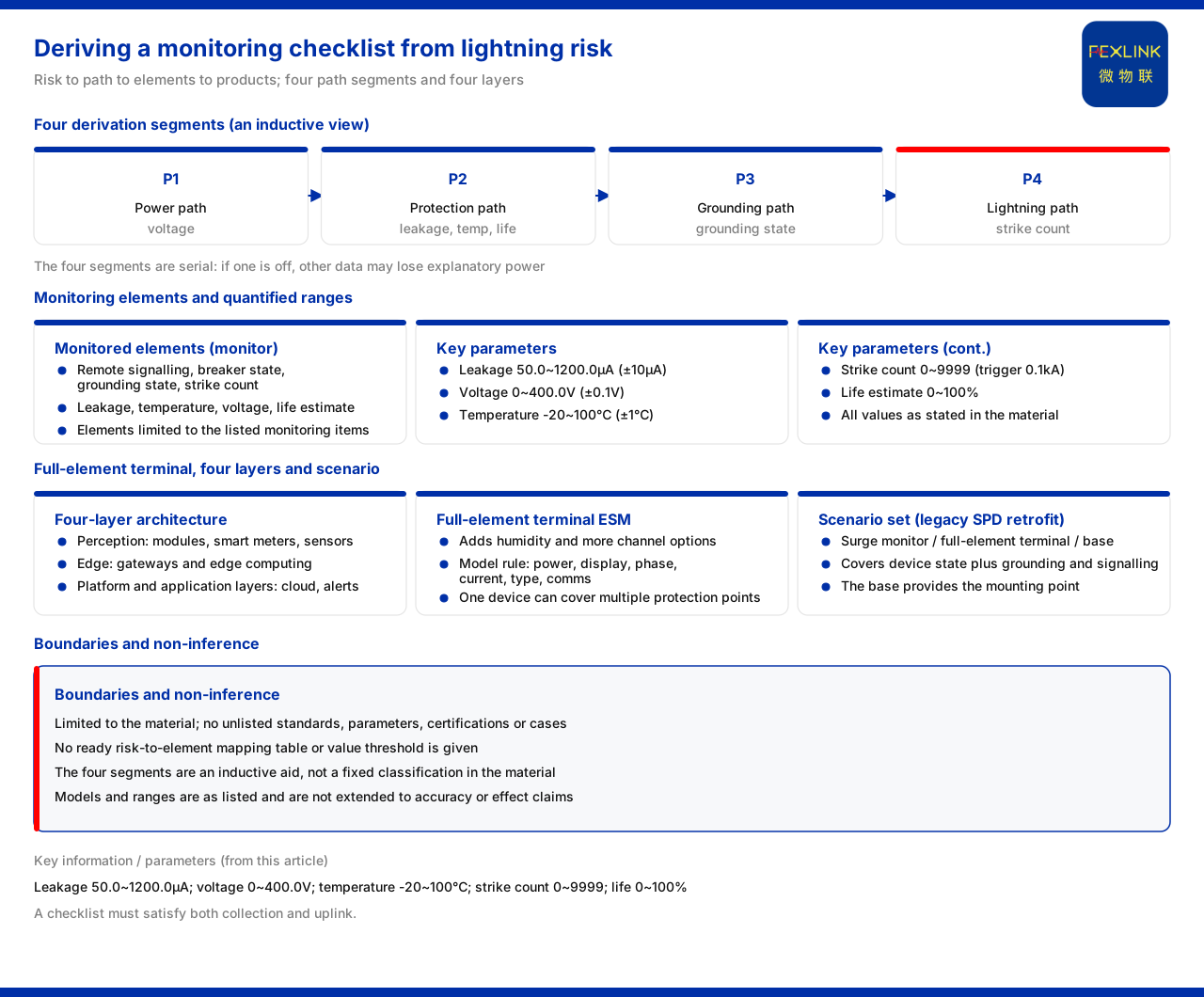
Direct Answer
Once lightning risk has been identified, the monitored parameters should not be listed from experience but derived segment by segment along the path by which the risk enters the system. The product knowledge base lists the intelligent lightning-protection line as seven categories covering monitoring, protection, grounding and gateways, and summarises the monitoring system as a four-layer architecture of sensing, edge, platform and application. The surge protective device monitor can provide leakage current, voltage, temperature, lightning strike count, grounding status and life estimate, which can be positioned along that path. First determine which paths the risk will take, then determine which quantities should be observed on each path; only then is the list reviewable.
1. First Separate Risk from Parameter
Risk answers "what may happen", while a parameter answers "what can be measured on site", and the two have no natural one-to-one correspondence. The product knowledge base groups the monitored parameters as voltage, leakage current, temperature, grounding status and lightning strike count, but it gives no ready-made mapping table from risk to parameter and no value thresholds for those parameters. This means the derivation must be done by the solution provider: site risk judgement determines the paths, while the parameters already listed by the knowledge base define the available range. Parameters or thresholds not listed must not be added by imagination. Once the boundary is clear, the list will not overreach, and each item can be explained during review as to "why this quantity is measured". Without this step, the list tends to degenerate into a copy of the product catalogue, responding to no specific risk and unable to serve as a reference during later acceptance.
2. Split the Entry Path into Four Segments
Lightning energy usually enters a system along the power line, the signal line, the grounding path and the lightning energy itself, so the derivation can be divided into four segments. The power path corresponds to voltage, used to observe whether overvoltage and operating voltage deviate. The protection path corresponds to the leakage current, temperature and life estimate of the surge protective device, used to judge the state of the protective component itself. The grounding path corresponds to grounding status, used to confirm whether the discharge channel is intact. The lightning energy path corresponds to the lightning strike count, used to record whether and how often an event occurs. The four segments are not parallel but serial: if any one is out of balance, the data of the others may lose their explanatory power, so the list should cover all four rather than only the segment that is easiest to collect.
3. Quantify Each Parameter to a Specific Device
After the paths are fixed, each parameter still has to be tied to a measurable quantitative basis. The product knowledge base records that the monitored parameters of the surge protective device monitor are remote signalling, breaker status, grounding status, lightning strike count, leakage current, temperature, voltage and life estimate; its key parameters are leakage current 50.0 to 1200.0μA (±10μA), voltage 0 to 400.0V (±0.1V), temperature -20 to 100°C (±1°C), lightning strike count 0 to 9999 counts (minimum trigger 0.1kA) and life estimate 0 to 100%. The value of this basis is that it turns qualitative statements such as "watch the leakage current and the temperature" into ranges and error limits that can be written into a scheme and checked against a table. If the list names only the parameters without ranges, later acceptance is difficult and it is hard to judge whether the data fall within a valid interval.
4. The All-Parameter Terminal Adds Humidity and More Channels
Beyond the basic parameters, an all-parameter monitoring terminal can be referenced when the site needs a more complete picture of protection status. The product knowledge base records that the intelligent lightning-protection monitoring terminal is the all-parameter version, whose monitoring items include switch quantity, grounding status, lightning strike count, leakage current, temperature, voltage, humidity and life estimate, with a model rule combining power supply, display, phase number, current parameter, board version and communication. Compared with the surge protective device monitor, it brings humidity into monitoring and supports more channel combinations, suitable for covering several protection points with one device. Whether to choose the all-parameter version depends on the number of protection points and the kinds of parameters to be observed, not on completeness for its own sake; where points are few and parameters are single, the basic version already satisfies the derivation result.
5. Use the Four-Layer Architecture to Confirm the Parameters Can Arrive
Whether the list can be implemented also depends on whether data can travel from the site to the application. The product knowledge base summarises the monitoring system as four layers: the sensing layer is made up of monitoring modules, smart meters and sensors; the edge layer aggregates through gateways and edge-computing devices; the platform layer is the IoT cloud platform; the application layer provides visualisation, alarm management, analysis reports and mobile inspection. Every item on the parameter list must find a landing point on this chain; otherwise, even if it can be measured on site, it cannot enter the operation-and-maintenance view. In other words, a derived parameter must satisfy two conditions at once: a corresponding monitoring device that can collect it, and a complete channel that can upload it. Collection without a channel, or a channel without collection, both leave the list incomplete.
6. Organise the Parameters into Judgeable Indicators
Raw collected quantities remain a pile of numbers unless they are organised. The product knowledge base records that the basic vital signs include voltage (dual-limit symmetric algorithm), current (overload factor), temperature (position-aware correction), leakage (time-series trend with safety pre-check) and grounding (TN, TT, IT identification); in the seven-dimensional perception matrix, trend drift is the core dimension and the time-series risk score is a composite decision value from 0 to 100. This shows that the parameter list should also state what each parameter is used to judge: voltage is used to judge limits, temperature to judge position-related risk, leakage to judge trend, and grounding to judge system type. Writing "what is measured" together with "what is judged" allows the list to support later graded alarms and disposal arrangements.
7. Turn the Derivation into a Scenario-Based Checklist
The end point of parameter derivation is an implementable list, and typical scenarios can provide a placement reference. In its typical application scenarios and selection comparison, the product knowledge base lists the recommended product combination for "SPD status monitoring (existing SPD retrofit)" as the surge protective device monitor, the all-parameter lightning-protection monitoring terminal and the SPD lightning-protection base. This combination shows that the list for a retrofit scenario should cover both the protective component state and auxiliary states such as grounding and remote signalling, with the base serving as the installation point. The solution provider can accordingly map the derived parameters to specific products one by one, then check back from the products whether any parameter has been omitted, forming a traceable chain of risk, path, parameter and product.
Scope of Application and Limitations
First, this article only explains the approach of deriving a monitoring-parameter list from lightning risk; the factual boundary is the product knowledge base, and no standard clauses, parameters, certifications or cases not listed there are introduced.
Second, the product knowledge base gives no ready-made mapping table from risk to parameter and no value thresholds for parameters; the four path segments in this article are a form of induction for derivation and are not a fixed classification originally listed in the source.
Third, the monitoring items, model rules and range bases of the surge protective device monitor and the all-parameter lightning-protection monitoring terminal are limited to the source entries; this article does not infer the specifications or functions of unlisted models.
Fourth, the descriptions of the four-layer architecture, the basic vital signs and the seven-dimensional perception matrix are cited from the source; this article does not extrapolate them into an accuracy or effect promise for any site.
Fifth, the parameter list and product configuration of a specific project must be verified against the site entry, the number of protection points and the grounding conditions; this article provides no selection or configuration calculation.