 微物联研究院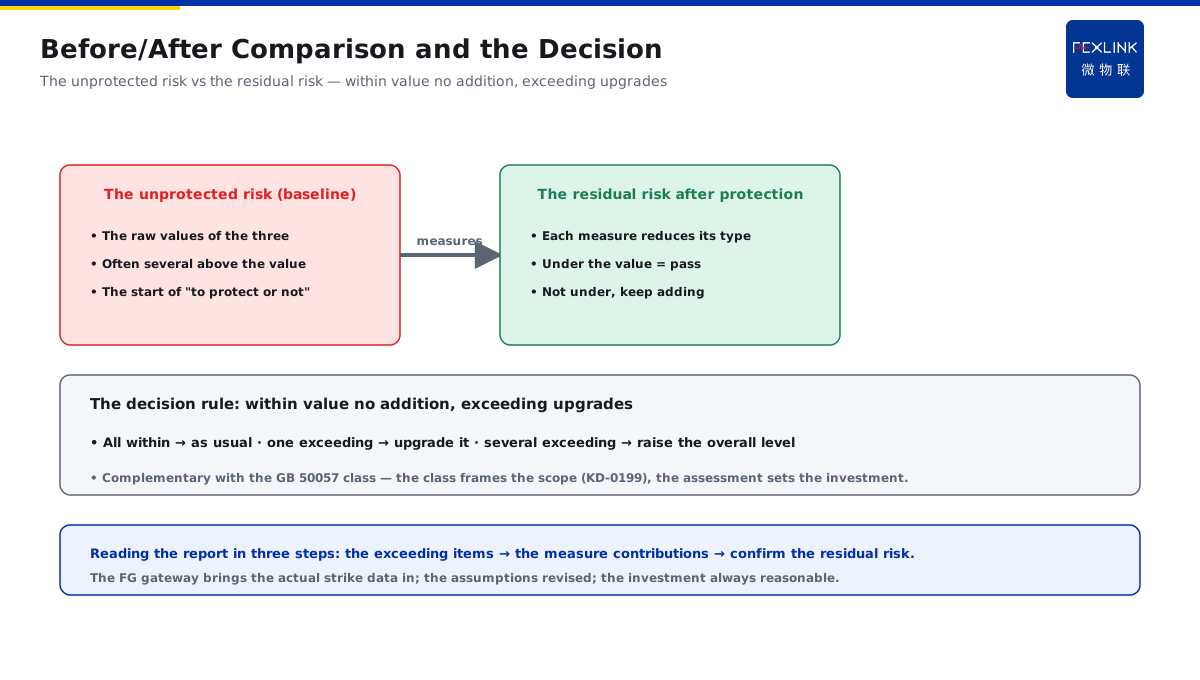
Direct Answer
Design institutes often say "do a lightning risk assessment per IEC 62305" — what does it actually assess and how is the conclusion used? The answer: the IEC 62305 / GB/T 21714 system estimates the various losses caused by lightning (human, physical, service failure) and the risk reduction achievable with measures, then compares "the risk without protection" with "the residual risk after protection", and thereby judges whether protection is needed and to what extent — it is the basis of "protection on demand", not the default full configuration for every building.
An office building was assessed per IEC 62305: the physical-loss risk was below the tolerable value, but the service-failure risk exceeded it — because of important servers inside. The conclusion: focus on the power/signal SPDs and bonding, with the air termination as usual. The key distinction: the risk assessment is not "a procedural formality" but "calculating the losses" — compare the risk without protection with the residual risk after protection, judge whether to protect and to what extent; it is the basis of protection on demand, not the default full configuration.
Why:
- The loss types: human, physical and service-failure losses calculated separately;
- The risk comparison: the unprotected risk vs the residual risk after protection;
- The measure reductions: air termination/bonding/SPD/monitoring each reduce the corresponding risks;
- The decision meaning: risk within tolerance adds nothing, exceeding upgrades.
Key insight: "The risk assessment is the basis of 'protection on demand' — calculate the human/physical/service-failure losses, compare the risks before and after protection; within tolerance no addition, exceeding upgrades; not the default full configuration."
A logistics park did the full-configuration lightning protection by default, with a high budget and some redundant measures; after re-assessment per IEC 62305, the risk was already within tolerance, so the redundancy was trimmed and the investment concentrated on the exceeding items. Lesson: full configuration is not reasonable — the assessment tells you where to invest and how much; protection on demand is optimal.
Overview: run "loss estimation → risk comparison → measure reduction → decision" as a quantifiable chain. The core of IEC 62305 / GB/T 21714 is not "what must be done" but "how big the risk is and how much it is worth investing". It calculates three losses — human (strikes injuring people), physical (equipment/building damage), service failure (business interruption); each type is compared with a tolerable risk value; then it estimates how much each protection measure can reduce the risk — within the tolerable value it passes, below it measures must be added. The assessment conclusion directly guides the protection level and investment. The five steps below expand: which loss types the assessment calculates, the annual expected strike count and loss probability, how the measures reduce each risk, the residual risk and economic comparison, and how the conclusion guides the protection-level choice.
The meaning of the tolerable risk value: the assessment is not "compute a number and done" but comparing the computed risk with the tolerable risk value (the acceptable risk level). The tolerable value represents "the acceptable probability ceiling of this loss per year" — the human-loss tolerable value is the lowest (life first, minimize even a little risk), the physical-loss middle, and the service-failure loss relatively looser (depends on the business value). The judging rule: a risk below the tolerable value passes, above it needs measures. This is also the quantitative source of "protection on demand": not all risks must be reduced, but the exceeding items get the money. The tolerable value = the acceptable probability ceiling — human the strictest, physical middle, service failure per the business; below passes, above adds measures; only the exceeding items get the money.
1. Which Loss Types the Assessment Calculates
Step one: first understand what "loss" means.
The three losses:
- Human: strikes directly injuring people/shocks;
- Physical: equipment/building/contents damage;
- Service failure: business interruption/data loss.
How each is calculated:
- Each estimated as probability × consequence;
- Each compared with the tolerable value;
- The exceeding items are the protection focus;
- Not one aggregated total.
The meaning of the losses:
- The loss type decides the protection direction;
- Human → air termination/evacuation;
- Physical → air termination/bonding/SPD;
- Service failure → SPD/redundancy/monitoring.
Key insight: "The losses are calculated in three types — human, physical and service failure each compared with the tolerable value; the exceeding items are the focus; the type decides the protection direction."
2. The Annual Expected Strike Count and Loss Probability
Step two: risk = probability × consequence.
The annual expected strike count:
- Related to the storm days and the equivalent area (relating to KD-0179);
- Direct and nearby strikes calculated separately;
- The count decides the exposure;
- The probability is the "input" of the risk.
The loss probability:
- The probability of a loss after a strike;
- Related to the protection level;
- Weak protection → high loss probability;
- Probability × consequence = risk.
The assessment inputs:
- The strike count (environment);
- The loss probability (protection level);
- The loss consequence (object value);
- The three multiply into the risk.
Key insight: "Risk = probability × consequence — the annual expected strikes are the input, the loss probability changes with the protection level; the three multiply into the risk, compared with the tolerable value to judge exceeding."
3. How the Protection Measures Reduce Each Risk
Step three: how the measures bring the risk down.
Air termination and down conductors:
- Reduce the direct-strike loss probability;
- Let the current follow the planned path;
- Both human and physical losses benefit;
- The first line.
Bonding and earthing:
- Reduce the human/physical losses from potential differences;
- Unify the reference potentials;
- The current has a place to discharge;
- The base measure.
SPDs and monitoring:
- Reduce the service-failure loss probability;
- Discharge the entering surges;
- FS/ESM for the states, degradation early;
- The equipment-level protection.
The measure-to-risk correspondence:
- Each measure reduces one or several risks;
- The assessment tells you which measure is worth the most;
- Do not invest the unnecessary;
- Make up the necessary.
Key insight: "Each measure reduces one or several risks — the air termination/down conductors manage human and physical, the bonding manages the differences, the SPDs/monitoring manage service failure; the assessment tells you which is worth the most."
4. The Residual Risk and Economic Comparison
Step four: how far to protect.
The residual risk:
- The risk after the measures;
- Within the tolerable value passes;
- Not within, keep adding measures;
- Meeting the value is the goal, not the full configuration.
The economic comparison:
- The measure cost vs the risk reduction;
- Full configuration not necessarily optimal;
- The minimum cost within the value;
- Protection on demand.
The comparison logic:
- The unprotected risk (baseline);
- The residual risk after protection (result);
- The difference = the reduction from the measures;
- Meeting the value at the minimum cost.
Key insight: "How far to protect — the residual risk within the tolerable value passes; full configuration not necessarily optimal; the minimum cost within the value; protection on demand."
5. How the Conclusion Guides the Protection-Level Choice
Step five: how the conclusion lands.
The three forms of the conclusion:
- All risks within tolerance → protection as usual;
- One item exceeding → upgrade that item;
- Several exceeding → raise the overall level.
The relation with the class:
- GB 50057 sets the class (relating to KD-0199);
- IEC 62305 sets the investment (this article);
- The class frames the scope, the assessment sets the details;
- The two complement.
The monitoring support:
- The FG Lightning-Protection Intelligent Gateway brings in the assessment data;
- The actual strike data feeds the assessment back;
- The conclusion revised dynamically;
- The investment always reasonable.
How to read the three results of the assessment: the report usually gives three conclusions. One, the "risk matrix" — the risk level (low/middle/high) of each of the three losses, with the exceeding items marked against the tolerable values. Two, the "measure contribution" — how much each existing/planned measure reduces which risk (the air termination reduces direct strikes, the bonding reduces differences, the SPDs reduce entering surges), which tells you where the money is worth the most. Three, the "residual risk" — how much risk remains after the measures, meeting or not. The reading order: find the exceeding items first, then see which measures can reduce them, finally confirm the residual risk meets. Reading the assessment in three steps: find the exceeding items first, then the measure contributions, finally confirm the residual risk — the money is worth the most on reducing the exceeding items.
Key insight: "The assessment conclusion has three forms — all within tolerance as usual, one exceeding upgraded, several exceeding raised; complementary with the GB 50057 class — the class frames the scope, the assessment sets the investment."
6. Product Implementation: From the Assessment to the Monitoring Loop
WeiWuLian products land the lightning risk assessment into the monitoring loop:
- FG Lightning-Protection Intelligent Gateway: the strike events/data into the assessment;
- Protection on demand: the assessment conclusion guides the SPD and monitoring configuration;
- Data feedback: the actual strike data revises the assessment assumptions;
- Closed-loop decisions: the investment always reasonable.
The design principle in one sentence: "The assessment tells you where to invest and how much — the three losses against the tolerable values, the residual risk within value passes; FG brings in the actual data to revise the assessment; protection on demand is optimal."
7. Common Understanding Misjudgments
- "The assessment is a procedural formality": not understanding the loss calculation. Result: the conclusion unused. Correct: look at the three losses and the tolerable values.
- "Full configuration is the safest": ignoring the economics. Result: redundant investment. Correct: the minimum cost within the value.
- "Assessed once only": ignoring the data feedback. Result: assumptions distorted. Correct: revise with the actual data.
- "The assessment detached from the class": ignoring the complement. Result: scope and investment detached. Correct: the class frames the scope, the assessment sets the investment.
- "Within tolerance, done": ignoring the dynamics. Result: the environment changes and the risk must be re-assessed. Correct: re-assess periodically.
Scope and Limitations
This article interprets the lightning risk assessment framework of IEC 62305 / GB/T 21714 (the loss types, probability × consequence, the measure reductions, the residual risk and economics, the conclusion guiding the protection level), applicable to understanding the assessment conclusions and protection decisions. The specific calculation methods follow the original texts of IEC 62305 / GB/T 21714; this article explains only the framework logic and the decision meaning. All cases are anonymized (an office building, a logistics park) and do not refer to any specific customer.