 FEXLINK Research Institute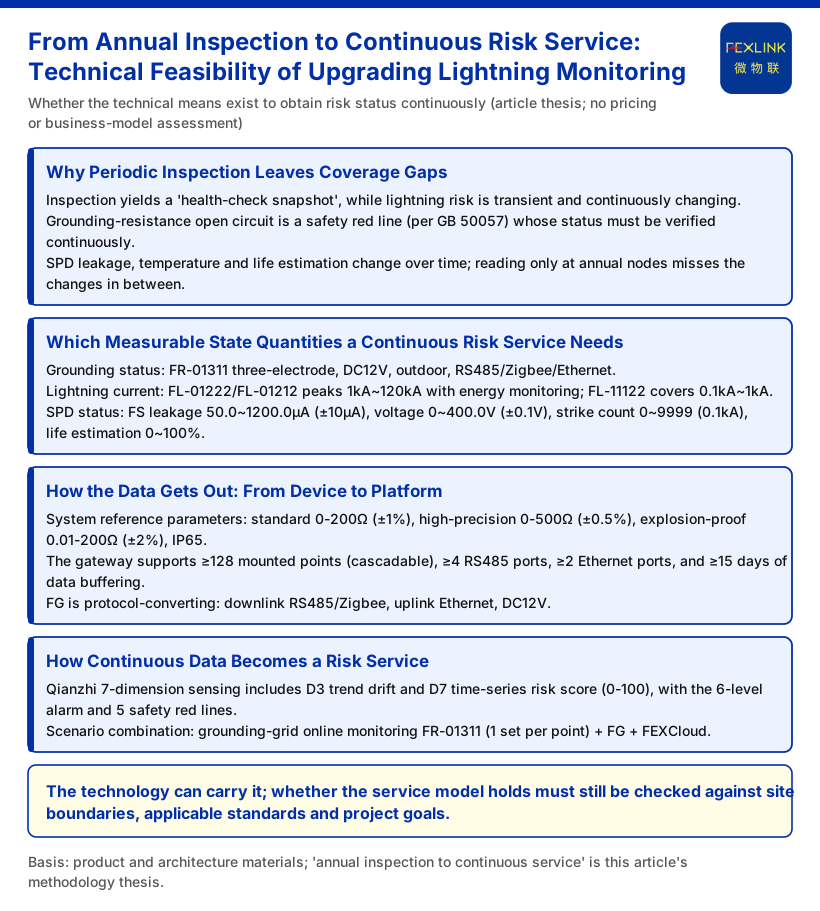
Lightning-protection inspection has long operated on an annual cycle. Discussion around it tends to stop at "should we inspect more often?", but the more useful question may be whether a one-off compliance action can become a continuous risk service. This article answers that question at two levels: methodology and technical feasibility. Every product and technical statement below links back to a corresponding knowledge-base entry. The article asks only whether the means exist to obtain risk status continuously; it does not assess service pricing, business models, or any unlisted effect.
Why Periodic Inspection Leaves Coverage Gaps
Periodic inspection yields a "health snapshot": at the moment of inspection, grounding, protective devices and circuits are recorded once. Lightning risk, however, is not static. A lightning strike is a transient event whose timing, amplitude and energy do not follow the inspection cycle. Protective devices and grounding connections also change gradually over long service and repeated surges. What happens between snapshots is the inherent blind spot of a periodic model.
Pushing this reasoning onto verifiable quantities gives the gap a concrete shape. The knowledge base lists "abnormal open circuit of grounding resistance" as a non-bypassable red line, grounded in GB 50057. If grounding is a red line, its state cannot be satisfied merely by "passing on inspection day"; it must be verified continuously. Likewise, SPD leakage current, temperature and lifetime estimation are time-varying quantities; reading them only at an annual checkpoint leaves the intermediate changes invisible. This judgment is methodological reasoning, and its basis — a red line must be held continuously, and status quantities vary with time — comes from the monitoring elements the knowledge base lists.
Which Measurable State Quantities a Continuous Risk Service Needs
Technical feasibility depends first on whether risk status can be sensed. The knowledge base breaks the objects requiring continuous observation for lightning protection and electrical safety into several monitorable quantities:
- Grounding status: The FR grounding-resistance monitor model rules define two measurement principles, the loop method and the three-point method; FR-01311 uses the three-electrode (three-point) method, DC12V supply, outdoor installation, with RS485 / Zigbee / Ethernet communications.
- Lightning and transient current: The FL lightning/transient current monitors FL-01222 (indoor) and FL-01212 (outdoor) cover a peak range of 1kA~120kA with energy monitoring, while FL-11122 (indoor) covers 0.1kA~1kA. This answers what the site actually experienced.
- SPD status: The FS surge protective device monitor covers remote signalling, air-switch status, grounding status, lightning-strike count, leakage current, temperature, voltage and lifetime estimation; the knowledge base key parameters are leakage current 50.0~1200.0μA (±10μA), voltage 0~400.0V (±0.1V), lightning-strike count 0~9999 (minimum trigger 0.1kA) and lifetime estimation 0~100%. The ESM intelligent lightning-protection monitoring terminal further covers humidity and other multiple elements.
These quantities map to three questions: is the discharge path intact, what surge did it recently absorb, and is protective capability degrading. Only by observing all three on one shared time axis can monitoring move from "qualified on some day" to "continuously judgeable".
How the Data Gets Out: From Device to Platform
A continuous risk service requires not only sensing but also transmission and visibility. At system level, the grounding-resistance monitoring reference parameters in the knowledge base include: standard monitoring unit 0-200Ω (±1%), high-precision 0-500Ω (±0.5%), explosion-proof 0.01-200Ω (Ex d IIB T4/T6 Gb, ±2%), ingress protection IP65; the intelligent gateway supports ≥128 points (cascadable), ≥4 RS485 channels, ≥2 Ethernet channels, optional 4G/5G/LoRa, and ≥15 days of data buffering. These parameters show that continuous monitoring includes an engineering provision for connection capacity and store-and-forward across interruptions.
Uplink and downlink roles are handled by the FG lightning-protection intelligent gateway. The knowledge base describes FG as a protocol-conversion type with RS485 and Zigbee downlink, Ethernet uplink, DC12V supply, in models FG-0221-ER and FG-0221-EZ. The fuller protocol arrangement is: device downlink covers Modbus RTU (RS485), Zigbee (Modbus) and LoRa; device uplink covers Modbus TCP / MQTT (Ethernet, 4G); gateway level optionally supports IEC 61850. Above that, per the four-layer architecture, the perception and edge layers handle "sense and transmit", the platform layer FEXCloud handles device onboarding, time-series database and AI inference, and the application layer provides visualisation, alarms, reports and mobile inspection.
How Continuous Data Becomes a Risk Service
Devices and links are only the foundation. Turning "continuous" into a "service" requires converting continuous data into a judgeable state. The knowledge base describes the Qianzhi engine's 7-dimension perception matrix, which includes D3 trend drift (core) and D7 time-series risk scoring (0-100 composite decision), together with a 6-level alarm system and 5 non-bypassable red lines; the red-line mechanism corresponds directly to abnormal open circuit of grounding resistance. The combination of a trend dimension and a red-line mechanism answers exactly the two blind spots of periodic inspection: the trend dimension watches slow change, while the red-line mechanism holds the floor that must not be crossed.
At scenario level, the knowledge base already provides directly comparable combinations: for online monitoring of substation / traction-substation grounding grids, FR-01311 (one set per point) + FG gateway + FEXCloud; for tank-farm / petrochemical lightning and explosion protection, explosion-proof grounding-resistance monitoring (Ex d IIB) + FL lightning-current monitoring + FS surge-arrester monitoring. This shows that "continuous risk service" is not invented from scratch but is a service-oriented expression that organises existing monitoring units, gateways and platforms by scenario. Note that the knowledge base internally records that FR/FRP series have been applied to railway traction-substation grounding-grid online monitoring and the Jinzhou Port tank farm (10 sets per tank); this is an internal application reference, and is cited here only as a source note, not as performance evidence.
What This Article Does Not Claim
The knowledge base does not assert that periodic inspection should or will be replaced by continuous service; this article only tests its technical feasibility.
Second, this article does not claim that continuous monitoring can replace statutory or contractual periodic inspection, nor does it judge the economics, business model or contractual arrangement of any service model.
Third, this article provides no unlisted parameters, certifications, cases or effects. The ranges, models, protocols and architecture appearing here are limited to those explicitly listed in the corresponding knowledge base entries, with no extrapolation of scope, certification or effect; the project application record is cited only as a source note.
Fourth, this article does not claim that continuous monitoring can eliminate lightning risk or guarantee any specific operating outcome. It answers only whether risk status can be obtained continuously and whether the link has the capacity to carry it.
Conclusion
Upgrading lightning inspection from "annual" to "continuous risk service" requires answering the inspection blind-spot question at the methodological level and the three questions of state quantities, transmission links and platform conversion at the technical level. The knowledge base's answer is: grounding is measurable via FR, lightning current via FL, and SPD status via FS / ESM; the FG gateway and the protocol matrix carry the data out; the four-layer architecture and FEXCloud receive it; and the scenarios plus the red line and 7-dimension trend turn the data into risk judgments. These capabilities support "technically capable of carrying it", but whether the service model itself holds still requires item-by-item review against site boundaries, applicable standards and project objectives — which is why this article separates methodology from fact.