 FEXLINK Research Institute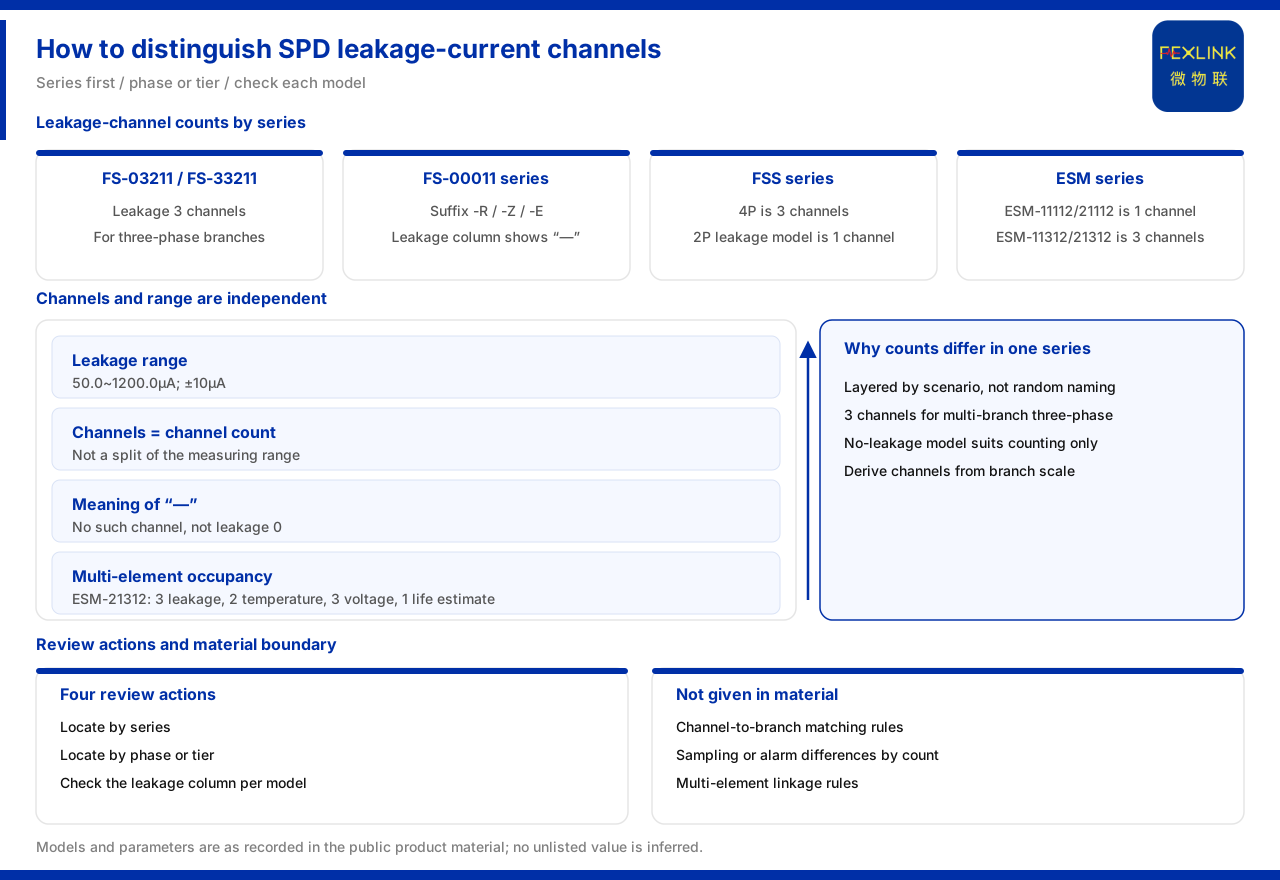
How should the number of leakage-current paths on surge protective device monitoring be distinguished?
Direct answer: the number of leakage-current paths determines how many protection channels a single monitoring device can watch at the same time. According to the available product material, within the FS surge protective device monitors, FS-03211 and FS-33211 have 3 leakage paths, while the FS-00011 family (including the -R, -Z and -E suffixes) does not include leakage-current monitoring and its leakage column is marked "—". The FSS intelligent surge protective devices vary with the number of phases: the 4P type has 3 paths, and the 2P type with leakage has 1 path. Among the ESM intelligent lightning-protection monitoring terminals, ESM-11112 and ESM-21112 have 1 path, while ESM-11312 and ESM-21312 have 3 paths. The judgement rule is uniform: look at the product series first, then the phase count or model tier, and finally whether a leakage-path count is marked.
What the number of leakage-current paths actually counts
The object of leakage-current monitoring is the small leakage current of a protective device under continuous operating voltage. One leakage channel corresponds to one group of monitored protective branches. The more paths, the more phase lines or branches can be covered at the same time; with 1 path, only one channel is covered. It is not a division of the range into segments; it is a difference in the number of channels.
This directly affects selection. For a single-phase or single-branch scenario, 1 path is enough; for a three-phase scenario or one where several branches must be observed separately, 3 paths are more meaningful. The material gives the leakage measurement range as 50.0 to 1200.0 μA with an accuracy of ±10 μA; that range applies to channels that have leakage monitoring, and it is an independent dimension from the channel count and must not be confused with it.
The 3-path and no-leakage types in the FS series
Not every model inside the FS surge protective device monitors carries leakage current. The material states explicitly that FS-03211 and FS-33211 have 3 leakage paths, while the FS-00011 family, including the three suffixes -R, -Z and -E, has "—" in the leakage column, meaning leakage-current monitoring is not included. This means that within one product series, different models can have completely different capability boundaries.
A common engineering misreading is to assume that because a model belongs to the same series it necessarily has the leakage function. In practice, the leakage column should be checked model by model. If a project needs to observe the leakage-current trend, a model marked with a leakage-path count must be chosen; if only functions such as lightning-strike counting are needed, the leakage channel need not be forced.
FSS series: the phase count decides 1 path or 3 paths
The leakage-path count of the FSS intelligent surge protective devices is related to the number of phases. The material states that the 4P type has 3 leakage paths and the 2P type with leakage has 1 path. The model group with leakage runs from FSS-11100 and FSS-21100 to FSS-14100 and FSS-24100, corresponding to 1 path and 3 paths respectively. This correspondence shows that the path count is not configured arbitrarily but is tied to the phase structure.
When reading an FSS model, therefore, the first step is to look at the phase count — 2P or 4P — and the second is to check whether it belongs to the leakage type. If the pairings of 4P with 3 paths and 2P with 1 path are remembered, it is hard to misconfigure the channel count during selection. Note that the material gives the correspondence for the "with leakage" type only; it does not mean that every model in the whole series carries leakage, so confirmation by model group is still required.
ESM series: 1 path and 3 paths on the same terminal
The ESM intelligent lightning-protection monitoring terminals offer different leakage-path tiers at the same time. The material lists ESM-11112 and ESM-21112 with 1 leakage path, and ESM-11312 and ESM-21312 with 3 leakage paths. The appearance of both 1-path and 3-path configurations in the same series shows that selection cannot rely on the series name alone; it must be pinned down to a specific tier.
It should be noted that the ESM terminal is positioned as "all-parameter" monitoring and can carry temperature, voltage and life prediction in addition to leakage. The material records that ESM-21312, beyond 3 leakage paths, also provides 2 temperature paths, 3 voltage paths and 1 life-prediction item. For scenarios that want to merge several kinds of monitoring into one terminal, this multi-parameter configuration is a useful reference; but note that the more parameters there are, the more the channel allocation and on-site wiring of a single unit need to be planned in advance.
Why the same series offers different path counts
Different leakage-path counts within the same series are not naming confusion but the result of layering products by scenario. In the FS surge protective device monitors, for example, the 3-path type addresses three-phase situations that need to observe several branches separately, while the no-leakage type addresses scenarios that need only functions such as counting. In the FSS intelligent surge protective devices, the path count follows the phase count directly: 4P needs to cover more phase lines and therefore gets 3 paths, while 2P covers only two phase lines and 1 path is enough. The ESM intelligent lightning-protection monitoring terminals offer both 1 path and 3 paths so that the same terminal can fit systems of different scale.
The path count corresponds to the scale of the monitored branches, not simply to a product grade.
Common misreadings during site verification
First, treating the series as a capability standard. FS, FSS and ESM are only series names; the path counts and functions inside a series differ greatly, and leakage capability cannot be inferred from the series.
Second, reading "—" as "0". For a model without leakage-current monitoring, the leakage column is marked "—", meaning "no such channel", not "leakage is always zero". The two readings lead to completely different selection conclusions.
Third, treating the leakage-path count as a range tier. The path count is the number of channels; the range is the measurement range of each path. The 50.0 to 1200.0 μA given in the material applies to channels that have leakage, regardless of path count.
Fourth, ignoring the occupancy of multiple parameters. A multi-parameter terminal such as ESM-21312 must carry temperature, voltage and life prediction beyond 3 leakage paths, so wiring and channel planning cannot consider leakage alone.
Four actions for selection and verification
First, position by series. Confirm whether the candidate model belongs to FS, FSS or ESM, because the leakage logic of the three differs.
Second, position by phase count or tier. For FSS, look at 2P and 4P; for ESM and FS, look at the specific model segment; rules must not be carried across series.
Third, check the leakage column model by model. In particular, the "—" of the FS-00011 family must be recognised as "no leakage", not "leakage equals zero".
Fourth, confirm whether multi-parameter merging is needed, so that temperature, voltage or life prediction in addition to leakage can be assessed.
Items the material does not provide
First, the material does not give a matching rule between the leakage-path count and the number of field branches, that is, how many monitored branches a given number of leakage paths corresponds to; this must be designed separately according to the protection structure.
Second, the material does not give the sampling or alarm differences between different path counts, and does not state whether a different path count brings a different refresh or threshold strategy.
Third, the material does not give the linkage rules between leakage and the other parameters on a multi-parameter terminal; the related configuration needs separate review.
Summary
The judgement of leakage-path count can be summed up in one sentence: fix the series first, then look at the phase count or tier, and finally check model by model. Within the FS surge protective device monitors, FS-03211 and FS-33211 have 3 paths and the FS-00011 family has no leakage; within the FSS intelligent surge protective devices, 4P has 3 paths and the 2P leakage type has 1 path; within the ESM intelligent lightning-protection monitoring terminals, ESM-11112 and ESM-21112 have 1 path, while ESM-11312 and ESM-21312 have 3 paths. The leakage measurement range is uniformly 50.0 to 1200.0 μA with an accuracy of ±10 μA.
Keeping "path count" and "whether leakage exists" separate is the key to avoiding selection errors: a model without leakage does not gain leakage capability merely because its range description is similar, and models with different path counts should be ordered separately according to channel requirements.