 微物联研究院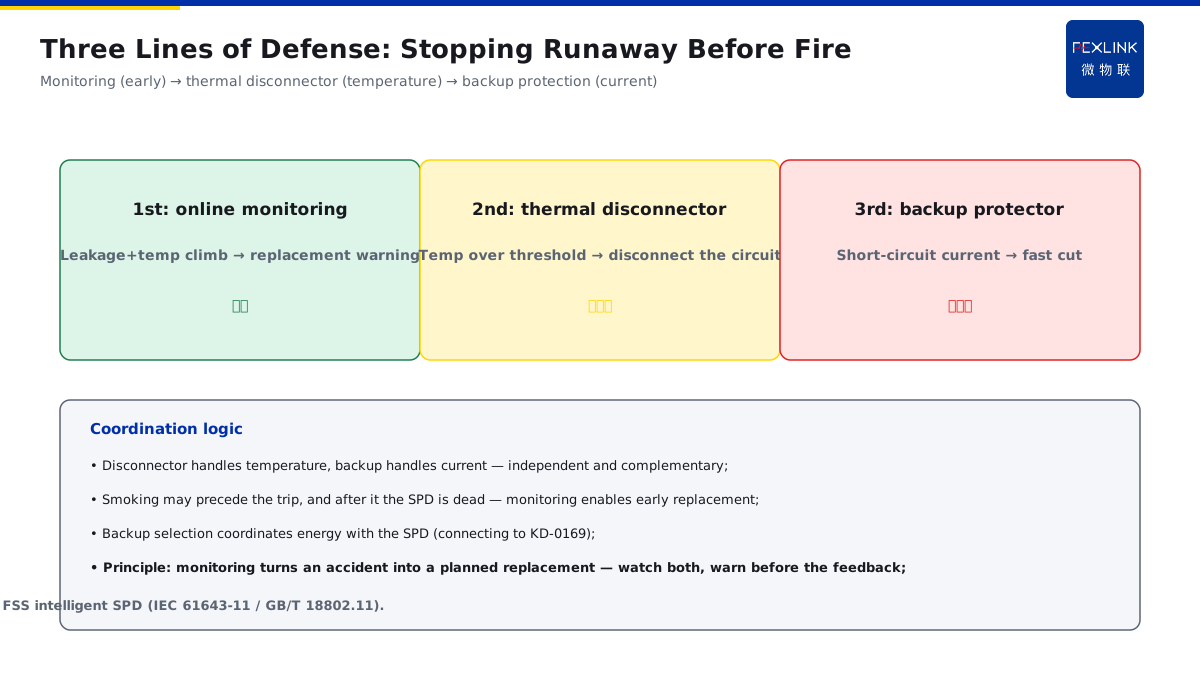
Direct Answer
Why does an SPD suddenly catch fire or even explode? What observable stages does it go through before failure? The answer: MOV ageing increases the leakage current → the leakage heats the MOV body → the higher temperature further lowers the resistance and the leakage rises again → a positive feedback loop forms (thermal runaway); without a thermal disconnector and backup protection cutting in in time, it can end in fire or explosion. Online monitoring seeing the leakage and temperature climb together is exactly the observable early signal of thermal runaway — it is not "without warning".
At a distribution room, an SPD smoked and caught fire late at night, and operations had received no alarm. Review: the SPD's leakage had been climbing for months and its temperature rising in step, but with no online monitoring nobody noticed; the thermal disconnector did not act (or the backup protection did not open after it acted), and the positive feedback developed into thermal runaway. The key distinction: SPD fire is not "instantaneous" — it is a positive feedback loop of "leakage → heat → more leakage" amplifying stage by stage; leakage and temperature climbing together is the early signal of thermal runaway, and monitoring exists to warn before the feedback forms.
Why:
- The starting point: after ageing the MOV leakage rises (the resistive component increases);
- Positive feedback: the leakage heats the MOV body → temperature rises → resistance falls → leakage rises again;
- The safety baseline: the thermal disconnector cuts the circuit and avoids thermal runaway;
- The value of monitoring: leakage and temperature rising together is the fire precursor — it can warn before the feedback forms.
Key insight: "Thermal runaway is a 'leakage-heat-leakage' positive feedback loop — measuring the leakage and temperature climbing together is the step taken before the fire."
At a park, an SPD aged under long-term overvoltage stress: the leakage rose from tens of μA to hundreds, and the case temperature was 15 °C higher than the other SPDs in the same cabinet. Platform monitoring flagged it and replacement was arranged; when removed, it was already near the thermal-disconnector trip value. Lesson: thermal runaway has a long precursor window — leakage and temperature rising together is the moment to replace before the fire.
1. The Starting Point: Rising Leakage after MOV Ageing
Step one: where thermal runaway begins.
The starting point of ageing:
- The MOV endures long-term voltage stress;
- Grain boundaries degrade, forming leakage paths;
- The resistive leakage begins to rise (connecting to KD-0175);
- The rising leakage is the "fuel" of thermal runaway.
The consequence of rising leakage:
- The leakage produces Joule heat in the MOV body;
- Power = voltage × leakage;
- More leakage → more heat;
- The heat is the "engine" of the positive feedback.
Why it is invisible at first:
- The early rise is slow;
- It is confused with temperature/voltage drift;
- Without monitoring the early window is missed;
- Once inside the feedback, the pace accelerates.
Key insight: "Everything starts with the rising leakage — the resistive leakage is the fuel, Joule heat is the engine, and the positive feedback starts from there."
2. The Positive Feedback Loop: Heat–Leakage–Heat
Step two: why it burns faster and faster.
The feedback chain:
- Rising leakage → heat in the MOV body;
- Rising temperature → the semiconductor resistance falls;
- Falling resistance → the leakage rises further;
- More leakage → more heat… the loop amplifies.
Why it is dangerous:
- The feedback has no self-limit (no external shunt);
- The temperature rises exponentially;
- The material decomposes and smokes;
- Finally fire or explosion.
The observable window:
- Leakage and temperature climb together;
- The case temperature rises abnormally;
- The leakage-curve slope increases;
- These signals are clear in the late stage of the feedback.
Key insight: "Heat lowers the resistance and the lower resistance raises the current — once the feedback is established it amplifies exponentially and thermal runaway is a matter of time; monitoring leakage and temperature together is the only way to catch the window."
3. Why the Thermal Disconnector Is the Safety Baseline
Step three: the built-in safety gate.
The thermal-disconnector structure:
- A thermal fuse/disconnector inside the SPD;
- It monitors the MOV temperature;
- When the temperature crosses the threshold → mechanical disconnection;
- The MOV is removed from the circuit.
Why it is the baseline:
- When the feedback has no self-limit, the disconnector forcibly terminates it;
- Disconnecting cuts the current → the heating stops;
- It prevents development into fire;
- It is the SPD's last safety gate.
The disconnector's limits:
- It needs the temperature to reach the trip value;
- Smoking may occur before it acts;
- After disconnection the SPD is no longer protective (needs replacement);
- The disconnector itself does not handle external short-circuit current (needs backup protection).
Key insight: "The thermal disconnector is the safety baseline that forcibly terminates the feedback — but there are signals before it acts, and after it acts the backup protection must cover the rest."
4. The Role of the Backup Protector in Thermal Runaway
Step four: the layer behind the thermal disconnector.
Why backup protection is necessary:
- Short-circuit current (power-frequency follow current) may exceed the disconnector's capability;
- In a fault the current bypasses the MOV through the fault point;
- The thermal disconnector cannot cut a large short-circuit current;
- A backup protector (fuse/circuit breaker) is needed.
What the backup protector does:
- Cuts quickly on a short-circuit fault;
- Forms double protection with the thermal disconnector;
- Protects the circuit and personal safety;
- It is the standard configuration of an SPD installation.
The coordination logic:
- Thermal disconnector: handles MOV thermal runaway (temperature type);
- Backup protector: handles short-circuit current (current type);
- The two are independent and complementary;
- Selection must coordinate energy with the SPD (connecting to KD-0169).
Key insight: "The thermal disconnector handles temperature, the backup protector handles current — two independent complementary layers; only then is an SPD failure truly contained."
5. How Monitoring Warnings Before the Positive Feedback Forms
Step five: turning "sudden fire" into "planned replacement".
What to monitor:
- Leakage (total + resistive component);
- Case temperature / temperature-rise trend;
- Events (surge counts, overvoltage);
- Multi-parameter comprehensive judgment.
The warning logic:
- Sustained leakage climb → ageing warning;
- Temperature and leakage rising together → thermal-runaway precursor;
- An accelerating slope → the feedback has started;
- Trigger replacement/inspection instructions.
Engineering effect:
- Replace before the feedback forms;
- Avoid fire/explosion;
- Fewer unplanned outages;
- Monitoring moves from "after-the-fire fighting" to "before-the-fire warning".
Key insight: "The point of monitoring is not to see the fire but to act when leakage and temperature climb together — blocking thermal runaway before the feedback is established."
6. Product Implementation: Intelligent Lightning-Protection Online Monitoring
WeiWuLian products manage the thermal-runaway precursor:
- FS/ESM SPD Monitor: synchronously monitors leakage (including resistive separation) and temperature;
- FSS Intelligent SPD: built-in thermal disconnector + state self-diagnosis;
- Platform warning: leakage-temperature simultaneous climb triggers a replacement warning;
- Event correlation: correlate surge counts, overvoltage and ageing.
The design principle in one sentence: "Watch leakage and temperature together, warn before the feedback — thermal runaway turns from an 'accident' into a 'planned replacement'."
7. Common Misjudgments
- "SPD fire is sudden": ignoring the precursor window. Result: the replacement moment is missed. Correct: monitor leakage and temperature.
- "A thermal disconnector makes it safe": smoking can occur before it acts. Result: fire still possible. Correct: monitoring warns early.
- "The thermal disconnector can cut short-circuit current": it handles temperature, not large currents. Result: short-circuit burns. Correct: add backup protection.
- "Normal leakage means all is well": ignoring the synchronous temperature. Result: the feedback has started unnoticed. Correct: watch both parameters together.
- "Install it and forget it": no monitoring. Result: fire without warning. Correct: online monitoring + trend warnings.
Scope and Limitations
This article explains the positive-feedback mechanism from rising leakage to thermal-runaway fire for MOV-type SPDs, the safety-baseline roles of the thermal disconnector and backup protection, and the warning value of synchronous leakage-temperature monitoring, applicable to SPD failure prevention and online monitoring. The thermal-runaway time scale, trip values and backup-protection selection depend on the SPD model, system short-circuit level and manufacturer data; follow IEC 61643-11 and GB/T 18802.11, configured professionally. All cases are anonymized (a distribution room, a park) and do not refer to any specific customer.