 FEXLINK Research Institute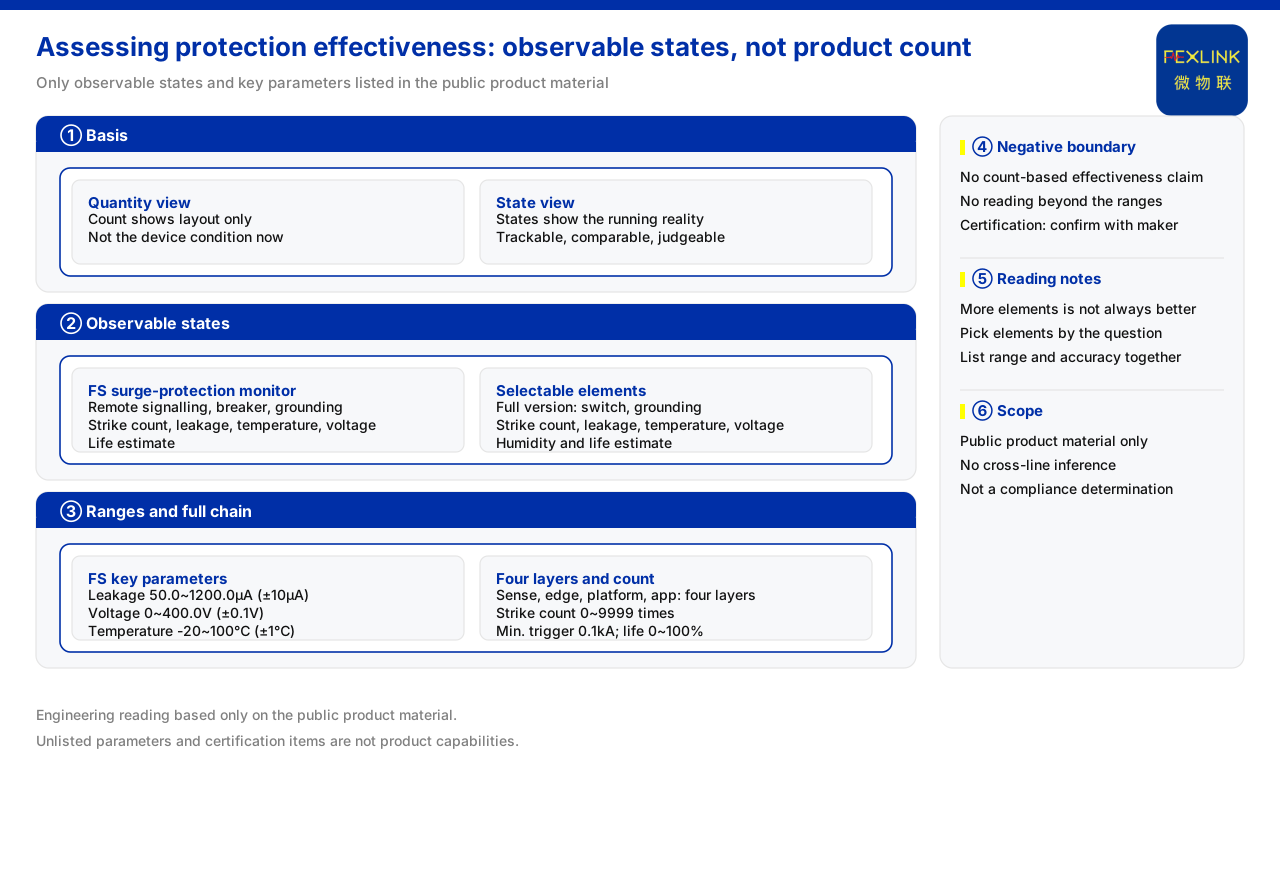
Direct answer
To judge whether a lightning-protection scheme is effective, one should not count how many surge protective devices were installed but ask which observable lightning-protection state quantities the scheme can read. The product knowledge base records that the surge protective device monitor (such as FS-00011-R) can acquire state quantities including remote signalling, air-switch state, grounding state, lightning-strike count, leakage current, temperature, voltage and life prediction. Product count describes deployment density; state quantities describe operating reality: whether a device is online, whether it has degraded and whether it has operated all have to be answered by these quantities. Switching the assessment basis from how many were installed to what can be read now is the starting point for judging scheme effectiveness.
1. Why product count does not equal effectiveness
The number of installed surge protective devices reflects only the deployment scope, not the present state of the devices. A device that has degraded, tripped or lost grounding still counts as one in a quantity tally, yet its contribution to protection may already have changed. The product knowledge base places the assessment basis on observable state quantities precisely to replace the quantity term with a state term.
The value of state quantities is that they are trackable. Remote signalling and air-switch state reflect circuit continuity, grounding state reflects whether grounding is reliable, leakage current reflects the device degradation trend, temperature reflects the operating thermal state, lightning-strike count reflects whether an impact has been endured, and life prediction gives a replacement reference. Aligning the same set of state quantities on a time axis makes readings at different times comparable and gives the assessment a consistent scale.
If only quantity is looked at, schemes cannot be compared for merit; if state quantities are looked at, substantive questions such as whether the scheme can find an abnormality and can support a replacement decision can be answered. The record of the product knowledge base unfolds along exactly this line.
The difference between the two terms can also be put this way: quantity is static and can be counted at scheme delivery; state quantity is dynamic and shows itself only after entering the operating period and acquiring continuously. Using quantity to evaluate a scheme evaluates the configuration at the moment of delivery; using state quantities evaluates the observability during operation. The two answer different questions and cannot substitute for each other.
2. Which observable state quantities are included
The product knowledge base records that the state quantities the surge protective device monitor can acquire include remote signalling, air-switch state, grounding state, lightning-strike count, leakage current, temperature, voltage and life prediction. If the monitored object needs a fuller set of elements, the model table of the intelligent lightning-protection monitoring terminal (SPD monitor) covers digital quantities, grounding state, lightning-strike count, leakage current, temperature, voltage, humidity and life prediction, and can be chosen by the number of elements to be observed.
These two product classes show the same thing: observable elements are an optional combination, not a fixed one or two readings. In assessment one should first determine which questions to answer and then decide which state quantities are needed, rather than fixing a count and working back to functions. For example, to judge whether a device has degraded, the combination of leakage current and temperature is more meaningful; to judge whether it has endured an impact, the combination of lightning-strike count and grounding state is more meaningful.
Note that more elements are not necessarily better. Being selectable as needed means choosing elements around the questions to be answered, not stacking every element; otherwise the data is greater but the judgment may not be clearer. The value of state quantities lies in corresponding to a judgment, not in quantity itself. This agrees with the article's theme: whether looking at products or elements, one should return to the question of what is to be answered.
3. The readability boundary of state quantities: range and accuracy
For state quantities to serve as a basis, readings must fall within a comparable interval. The key parameters the product knowledge base gives for the surge protective device monitor are: leakage current 50.0 to 1200.0 μA with an accuracy of plus or minus 10 μA; voltage 0 to 400.0 V with an accuracy of plus or minus 0.1 V; temperature -20 to 100 ℃ with an accuracy of plus or minus 1 ℃; lightning-strike count 0 to 9999 counts with a minimum trigger of 0.1 kA; and life prediction 0 to 100%.
These boundaries decide what a state quantity can and cannot answer. Events outside the range cannot be read, and differences within the accuracy cannot be distinguished. Listing range and accuracy together when assessing a scheme shows whether the present readings suffice to support a judgment; otherwise an apparently complete state quantity may lack resolution in a key interval.
4. Full chain: from perception to platform
The product knowledge base summarises the monitoring system into a four-layer architecture of perception, edge, platform and application, and notes that assessing the effectiveness of a lightning-protection scheme should cover the full chain from field perception to platform analysis. The division is: the perception layer contains monitoring modules of various kinds, Rogowski coils, NTCs and microamp-level leakage-current sensors; the edge layer contains gateway devices such as the lightning-protection smart gateway and related edge components; the platform layer is the IoT cloud platform; and the application layer is the visualisation and alarm management of Web and App.
The meaning of the full chain is that a state quantity enters assessment only when it is correctly acquired at the end, correctly gathered at the edge and correctly presented on the platform. If any layer is absent, the assessment lacks a usable data base. Checking layer by layer when assessing a scheme shows how far a state quantity can actually go.
It should be stressed that the four-layer architecture describes a data path, not a parallel product list. The perception layer settles whether it can be read, the edge layer whether it can be gathered and buffered, the platform layer whether it can be accessed and stored, and the application layer whether it can be presented and alarmed. Checking in path order when judging a scheme is closer to effectiveness itself than counting by product category.
5. State-quantity combinations in typical scenarios
The product knowledge base lists lightning-protection device state monitoring (retrofit of existing SPDs) as a typical application scenario, recommending a combination of the surge protective device monitor, the intelligent lightning-protection monitoring terminal and the SPD lightning-protection base. The landing point of this combination is to add state-observation capability around existing surge protective devices rather than to add more devices, exactly matching the state term described above.
Another scenario is online monitoring of substation and traction-substation earth grids, recommended as the grounding resistance monitor (FR-01311, one set per point), the lightning-protection smart gateway and the IoT cloud platform. Earth-grid monitoring brings grounding state into the assessment, showing that effectiveness assessment does not stop at the SPD itself but includes the grounding condition it depends on.
6. Putting the assessment onto checkable indicators
Taken together, assessing a lightning-protection scheme can unfold in a sequence: first determine the questions to answer, then choose the observable state quantities accordingly, then check whether range and accuracy cover the judgment interval, then confirm whether the four-layer chain is complete, and finally map the state quantities onto the combination of a specific scenario. That the product knowledge base uses state quantities rather than quantity as its assessment basis suggests that assessment should land item by item on checkable indicators rather than stopping at a quantity list.
Scope and limitations
First, this article only explains the idea of assessing scheme effectiveness by lightning-protection state quantities; its factual boundary is limited to the product knowledge base, and it introduces no standard clause, parameter, certification or case not listed there.
Second, the leakage-current, voltage, temperature, lightning-strike-count and life-prediction parameters of the surge protective device monitor in the text, and the element combination, four-layer architecture composition and recommended scenario combinations of the intelligent lightning-protection monitoring terminal, are all content listed in the product knowledge base; this article does not extend them to other models.
Third, this article does not equate the observability of state quantities with a quantitative conclusion about protection effect, nor derive a protection level from product count; the description of the four-layer architecture and scenario combinations is limited to the terms summarised in the product knowledge base.