 FEXLINK Research Institute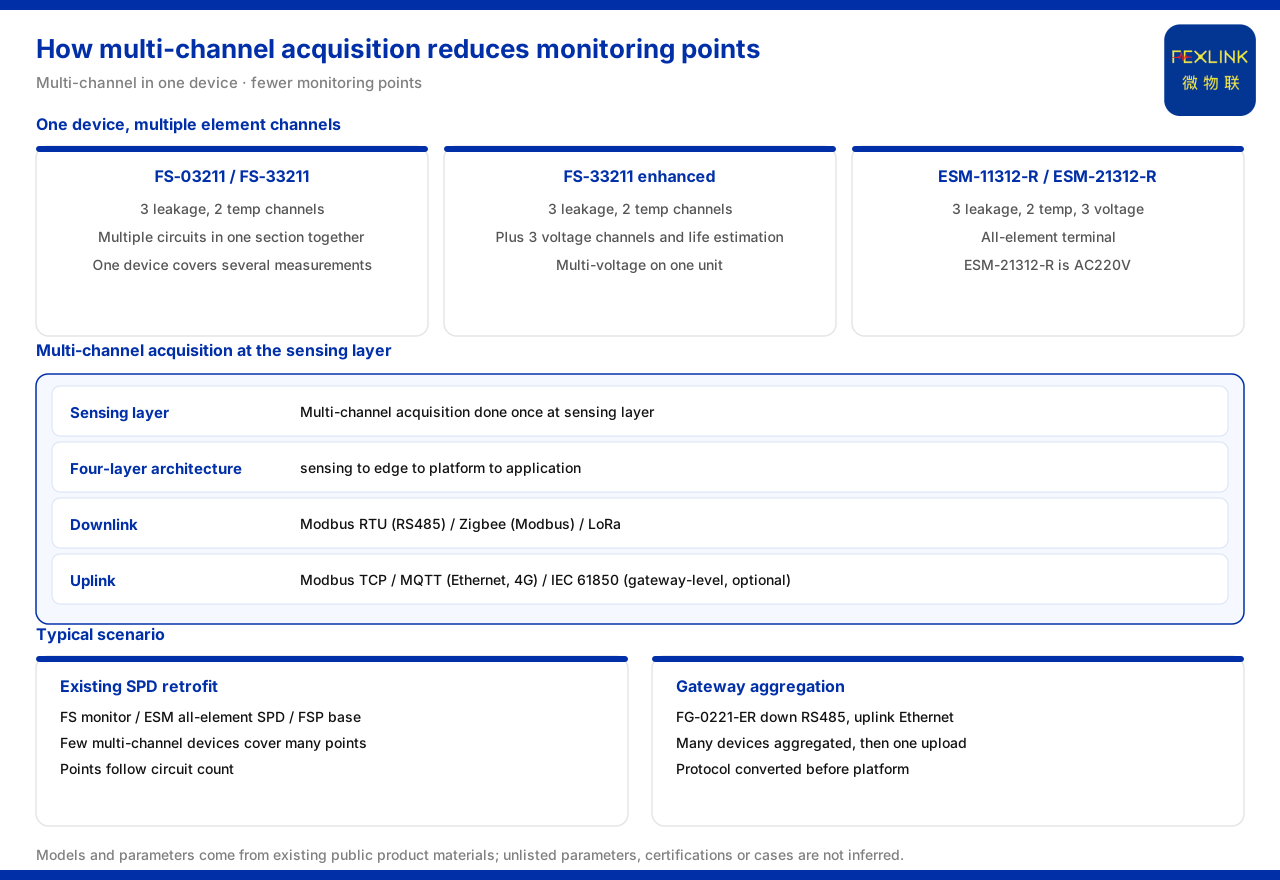
Direct answer
A single device can reduce the number of monitoring points because multi-channel acquisition is completed once at the sensing layer. The product knowledge base records that the FS surge protective device monitor (FS-03211) and the FS surge protective device monitor (FS-33211) both provide 3 leakage-current channels and 2 temperature channels, so one device can cover the leakage-current and temperature elements of several circuits in the same distribution section; the FS surge protective device monitor (FS-33211) adds 3 voltage channels and lifetime estimation. For a full-element terminal, the ESM intelligent lightning-protection monitoring terminal (ESM-11312-R) provides 3 leakage-current, 2 temperature, and 3 voltage channels, while the same-specification ESM intelligent lightning-protection monitoring terminal (ESM-21312-R) uses AC220V. Multi-channel acquisition happens at the sensing layer of the four-layer architecture and then goes up through a gateway. The recommended combination for the typical scenario "surge protective device status monitoring (retrofit of existing SPDs)" is the FS surge protective device monitor, full-element ESM SPD monitoring, and the FSP SPD lightning-protection base.
1. "Monitoring points" are determined by circuit count
To discuss reducing points, the meaning of a point must first be clear. The lightning-protection state of a distribution section is not a single observed object: several circuits' leakage currents and several temperature locations may each need separate monitoring. If every device acquires only one channel, every measured quantity needs an installation position, a supply, and a communication path, and the point count grows linearly with the circuit count. The product knowledge base records that the FS surge protective device monitor (FS-03211) and FS-33211 both provide 3 leakage-current channels and 2 temperature channels, so one device can carry several measurements of several circuits at once. Changing from one device per circuit to one device per several circuits lowers the point count by the device's channel count.
2. Multi-channel coverage of leakage current and temperature
The first multi-channel capability to form concerns leakage current and temperature. The product knowledge base records that the 3 leakage-current channels and 2 temperature channels of the FS surge protective device monitor (FS-03211) and FS-33211 are parallel channels on one device. This decides its suitability for retrofits: an existing distribution section usually already has several circuits and temperature locations, and adding a monitoring device point by point would multiply installation and wiring cost with the point count; one monitor carrying 3 leakage-current and 2 temperature channels can cover those circuits from a single installation position. The essence of reducing points is to converge "scattered multi-point acquisition" into "centralized multi-channel acquisition," while acquisition still happens at the sensing layer and does not change the nature of the data.
3. Voltage and lifetime estimation fold in further
If the monitoring elements also include voltage and device lifetime, the convergence is more obvious. The product knowledge base records that the FS-33211, beyond 3 leakage-current and 2 temperature channels, adds 3 voltage channels and lifetime estimation, so multi-channel voltage monitoring is covered on one device. Leakage current, temperature, and voltage in the same distribution section can then be acquired in parallel by one device. For point accounting, each class of element that no longer needs an independent device removes one separate point; merging three classes of elements into one device merges what could have been three acquisition points into one.
4. Full-element terminals are also designed for multiple channels
If more SPD states need coverage, the full-element terminal follows the same logic. The product knowledge base records that the ESM intelligent lightning-protection monitoring terminal (ESM-11312-R) provides 3 leakage-current, 2 temperature, and 3 voltage channels, and that the ESM intelligent lightning-protection monitoring terminal (ESM-21312-R) has the same specification and uses AC220V. This shows that multi-channel acquisition is not an individual case of one model but a shared design direction of terminal-class products: covering several elements of several circuits with the multi-channel paths of one device. In point accounting, the number of circuits covered should be converted from the terminal's channel count, rather than still estimated as "one device per circuit."
5. Multi-channel acquisition sits at the sensing layer
The multi-channel capability must be understood within the architecture. The product knowledge base summarizes the monitoring system as a four-layer architecture of sensing, edge, platform, and application layers, in which the sensing layer carries the FS, FR, FL, and ES series monitoring modules and sensors. Multi-channel acquisition happens at the sensing layer: one device completes the access and conversion of multiple signals there, after which the data goes up through the edge and platform layers as one stream. This position means that multi-channel merging does not change the data path above—what is reduced is the installation points at the sensing layer, not the links in the chain. The upper layers still see gateway-aggregated data, just from fewer physical devices.
6. Protocols and gateways let multi-channel data go up as one
For multi-channel acquisition to truly reduce points, the data must also be sent up as one. The communication protocol matrix lists device downlinks of Modbus RTU (RS485), Zigbee (Modbus), and LoRa, and device uplinks of Modbus TCP and MQTT (Ethernet, 4G) plus gateway-level optional IEC 61850. The FG lightning-protection smart gateway performs protocol conversion; FG-0221-ER uses RS485 downlink and Ethernet uplink, and FG-0221-EZ uses Zigbee downlink and Ethernet uplink, so several devices at one site can be aggregated and uploaded together. This lets multi-channel devices go up on one path without a separate uplink per channel, the link-layer counterpart of point reduction.
7. Typical scenarios confirm few devices with many channels
The typical application scenario table lists "surge protective device status monitoring (retrofit of existing SPDs)," with a recommended combination of the FS surge protective device monitor, full-element ESM SPD monitoring, and the FSP SPD lightning-protection base. A retrofit has measured objects already in place and a limited window, so point-by-point installation is more constrained. Among the three recommended product classes, the first two are monitoring devices with the multi-channel design, which shows that covering many points on an existing distribution section with few multi-channel devices is the path the materials give. Putting scenario, model, and channel count together, "reducing the number of monitoring points" becomes a configuration method with concrete channel counts to check.
8. Reducing the point count into an ordered sequence
Taken together, the accounting sequence is as follows. Step one, determine the elements to monitor: how many circuits' leakage currents, how many temperature locations, and how many voltage channels in the same distribution section. Step two, choose the product by element: for leakage current and temperature, look at the FS surge protective device monitor; for voltage and lifetime estimation, look at FS-33211; for a wider element surface, look at the ESM intelligent lightning-protection monitoring terminal. Step three, read the channel counts: FS-03211 and FS-33211 have 3 leakage-current and 2 temperature channels, FS-33211 adds 3 voltage channels, and the ESM intelligent lightning-protection monitoring terminal (ESM-11312-R) and ESM-21312-R have 3 leakage-current, 2 temperature, and 3 voltage channels. Step four, convert the channel counts into the number of circuits covered, and derive the device count. Step five, plan aggregation and uplink according to the gateway's downlink and uplink. Step six, verify the selection against the combination given for "surge protective device status monitoring (retrofit of existing SPDs)." This answers "how many multi-channel devices cover how many circuits."
Scope and limitations
First, this article restates only what the product knowledge base lists, and the factual boundary is limited to the channel counts of the FS and ESM families, the four-layer architecture, the communication protocol matrix, the gateway downlink and uplink, and the typical scenario combination; it introduces no unlisted parameter, certification, or case.
Second, the 3 leakage-current and 2 temperature channels of the FS surge protective device monitor (FS-03211) and the FS surge protective device monitor (FS-33211), and the 3 voltage channels and lifetime estimation added by FS-33211, are cited as the product knowledge base lists them.
Third, the 3 leakage-current, 2 temperature, and 3 voltage channels of the ESM intelligent lightning-protection monitoring terminal (ESM-11312-R), and the same specification and AC220V of the ESM intelligent lightning-protection monitoring terminal (ESM-21312-R), are cited as the product knowledge base lists them.
Fourth, the sensing-layer modules, the downlink and uplink protocols of the communication protocol matrix, the protocol conversion and model downlink/uplink of the FG lightning-protection smart gateway, and the recommended combination for "surge protective device status monitoring (retrofit of existing SPDs)" are cited as the product knowledge base lists them.
Fifth, the product knowledge base gives no conversion formula between device channel count and circuit quantity, nor does it expand the specific point layout of each scenario; this article records that boundary and does not infer an unlisted accounting method or configured quantity from it.
Sixth, this article explains only the relationship between multi-channel acquisition and point count and provides no specific engineering selection or configuration calculation; related conclusions must be confirmed against site circuit conditions and the project scheme, and the latest product materials and project scheme always prevail.