 FEXLINK Research Institute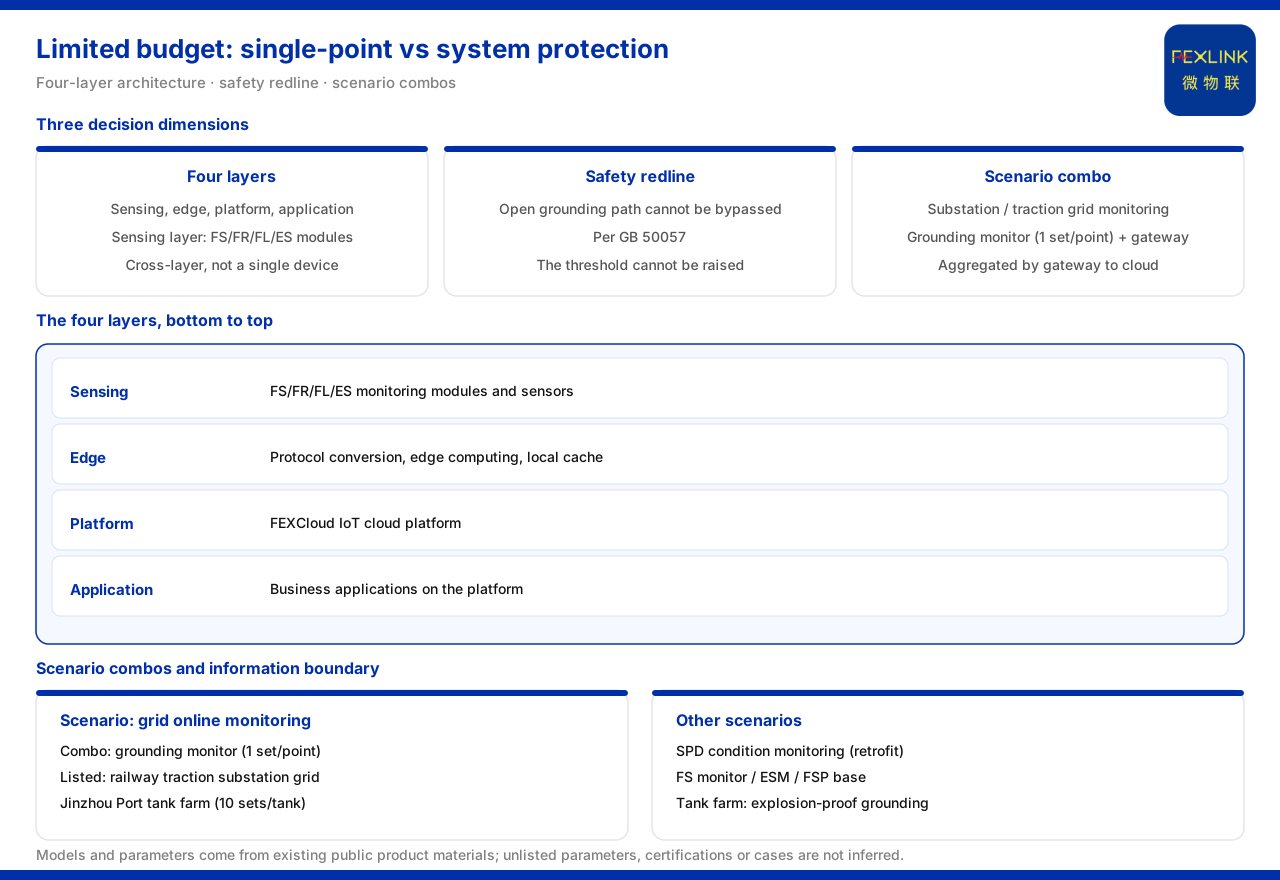
Trade-offs Between Point Protection and System Protection Under a Limited Budget
Direct answer: when the budget is limited, first lock down the "baseline items that cannot be cut", then rank the remaining links by risk from high to low. The public product material divides the monitoring system into a four-layer structure of perception layer, edge layer, platform layer and application layer, and the perception layer consists of monitoring modules and sensors of the FS, FR, FL and ES series. This shows that lightning-protection monitoring is a cross-layer system rather than something a single device can achieve. The material also lists safety red-lines that cannot be bypassed, one of which targets "abnormally open grounding resistance" and, under GB 50057, provides that no one may raise its threshold. The principle follows: grounding and similar baseline items are the part to keep first, while point protection is an increment to be filled in by risk once the baseline items are satisfied.
Why Lightning Protection Is a System Rather Than a Point
Treating the lightning-protection system as one device has a fundamental flaw: it cannot answer the question "which other links will fail". The four-layer structure recorded in the material runs, from bottom to top, through the perception layer, the edge layer, the platform layer and the application layer. The perception layer turns physical quantities on site into readable signals and is carried by monitoring modules and sensors of the FS, FR, FL and ES series; the edge layer handles protocol conversion, edge computing and local aggregation; the platform layer receives data storage and applications, and the application layer serves specific business. If any one layer is missing, the information chain breaks somewhere.
This shows that "point protection" and "system protection" are not two options on the same layer. Point protection adds one acquisition or protection measure at one position, whereas system protection requires a complete chain from perception to application. The two differ in granularity and scope. What really has to be decided under a limited budget is which positions to cover first and which layers to connect first.
Which Items Form the Baseline That Cannot Be Omitted
Among the safety red-lines the material lists, one is triggered by "abnormally open grounding resistance", is based on GB 50057, and provides that no one may raise its threshold. Such a rule is not an adjustable alarm but a floor that cannot be bypassed. Once grounding is abnormally open, the later protection and monitoring lose their common reference point, so it must be handled first. Its priority is therefore higher than that of other optional items, and no matter how tight the budget is it should not be pushed back.
It should be noted that what the material confirms is the existence and basis of this safety red-line; it does not give a specific threshold value, nor does it unfold the other rules one by one. At the scheme level we can only confirm the principle that "red-line items cannot be omitted" and cannot invent a quantitative threshold for it.
Breaking the Protection System into Rankable Layers
Since protection is a system, it can be broken into items that can be ranked. The perception layer can be divided by monitoring object: the FS surge protective device monitor faces the state of the surge protective device, the FR grounding resistance monitor faces grounding resistance, the FL lightning current / transient current monitor faces lightning current, and the ES and other modules face other electrical quantities. The edge layer is handled by devices such as the FG lightning-protection smart gateway for protocol conversion and aggregation, and the platform layer by the FEXCloud IoT cloud platform. Under this layering, a scheme can list "what happens if this is missing" item by item and rank priorities on that basis, instead of saying vaguely "do everything" or "do only one unit".
The benefit of this decomposition is that the trade-off lands on concrete positions. When the budget supports only a point, pick the position most exposed to risk; when it supports a group, fill in mutually dependent points within the same layer first so the chain takes shape before expansion.
Ranking Protection Items by Risk
One workable approach is to place every candidate protection item on two dimensions: risk and foundational nature. Anything on a safety red-line, or belonging to the baseline items that other links depend on together, has the highest priority, such as grounding monitoring. Next come the links directly related to the main energy path, such as lightning current and surge protective device state. Last come the nice-to-have expansion items. Under a limited budget, secure the first two classes first and consider the third afterwards; when the budget supports only a point, place that point where risk is most exposed rather than spreading effort evenly.
After ranking, review once more: among the items pushed to the back, is there a precondition on which some other link depends? If so, it should be promoted. This avoids the situation of "doing a lot of acquisition but losing the whole because one baseline item is missing".
Trade-off References from Three Typical Scenarios
The typical scenarios in the material help determine "what to do first". For online grounding-grid monitoring of substations and traction substations, the recommended combination is the FR grounding resistance monitor (FR-01311, one set per point) together with the FG gateway and the FEXCloud platform, which reflects solving the grounding baseline item first and then aggregating and uploading through the gateway. For surge protective device state monitoring (retrofit of installed SPDs), the recommendation is the FS surge protective device monitor, the ESM all-factor SPD monitoring and the FSP SPD base, aimed at making the state of existing surge protective devices visible. For oil-tank areas and petrochemical lightning and explosion protection, the recommendation is an explosion-proof grounding resistance monitoring unit (Ex d IIB), FL lightning current monitoring and FS surge protective device monitoring, balancing grounding and lightning current factors in an explosion-proof environment. All three stress that the links directly related to risk should be covered first before expansion is discussed.
In addition, the FR grounding resistance monitor (FR-01311-R/Z/E) is supplied at DC12V, installed outdoors and measured by the three-electrode method, and the FR and FRP series have been applied to projects such as online grounding-grid monitoring for railway traction substations and the Jinzhou Port oil-tank area (ten sets per tank). This shows the foundational position of grounding monitoring in system protection, but does not support an inference about a specific project's effect.
How Communication and Data Aggregation Affect the Trade-off
For system protection to be delivered, the question of how data comes out has to be considered. The communication protocol matrix in the material shows that the device downlink includes Modbus RTU (RS485), Zigbee (Modbus) and LoRa; the device uplink includes Modbus TCP or MQTT (Ethernet, 4G), plus gateway-level IEC 61850 (optional). A wireless method can thus be chosen where on-site cabling is difficult, and a higher-level interface can be opened through the gateway when needed. The communication method directly affects construction cost and retrofit difficulty, so it should be assessed after the protection items are fixed and before delivery, rather than patched up afterwards.
Boundaries to Clarify
What the material confirms is the four-layer structure of the monitoring system, the composition of the perception layer series, the existence and basis of the safety red-lines, the recommended combinations of the three scenarios, and the communication protocol matrix. What the material does not give is the specific threshold of each safety red-line, the number and position of deployment points in each scenario, and a quantitative benefit comparison between a given point protection and system protection. These belong to scheme design and must be determined together with the on-site structure and risk level.
Implementation Recommendations
- First list the safety red-lines and baseline dependencies, and fix grounding and other items that cannot be omitted as mandatory.
- Check chain completeness layer by layer through the perception, edge, platform and application layers, and find the gaps.
- Rank the remaining protection items by risk and foundational nature, and do the high-priority items first when the budget is insufficient.
- Use the recommended combinations of the three typical scenarios as a direction, but do not treat a recommended combination as the whole answer.
- After the protection items are fixed, assess the communication method and data aggregation to avoid rework during construction.
Summary
Point protection answers "whether a given place is seen"; system protection answers "whether the whole chain is complete". Under a limited budget, the right trade-off is not a binary choice but to keep the safety red-lines and baseline items first and then fill in the remaining links by risk. The four-layer structure, the safety red-lines, the scenario combinations and the communication matrix give a defensible starting point for this ranking; the specific thresholds, deployment points and benefit comparisons still have to be completed in scheme design.