 FEXLINK Research Institute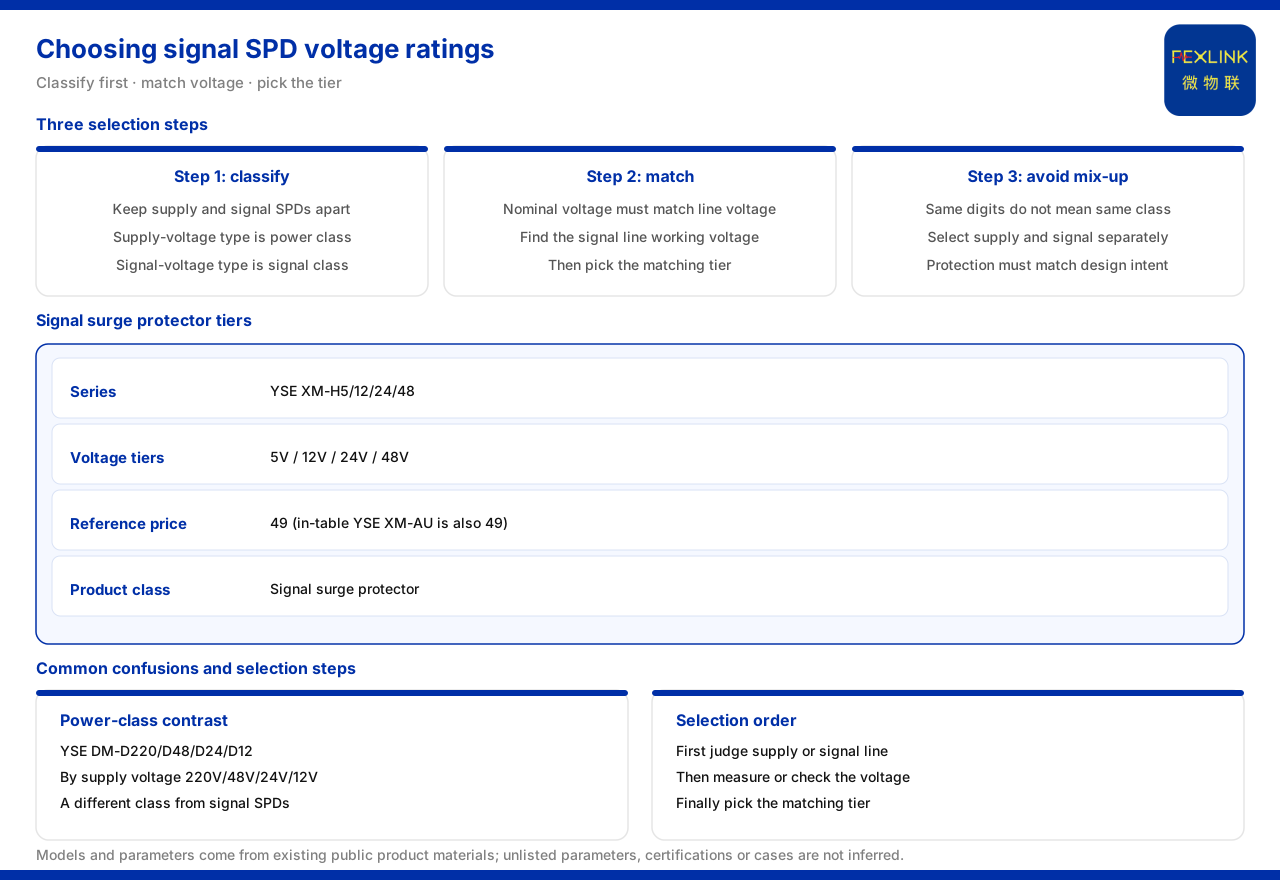
How to Select 5V/12V/24V/48V Signal Surge Protective Devices
Direct answer: the key to choosing a signal surge protective device is to match its nominal voltage class to the operating voltage of the signal line. The YSE XM-H5/12/24/48 in the material is a signal surge protective device, and the number after the letter H distinguishes the nominal voltage class, in the order 5V, 12V, 24V and 48V. In selection, first measure or establish the operating voltage of the signal line, then choose the corresponding class; at the same time it must be kept apart from power-supply SPDs that are distinguished by supply voltage, because the two belong to different product categories and must not be confused.
First Separate Power-Supply SPDs from Signal SPDs
Within the supporting surge protective device system there are at least two product classes that are easily confused. One is the Class D power-supply SPD, YSE DM-D220, YSE DM-D48, YSE DM-D24 and YSE DM-D12, distinguished by supply voltage 220V, 48V, 24V and 12V. The other is the signal SPD, YSE XM-H5/12/24/48, distinguished by the operating voltage of the signal line. Although both show figures such as 12V, 24V and 48V, one describes a supply class and the other a signal operating voltage, and the selection basis is entirely different. Separating the categories first is the first step to avoiding a wrong choice.
If one looks only at the figures without looking at the category, a signal device may be chosen at a power-supply entry, or a power-supply device on a signal line, so that the protected object does not match the design intent. Before checking a model, therefore, judging the nature of the line is the starting point of the selection process.
How the Voltage Classes of the XM-H Series Are Distinguished
The model rule of YSE XM-H5/12/24/48 is intuitive: the prefix XM identifies the signal class, and the number after the letter H is the nominal voltage class. 5 corresponds to 5V, 12 to 12V, 24 to 24V and 48 to 48V. Within one series, a suffix number thus covers four operating voltages, and selection does not require jumping between series but only fixing one of the four classes.
It should be noted that the nominal voltage class reflects the signal operating voltage the device is designed for; it is neither better the higher nor safer the lower. Choosing too high may cause unnecessary attenuation of the signal, while choosing too low may lose the protection margin on the protected line. The actual operating voltage of the line should govern, not a rounded figure based on experience.
Concrete Steps for Selection by Operating Voltage
Step one: confirm the line category and decide whether it is a power-supply line or a signal line. For a power-supply line, look at the Class D power-supply SPD; only for a signal line do you enter the four classes of XM-H.
Step two: measure or establish the operating voltage of the signal line, for example 5V, 12V, 24V or 48V. This voltage is the direct basis of selection.
Step three: choose the class corresponding to the operating voltage in YSE XM-H5/12/24/48. A 24V line takes the 24V class, and a 48V line takes the 48V class.
Step four: confirm whether the interface and mounting method match, and check overall compatibility together with the communication and power conditions. What the material gives is mainly the voltage classes and the model composition; the specific interface form still has to be checked on site.
Distinguishing Network SPDs from Signal SPDs
In the same supporting product table, besides the signal XM-H series there are network SPDs. The network class listed in the material includes the PoE network surge protective device YSE X/RJ45-NET-POE, the 100 Mbps network surge protective device YSE X/RJ45-NET-100 and the gigabit network surge protective device YSE X/RJ45-NET-1000, standing alongside the signal XM-H series. The way to distinguish them is to look at the protected object: choose the network class for an RJ45 network link, and the signal class for a general signal line. The network class is further divided by PoE, 100 Mbps and gigabit, whose rates and power capabilities differ and should be chosen according to the actual link.
The table also lists the broadcast signal surge protective device YSE XM-AU, which shows that the signal class is itself subdivided by purpose. In selection, first determine the signal purpose, then fix the voltage class or interface type within that purpose.
How Communication Suffixes Affect Selection
The general suffix convention in the material is: -R means RS485 (Modbus), -E means Ethernet (MQTT), -Z means Zigbee (Modbus), and 4G (MQTT) is optional on some products. These suffixes usually appear on products with communication capability and identify the data interface. In selection, if the surge protective device itself needs to join monitoring or networking, the suffix must be chosen according to the existing field bus or network; if it is only a passive protective component, the suffix is not a major constraint, but compatibility with upstream and downstream devices should still be confirmed.
Looking at the suffix together with the voltage class avoids focusing on one dimension and ignoring the other. For example, a 24V signal SPD that must join an RS485 bus should be the -R version, while one that uploads over Ethernet should be the -E version.
Outsource Support and the Boundary of Pricing
The material states that the YSE series surge protective device system belongs to outsourced production support, and its price is for cost reference only; external quotations must follow the company's standard price system. This means that when a price is cited in a scheme or quotation, the reference price in the material must not be treated directly as an external quotation. For the person writing the scheme, the safer practice is to focus on voltage class, category and interface matching, and leave pricing to the formal price system.
Common Misunderstandings and a Checklist
There are three common misunderstandings. The first is substituting a power-supply SPD and a signal SPD that carry the same figures, for example choosing across categories merely because 24V appears, ignoring that they describe different objects. The second is selecting by the operating voltage of the protected equipment rather than of the signal line, causing a class deviation. The third is attending only to the voltage class and ignoring the communication suffix, only to find an interface mismatch when joining a bus.
The checklist can be reduced to four questions: is this line power or signal? What is the operating voltage of the signal line? Is the protected object an ordinary signal or an RJ45 network? Does it need to join a bus or network? Once all four are answered, the model is essentially determined. Putting the four questions at the front of a selection table can significantly reduce rework.
Boundaries to Clarify
What the material confirms is that the XM-H series covers the four classes 5V, 12V, 24V and 48V; that the Class D power-supply SPD is distinguished by 220V, 48V, 24V and 12V; that the network class includes PoE, 100 Mbps and gigabit; the meaning of the general suffixes; and that the YSE series is outsourced production support whose price is for cost reference. What the material does not give is the specific insertion loss, surge current capability and other parameters of each signal SPD, nor does it bind a given line scenario to a specific model. These must be determined from field conditions and later parameter data.
Implementation Recommendations
- First judge whether the line is power or signal, to avoid mixing power-supply SPDs with signal SPDs.
- For a signal line, first measure or establish the operating voltage, then choose the corresponding class among the 5V, 12V, 24V and 48V of XM-H.
- For a network line, choose the corresponding network SPD by PoE, 100 Mbps or gigabit.
- When networking or monitoring is needed, choose the suffix -R, -E or -Z that matches the field communication method.
- When citing a price, follow the company's standard price system and do not use the reference price in the material directly.
Summary
The core of signal SPD selection is "match the voltage, separate the categories". YSE XM-H5/12/24/48 uses the number after H to distinguish the four classes 5V, 12V, 24V and 48V, so once the operating voltage of the signal line is fixed it can be matched directly; at the same time it must be kept apart from Class D power-supply SPDs and RJ45 network SPDs, and then the communication suffix and interface conditions complete the delivery. What the material gives is the classes and the model composition; the specific parameters and scenario binding still have to be confirmed on site.