 微物联研究院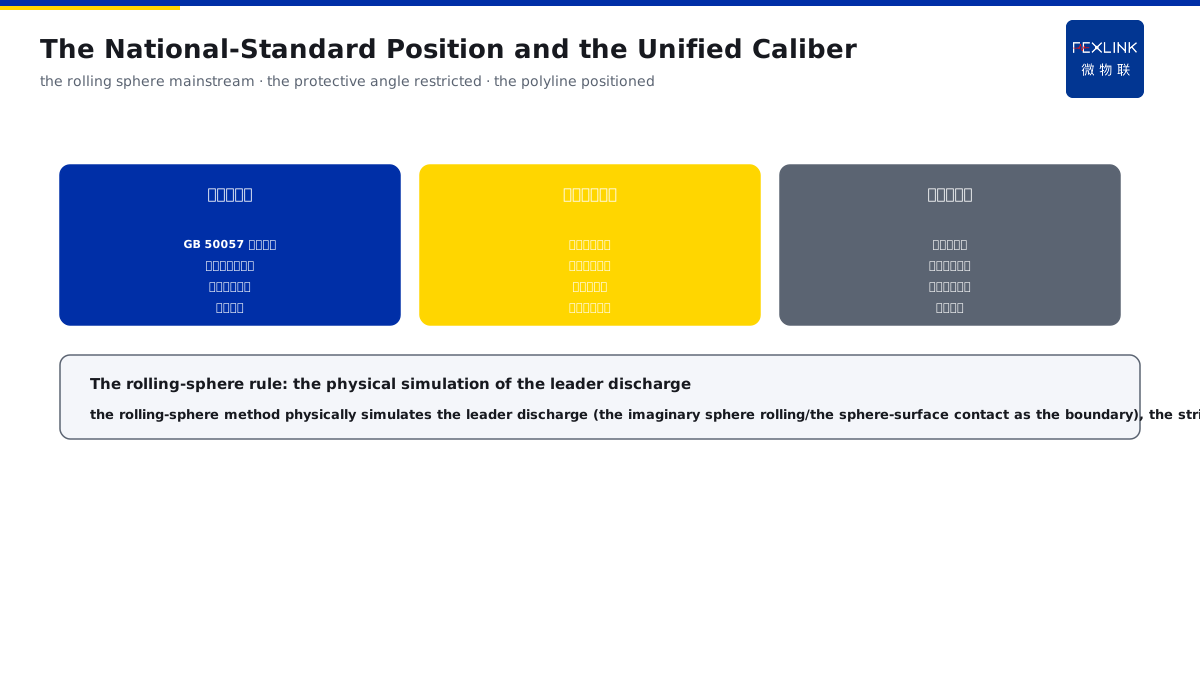
Direct Answer
The different materials give different air-termination protection-zone algorithms — which one should the design use? The answer: the current national standard GB 50057 mainly adopts the rolling-sphere method, applicable to most buildings; the protective-angle method is applicable only to a few tall structures, and the polyline method is mainly continued in the power and communication lines and some old standards; the same project should uniformly produce the drawings by the rolling-sphere method of the current national standard to avoid the protection-zone disputes caused by the mixed use of the multiple algorithms.
At an industrial-park factory-building project, the design institute calculated the protection zone of the air-termination rod by the rolling-sphere method, and the owner's technician questioned the insufficient protection zone using the polyline method from the old drawing collection; after the designer explained that the polyline method is based on the old standard and the current GB 50057 adopts the rolling-sphere method, and supplemented the rolling-sphere calculation book, the dispute subsided. The design core: the rolling-sphere method mainstream, the applicability bounded, and the project unified — most buildings use the rolling-sphere method, only the tall structures look at the protective-angle method, the power lines continue the polyline method, and the same project produces the drawings with one algorithm.
Why:
- The rolling-sphere method mainstream: applicable to most buildings;
- The protective-angle method: applicable to a few tall structures;
- The polyline method: continued in the power and communication lines;
- The project unified: avoiding the mixed-use disputes.
Key insight: "The three-method selection has three points — the rolling-sphere method mainstream (most buildings), the protective-angle method narrowly applicable (the tall structures), and the polyline method of the old standard (continued in the power and communication) — the same project unified by the rolling-sphere method for the drawings, without the mixed use."
At a substation retrofit project, the drawings simultaneously showed the polyline-method and the rolling-sphere-method annotations, and the review raised "the inconsistent protection-zone calibers"; after the designer uniformly re-produced the drawings by the rolling-sphere method, it passed. Lesson: the mixed use of the multiple algorithms is bound to be questioned by the review — the same project uniformly uses the algorithm of the current national standard, and the protection-zone caliber is consistent."
Overview: run "the principles of the three methods → the difference of the three methods on the same rod → the position of the current national standard → the unified caliber of the project" as one air-termination algorithm-decision interpretation. The current national standard GB 50057 mainly adopts the rolling-sphere method, and the protective-angle method and the polyline method each have their applicability boundaries. The four layers are unfolded below.
A "navigation software three routes" analogy: think of the three protection-zone algorithms as the three route recommendations of a navigation app. Going to the same place, the navigation gives three routes: the highway first (the rolling-sphere method) — with the complete road information and the reasonable physical distance, optimal in most cases; the shortest time (the protective-angle method) — calculated fast but relying on the real-time data, accurate only in the specific road conditions; the shortest distance (the polyline method) — the old algorithm with less road information, easy to take a detour. If the three routes are all shown on the screen, the driver does not know which to follow; if only one route is shown with the recommendation reason, the driver just follows it. The lightning-protection design works the same: the three algorithms can all calculate the protection zone, but the result calibers differ; with the three calibers coexisting on the same drawing, the review and the site are at a loss; uniformly producing the drawings by the current national-standard rolling-sphere method is like the navigation giving only one recommended route — the caliber clear and the dispute minimal. The navigation analogy: the highway first = the rolling-sphere method (the complete information/optimal in most cases), the shortest time = the protective-angle method (calculated fast/accurate in the specific scenes), the shortest distance = the polyline method (the old algorithm/easy to detour), the three routes on the same screen = the mixed-use confusion, and only one route given = the unified-caliber drawings with the minimal dispute — the algorithm must be unified, and the caliber consistent.
1. The Three-Method Principles: How Each Calculates the Protection Zone
Step one: first look at the principles and the applicable objects of the rolling-sphere, the protective-angle and the polyline methods.
The rolling-sphere method:
- The imaginary sphere rolling;
- The sphere-surface contact as the boundary;
- The physical simulation of the strike;
- The building-protection mainstream.
The protective-angle method:
- The angle drawn from the rod top;
- The inside of the angle is the protection zone;
- The simple and fast estimation;
- Applicable to the tall structures.
The polyline method:
- The polyline determining the boundary;
- Continued in the power lines;
- The old-standard basis;
- Used in the specific scenes.
Key insight: "The three-method principles — the rolling-sphere method (the imaginary sphere rolling/the physical simulation of the strike/the building mainstream), the protective-angle method (the rod-top angle/the fast estimation/the tall-structure applicability), and the polyline method (the polyline boundary/the power and communication/the old-standard continuation) — the principles differ, and the applicability differs."
2. The Result Difference: How Much the Three Methods Differ on the Same Rod
Step two: the result-difference illustration of the three algorithms on the same air-termination rod.
The protection-zone comparison:
- The rolling-sphere method more rigorous;
- The protective-angle method more optimistic;
- The polyline method more conservative;
- The different results need the unification.
The influencing elements:
- The rod height and the sphere radius;
- The building height and shape;
- The class and the protection level;
- The different parameter substitutions.
The difference hazard:
- The mixed use with the inconsistent calibers;
- The review necessarily questioning;
- The protection-zone dispute;
- The rework and the delay.
Key insight: "The three-method difference has three things — the different results (the rolling sphere rigorous/the protective angle optimistic/the polyline conservative), the element influence (the rod height/the building/the class substituted differently), and the mixed-use hazard (the inconsistent caliber/the review questioning/the rework) — the same project must unify the algorithm."
3. The National-Standard Position: How the Current Standard Determines
Step three: the adoption position of the current national standard GB 50057 on each method.
The rolling-sphere method mainstream:
- Mainly adopted by GB 50057;
- Applicable to most buildings;
- The drawing standard caliber;
- Recognized by the review.
The protective-angle method boundary:
- A few tall structures;
- Applicable in the special conditions;
- With the clear restrictions;
- Not arbitrarily generalized.
The polyline method position:
- Continued from the old standard;
- The power and communication lines;
- Not the main recommendation of the new projects;
- Referenced historically.
Key insight: "The national-standard position has three things — the rolling-sphere method mainstream (adopted by GB 50057/the drawing caliber/recognized by the review), the protective-angle method restricted (only the tall structures/with the clear restrictions), and the polyline method positioned (the old-standard continuation/not the main recommendation of the new projects) — producing the drawings by the current national standard, the dispute minimal."
4. The Unified Caliber: How the Project Lands
Step four: the landing suggestions for unifying the algorithm in the same project.
The unified algorithm:
- All by the rolling-sphere method;
- The calculation-book caliber consistent;
- The drawing annotations unified;
- The mixed use avoided.
The process management:
- The algorithm determined at the scheme stage;
- The calculation book retained;
- The review reply justified;
- The changes updated synchronously.
The review mechanism:
- The drawing self-check of the caliber;
- Consistent with the design calculation;
- The site review of the range;
- The acceptance comparison.
Key insight: "The unified caliber has three things — the unified algorithm (all by the rolling-sphere method/the caliber consistent/the annotations unified), the process management (the algorithm determined at the scheme stage/the calculation book retained/the changes updated), and the review mechanism (the drawing self-check/the site review/the acceptance comparison) — the caliber unified, and the dispute zero."
5. Product Implementation: The Air-Termination Protection and Monitoring Closed Loop
WeiWuLian makes the air-termination protection "the algorithm unified and the effect visible":
- The unified-algorithm drawings: the rolling-sphere-method caliber consistent;
- The protection-zone verification: the air-termination layout reviewed on site;
- The lightning-event recording: the air-termination effectiveness corroborated by the data;
- The state online: the air-termination and the SPD states continuously visible.
The design principle in one sentence: "The rolling-sphere method mainstream, the protective-angle method restricted, and the polyline method continued — the algorithm unified for the drawings, the effect corroborated by the data, and the air-termination protection justified."
6. Common Understanding Misjudgments
- "The three algorithms are arbitrarily selectable": wrong. The current national standard mainly uses the rolling-sphere method, and the same project unifies the caliber.
- "The protective-angle method is the most convenient, so use it": wrong. The protective-angle method is applicable only to a few tall structures with the clear restrictions.
- "The polyline-method drawing collection is still usable": wrong. The polyline method is based on the old standard, and the new projects produce the drawings by the rolling-sphere method.
- "The drawings with the two algorithms annotated are fine": wrong. The mixed use of the multiple algorithms is bound to be questioned by the review.
- "No review needed after the calculation": wrong. The protection zone is reviewed on site, and the effect is verified by the data.
Scope and Limitations
This article compares the three air-termination protection-zone algorithms: the rolling-sphere, the protective-angle and the polyline methods (the principles, the difference, the national-standard position and the unified caliber), applicable to the air-termination design decisions. The specific calculation follows GB 50057-2010; this article explains only the algorithm-decision logic. All cases are anonymized (an industrial-park factory building/a substation retrofit) and do not refer to any specific customer.