 FEXLINK Research Institute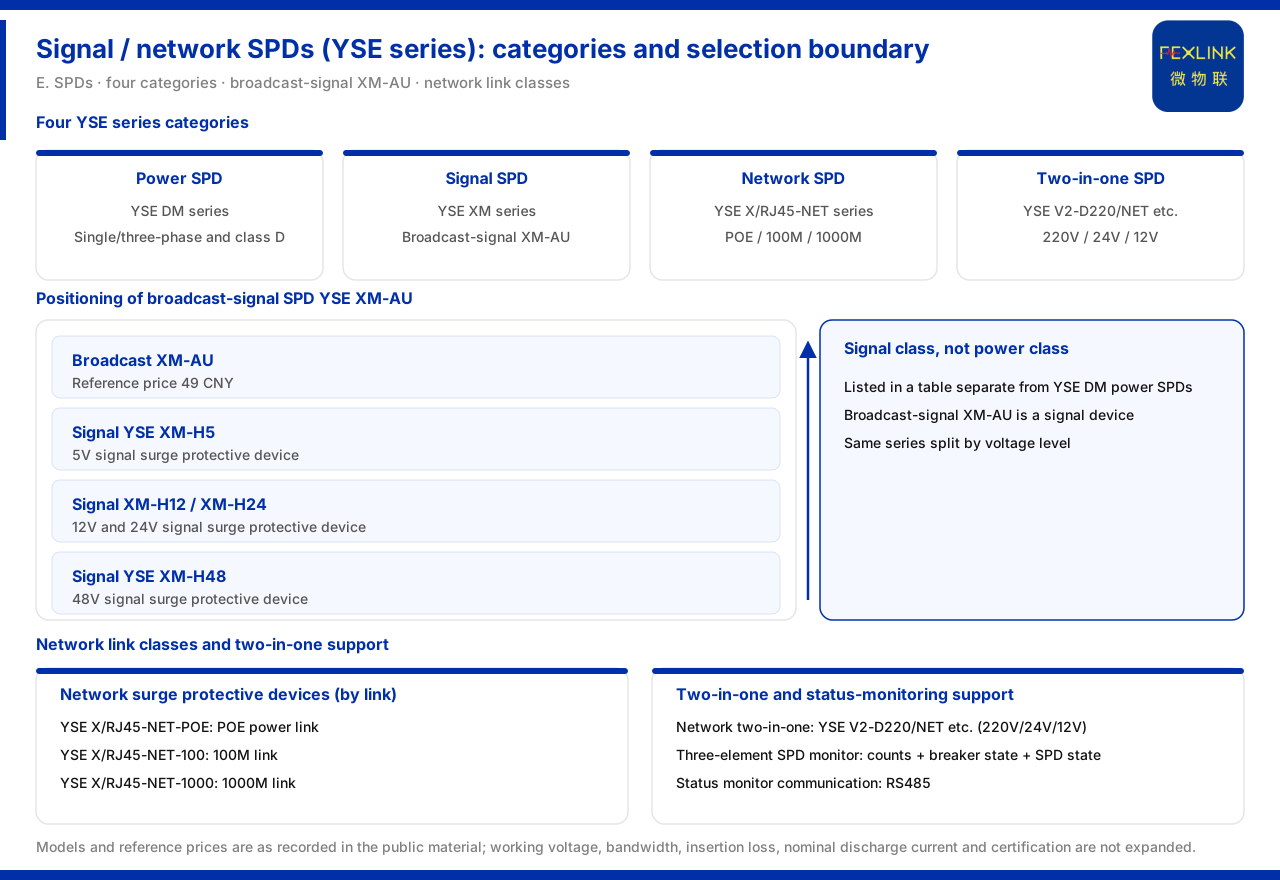
Direct Answer
The broadcast signal surge protective device belongs to the signal class of surge protective devices, not the power-supply class. In the product-line overview, the product knowledge base groups signal SPDs, network SPDs and two-in-one SPDs together with power-supply SPDs under E. surge protective devices, an outsourced-support YSE series; for the specific purpose of broadcast signals, the public entry lists only one item: the broadcast signal surge protective device (YSE XM-AU), with a reference price of 49.
What should be said clearly is that the information in this record is very limited. In the signal and network SPD table, the product knowledge base lists the broadcast signal surge protective device (YSE XM-AU) by name and reference price only, without unfolding its operating voltage, interface form, transmission bandwidth, insertion loss, nominal discharge current or certification information. Selection for a broadcast line should therefore take this listed information as its boundary, and the remaining parameters must be requested separately. On this basis the article explains its place in the YSE series, its relationship with products in the same table, and the parts the material does not cover.
1. The Place of Signal and Network SPDs in the YSE Series
The product-line overview marks E. surge protective devices as outsourced support, collectively called the YSE series, which contains power-supply SPDs, signal SPDs, network SPDs and two-in-one SPDs. The broadcast signal surge protective device (YSE XM-AU) falls exactly in the signal SPD category.
Confirming this point by classification first matters: a broadcast signal line carries a signal, not distribution power, so its protected object should be classed as signal. Mistaking a broadcast signal SPD for a power-supply SPD would lead selection to look at the wrong parameter table and check nominal discharge current and distribution class that should not be examined.
2. Listed Information on the Broadcast Signal SPD
The public entry records only two things about the broadcast signal surge protective device (YSE XM-AU): the name, broadcast signal surge protective device, and a reference price of 49. It comes from the signal and network SPD table, showing that the product is positioned as a signal-class surge protective device.
These two pieces of information answer only a limited set of questions. They show that the product is used for surge protection of a broadcast signal line and give a reference price; as for its applicable operating voltage, the form of its interface, the transmission bandwidth it supports, its insertion loss, the nominal discharge current it can withstand, and whether it has obtained a particular certification, the product knowledge base gives none of them in the entry. That is, its category and reference price can be confirmed, but its electrical and interface specifications cannot be confirmed from them.
3. Voltage-Differentiated Signal SPDs in the Same Table
In the same signal and network SPD table, the product knowledge base also lists signal SPDs differentiated by voltage class, with models covering YSE XM-H5, YSE XM-H12, YSE XM-H24 and YSE XM-H48. They belong with the broadcast signal surge protective device to the YSE XM signal SPD series.
This parallel relationship provides a reference. Voltage-differentiated signal SPDs use operating voltage as the distinguishing dimension, showing that signal SPD selection usually has to match the line voltage; the broadcast signal surge protective device is not unfolded in the same table in the form of voltage classes, which is the direct manifestation of its thin information. The two are in the same series but unfolded to different degrees, and their parameters must not be applied across.
4. Three Link Types of Network SPDs
The table also contains a group of network surge protective devices, differentiated by link form, including the power-capable YSE X/RJ45-NET-POE, the 100 Mbps YSE X/RJ45-NET-100 and the gigabit YSE X/RJ45-NET-1000. They use the RJ45 network interface and belong to a different physical interface category from the broadcast signal surge protective device.
Looking at signal SPDs and network SPDs separately avoids a common misuse: a broadcast signal line and an Ethernet line differ in interface form and transmission characteristics, and the interface and link-class parameters of a network SPD cannot be applied directly to a broadcast signal line. The first step in selection should be to judge from the line nature whether it belongs to the signal class or the network class, then enter the corresponding sub-table.
5. The Separate-Table Relationship with Power-Supply SPDs
The product knowledge base lists power-supply SPDs and signal and network SPDs in separate tables. On the power-supply side, the new-generation power-supply SPD is given as the YSE DM series, for example single-phase and three-phase models such as YSE DM80C/2; the Class D power-supply SPD includes YSE DM-D220, YSE DM-D48, YSE DM-D24 and YSE DM-D12. Signal and network SPDs are listed in a separate table.
The separate-table approach is itself a criterion: power-supply SPDs are organised by distribution voltage and phase count, and the Class D ones are further distinguished by DC voltage class, while the broadcast signal surge protective device is placed in the signal table, showing that its classification basis is the signal line, not the distribution line. In other words, from which table it sits in, one can confirm that it belongs to the signal class rather than the power-supply class.
6. Two-in-One and State-Monitoring Support
In the supporting system of signal and network SPDs there are two further related product types. The first is the network two-in-one surge protective device, divided by voltage into 220V, 24V and 12V, with models such as YSE V2-D220/NET, suitable where both power and network protection are needed. The second is the three-factor SPD monitor, which can acquire counts, switch status and SPD status and communicates over RS485.
The existence of these two product types shows that the YSE protection support is not only single items but also includes a two-in-one form and state-monitoring parts. However, the product knowledge base does not state whether the broadcast signal surge protective device can be combined with the monitors above, nor does it give its combination with the two-in-one products. The supporting relationship is outside the material and must be confirmed by the actual project scheme.
7. Selection Boundaries and Information to Confirm
From the existing entries, broadcast signal line selection can proceed on the following points. First, confirm that it belongs to the signal class of surge protective devices; YSE XM-AU is the broadcast signal surge protective device listed in the public entry, with a reference price of 49. Second, do not treat it as a power-supply SPD, and do not apply the link-class parameters of a network surge protective device. Third, its operating voltage, interface form, transmission bandwidth, insertion loss and nominal discharge current are all unlisted and the corresponding data must be requested from the supply side. Fourth, certification information is likewise unlisted, and where certification requirements are involved it should be requested separately rather than concluding on certification from the existing entry.
Keeping the listed and the unlisted apart makes the question clear within the information boundary: the product knowledge base can answer which class a broadcast signal SPD belongs to and how much its reference price is, and cannot answer how its electrical and interface specifications are. Proceeding on this boundary neither misuses the material nor makes the work impossible because of missing data.
Scope and Limitations
First, this article restates only what the product knowledge base lists, with the factual boundary limited to the E. surge protective device classification in the product-line overview, the signal and network SPD table, and the separate power-supply SPD table.
Second, the name and reference price of the broadcast signal surge protective device (YSE XM-AU) are cited as listed in the product knowledge base; this article does not infer its operating voltage, interface form, transmission bandwidth, insertion loss, nominal discharge current or certification information.
Third, the voltage-differentiated signal SPDs and the three link types of network SPDs are cited as listed in the product knowledge base; this article does not apply their parameters to a broadcast signal line.
Fourth, the series and DC voltage classes of power-supply SPDs are cited as listed in the product knowledge base; this article does not change the classification of signal class and power-supply class on that basis.
Fifth, the network two-in-one surge protective device and the three-factor SPD monitor are cited as listed in the product knowledge base; this article does not infer their supporting relationship with the broadcast signal surge protective device.