 微物联研究院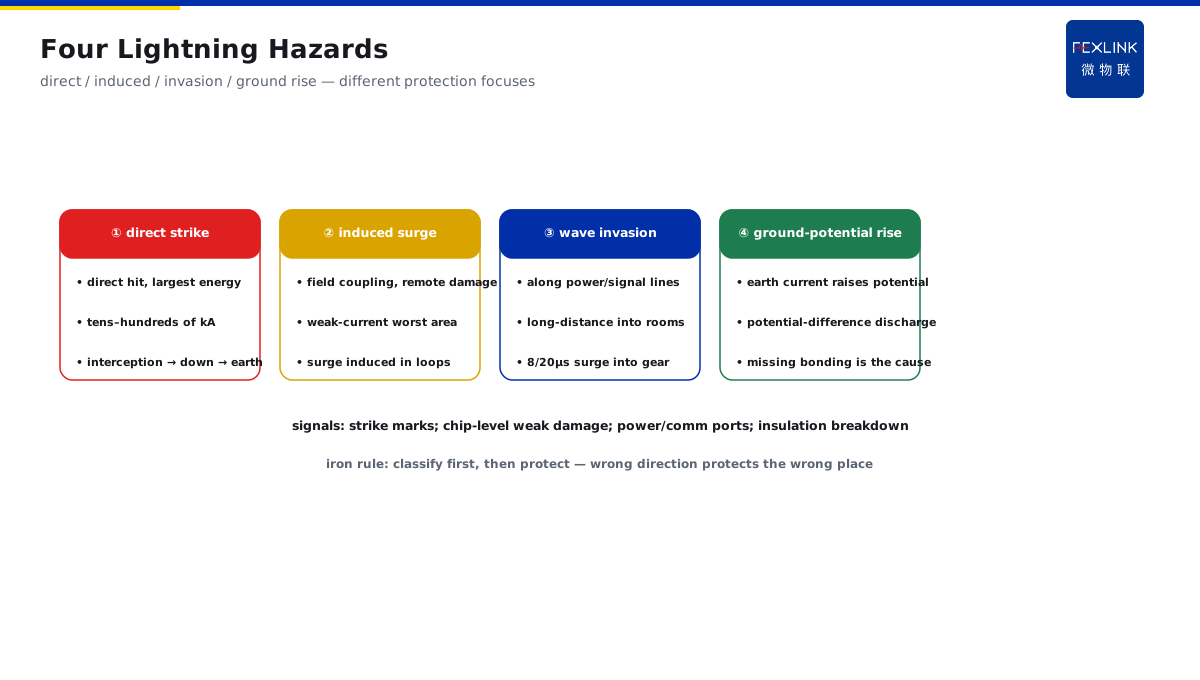
Direct Answer
After a lightning incident on site, which hazard is it, and in which direction should we look for protection weaknesses? The answer: lightning hazards to electrical systems fall into four categories — direct strike (direct interception), induced surge (the electromagnetic field inducing a surge in circuits), lightning wave invasion (surge carried indoors along power/signal lines), and ground-potential rise (earth current raising local potential and discharging to equipment); each category has a different protection focus, so correct classification enables targeted design.
At one park's weak-current equipment room, equipment was damaged by lightning and everything was lumped as "hit by lightning." Investigation: the roof had air-termination rods (direct-strike protection in place) and power-side SPDs at the room — but the damaged equipment concentrated on signal boards without equipotential bonding. Conclusion: this was lightning wave invasion + ground-potential rise (signal lines uncovered by SPD, no equipotential bonding), not a direct-strike problem. Rectification: add signal SPDs + equipotential bonding in the room. Classification core: judge the hazard type first, then find the protection focus — air-termination/shielding/SPD/equipotential each covers a segment; judging the wrong direction means protecting the wrong place.
Because:
- Direct strike goes through air-termination and down-conductors: largest energy, direct path;
- Induced surge is electromagnetic coupling: the field induces surges in circuits (weak-current worst area);
- Lightning wave invasion travels along lines: power/signal lines carry the surge indoors;
- Ground-potential rise is potential elevation: earth current raises local potential, causing secondary discharge.
Key insight: "judge the type first, then match the protection" is the first principle of lightning-incident investigation. The four categories have different protection focuses — air-termination for direct strikes, shielding for induced surges, SPDs for wave invasion, equipotential bonding for ground rise.
At one airport, signal lines were burned by lightning wave invasion (power SPD intact); misjudged as "SPD not working," they replaced it with a more advanced power SPD and the problem persisted. Rectification: add signal SPDs + shielding improvements. Lesson: with the wrong protection direction, any investment is ineffective — classify the hazard first, then choose the protection.
1. Direct Strike: Largest Energy, Through Air-Termination and Down-Conductors
Step one: how to protect against direct strikes.
Features:
- Lightning directly strikes a building/equipment/line;
- Large current amplitude (tens to hundreds of kA), largest energy;
- Direct path: interception → down-conductor → earthing;
- Damage forms: thermal effect, mechanical force, electrodynamic force.
Protection focus:
- Air-termination systems (rods/strips/meshes);
- Down-conductors (short, equally spaced, divided);
- Earthing system (low impedance, potential equalization);
- Bonding and equipotential (eliminate potential differences).
Judgment signals:
- Strike marks on the roof/exterior;
- Equipment damage near air-termination devices;
- Destruction along down-conductor paths;
- Clear on-site evidence of the strike point.
Key insight: "air-termination + down-conductor + earthing + equipotential" is the direct-strike protection set. Direct strikes carry the largest energy — protection is at the building level, not something equipment-side can withstand.
2. Induced Surge: Electromagnetic Coupling, the Weak-Current Worst Area
Step two: how to protect against induced surges.
Features:
- Lightning current creates a rapidly changing electromagnetic field around it;
- The field induces surges in closed circuits;
- No direct interception ("remote" damage);
- Weak-current equipment (signal/control/communication) is most sensitive.
Coupling modes:
- Magnetic coupling: larger loop area → higher induced voltage;
- Electric coupling: electrostatic induction from high voltage to adjacent conductors;
- Coupling targets: signal lines, control lines, long loops;
- Impact: chip-level damage (seemingly "unexplained").
Protection focus:
- Shielding (shield grounded, shielded room/cabinet);
- Reduce loop area (lines laid close/twisted);
- Weak-current equipment SPDs (signal-port protection);
- Stay away from lightning-current paths (spatial separation).
Key insight: "shielding + smaller loops + signal SPDs" are the induced-surge protection points. Weak-current equipment relies on spatial shielding and signal protection — not something power SPDs can solve.
3. Lightning Wave Invasion: Long-Distance Conduction Along Metal Lines
Step three: how to protect against lightning wave invasion.
Features:
- Lightning current conducts along power/signal/metal lines;
- Long-distance propagation (from outdoors into rooms);
- Surge waveforms (8/20μs, etc.) reach equipment terminals;
- Damage: power modules, communication ports, control boards.
Invasion paths:
- Power lines (overhead/buried intake);
- Signal lines (communication/control/data);
- Metal pipes (water/gas, etc.);
- Earthing conductors (lightning-current division paths).
Protection focus:
- Power SPDs (staged installation, energy coordination);
- Signal SPDs (matching interface types);
- Protection at the entrance (boundary position);
- Cable shielding and standard laying.
Key insight: "staged SPDs at the entrance + cable shielding" is the focus of wave-invasion protection. Surges come along the lines — install SPDs at the entrance and stage by stage, keeping the surge out of the equipment.
4. Ground-Potential Rise: Secondary Discharge from Grid Potential Elevation
Step four: how to protect against ground-potential rise.
Features:
- Lightning current raises the earthing-grid potential after entering the ground;
- Local potential differences cause discharge between equipment;
- No direct strike (brought in by the earthing system);
- Damage: insulation breakdown, equipment damage, personal danger.
Conditions of occurrence:
- High earthing resistance (large potential elevation);
- Equipment earthed close to the lightning-current entry point;
- Large earthing-potential differences between equipment;
- Missing equipotential bonding (no path to equalize potential differences).
Protection focus:
- Lower earthing resistance (improve entry conditions);
- Equipotential bonding (potential equalization between equipment);
- Equalization rings/meshes (uniform potential distribution);
- Isolation/shielding (sensitive-equipment protection).
Key insight: "lower resistance + equipotential bonding" is the core of ground-rise protection. Potential elevation is equalized by bonding — do not let dangerous potential differences appear between equipment.
5. Aligning the Four Hazards with Protection Measures
Step five: how to design in a targeted way.
Four-hazard mapping:
- Direct strike → air-termination + down-conductor + earthing;
- Induced surge → shielding + smaller loops + signal SPDs;
- Lightning wave invasion → staged power/signal SPDs;
- Ground-potential rise → lower resistance + equipotential bonding.
Investigation flow:
- Step 1: confirm the damaged equipment and location (which category);
- Step 2: judge the hazard type (direct/induced/invasion/rise);
- Step 3: check the corresponding protection (air-term/shield/SPD/bonding);
- Step 4: locate the weakness (missing/failed/nonstandard);
- Step 5: targeted rectification + verification (lightning-protection testing).
Protection combination:
- Building level: air-termination + down-conductor + earthing (against direct strikes);
- Space level: shielding + zoning (against induced surges);
- Line level: staged SPDs (against wave invasion);
- System level: equipotential + equalization (against ground rise).
Key insight: "four hazards × four protections" map one-to-one. With the hazard type classified, protection is targeted — combined protection is complete.
6. Product Landing: Intelligent Lightning-Protection On-Line Monitoring
FEXLINK products land lightning protection:
- FL Lightning-Current Monitor: records strike currents (judging direct/invasion paths);
- FR Earthing-Resistance Monitor: tracks earthing resistance (ground-rise risk);
- FS SPD Monitor: SPD state and leakage trend (protection effectiveness);
- Monitoring platform: event records + trend analysis + protection-state summary.
Design principle in one sentence: "classify first, protect in a targeted way, verify by monitoring." Direct/induced/invasion/rise — classified judgment, protection with evidence.
7. Common Judgment Misconceptions
- Lumping everything as "hit by lightning": without distinguishing the hazard type. Consequence: wrong protection direction. Correct: first classify into one of the four.
- Installing only power SPDs: ignoring signal lines and induced surges. Consequence: weak-current equipment still damaged. Correct: signal SPDs + shielding.
- Treating direct-strike protection as everything: assuming an air-termination rod means safety. Consequence: invasion/rise still damage. Correct: combined protection.
- Ignoring equipotential bonding: leaving potential differences untreated. Consequence: ground-rise damage. Correct: equipotential bonding.
- Rectification without verification: changing without testing. Consequence: weaknesses remain. Correct: lightning-protection testing verification.
Scope and Limitations
This article provides the distinction among four lightning hazards (direct strike, induced surge, lightning wave invasion, ground-potential rise) and targeted protection points, applicable to lightning-incident investigation and protection-scheme design. Specific protection measures must follow on-site lightning-protection class, equipment importance, and codes (GB 50057, etc.); SPD selection and inter-stage coordination require professional design; incident-cause determination should combine on-site traces and monitoring records. All cases are anonymized (a certain park/a certain airport) and do not refer to any specific customer.