 FEXLINK Research Institute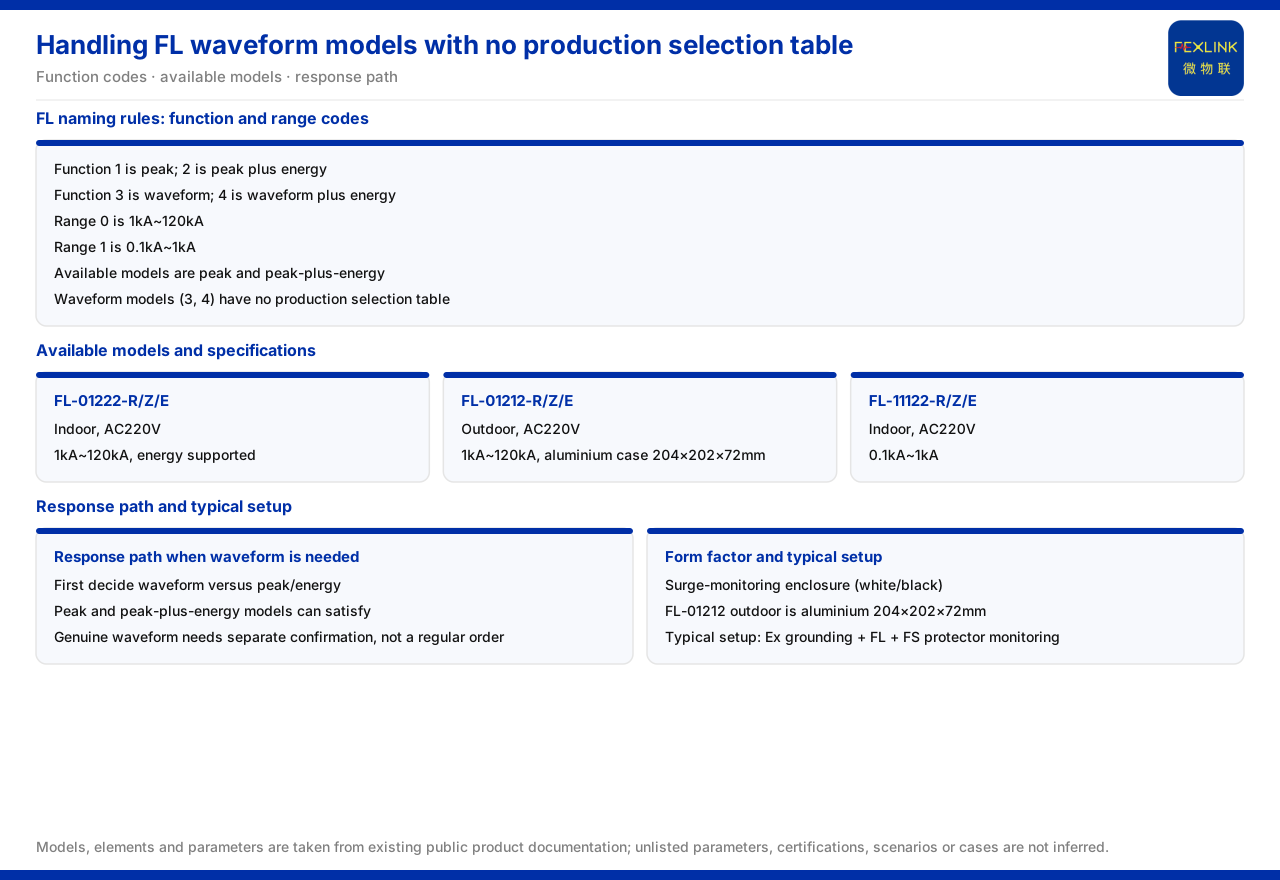
Handling Waveform Recording When the Waveform Band Has No Production Selection Table
Direct answer: if waveform recording is required but the in-service waveform-band models have no production selection table, the correct response is not to "find a waveform model" but to return to the requirement and handle it in two steps. First, establish whether the requirement is really "waveform" or "knowing that a lightning event occurred, how large the peak was, and how much energy it carried." If it is the latter, the in-service peak band and peak-plus-energy band already satisfy it. Second, if waveform capability is genuinely required, state clearly that this capability currently has no production selection table and must be confirmed separately by means other than routine selection, rather than being ordered as a regular in-service model. The following lays out the function bands, in-service models, and documentation boundary of the lightning current monitor (FL series) to explain why this path holds.
Distinguishing the FL Function Bands
The model rule of the lightning current / transient current monitor is FL–[detection range][channels][function][mounting][power]–[communication], where the function digit is defined as 1 for peak, 2 for peak plus energy, 3 for waveform, and 4 for waveform plus energy. Function 1 and function 2 record information at the value level — peak and energy; function 3 and function 4 involve the waveform itself, and function 4 also includes energy.
The detection-range digit likewise has two options: 0 means 1kA~120kA, and 1 means 0.1kA~1kA. Even the same function can therefore correspond to different range bands. Only the combination of function digit and detection-range digit forms a complete model judgment; looking at function without range makes mis-selection easy.
The point of distinguishing the bands is that waveform recording and "peak/energy recording" are different levels of monitoring goal. Many sites say "we want waveform" when what they actually care about is whether lightning struck, how large the peak was, and how much energy was involved; such needs do not necessarily require the waveform band itself.
What the In-Service Models Provide
The documentation lists three in-service models. The lightning current monitor (FL series), for example FL-01222-R (indoor, AC220V, 1kA~120kA, energy supported), FL-01212-R (outdoor, AC220V, 1kA~120kA, energy supported), and FL-11122-R (indoor, AC220V, 0.1kA~1kA).
By function digit, these all belong to the "peak plus energy" combination (function digit 2), covering the 1kA~120kA and 0.1kA~1kA ranges; by communication, all offer RS485, Zigbee, and Ethernet suffix options; by mounting, both indoor and outdoor are covered. None falls on the waveform band (function 3/4).
So if the requirement is to record a lightning event's peak and energy, the in-service models already provide the corresponding function and range combinations; if the core requirement is "waveform," it is outside the scope of the current in-service models.
Why the Waveform Band Is Not Currently Selectable
The documentation states in its known information gaps that the waveform-band FL models (function 3/4) currently have no production selection table. This wording defines the response — not "the waveform band does not exist," but "the waveform band currently has no available production selection table."
The documentation also states that the lightning current / transient current monitoring module is self-produced. This helps explain the difference between in-service models and function bands: the monitoring module is a self-produced capability, but the production selection table covers only the function 1/2 combinations, and the waveform band has not yet formed an externally selectable production list. For selection staff this means function 3/4 cannot be quoted or ordered as a regular in-service model.
It is worth stressing that this information is itself useful knowledge: knowing which bands have a production selection table and which do not avoids promising a model in a plan that cannot be delivered through routine channels.
A Path When Waveform Recording Is Needed
Based on the above, when a site raises a waveform recording requirement, the response can follow this path:
First, split the requirement. Separate "waveform data" from "lightning event recording." If the concern is whether lightning struck, how large the peak was, and how much energy was involved, that belongs to the latter category and can be selected directly among the in-service peak-plus-energy models.
Second, settle the model by range and mounting. If the range is 1kA~120kA, FL-01222 or FL-01212 can be chosen; if it is 0.1kA~1kA, FL-11122 can be chosen. Choose 01222 or 11122 indoors and 01212 outdoors, and determine the communication suffix accordingly.
Third, explain waveform capability separately. If the requirement really calls for waveform recording, state honestly in the plan that this function band has no production selection table and cannot be handled as a regular in-service model; the needed capability must be confirmed separately, not by citing a production model that does not exist.
Fourth, avoid "making do with a promise." Do not write "use a certain model to achieve waveform" in the plan, because the function digit of the in-service models does not include waveform. Stating the boundary clearly is more reliable than adjusting afterward.
How Enclosure and Mounting Affect Selection
Besides function and range, mounting conditions also affect the selection outcome. The documentation records that the FL enclosure uses a lightning-monitoring housing with white and black options; the outdoor FL-01212 version uses an aluminum enclosure measuring 204×202×72mm.
This matters especially for outdoor installation: indoor versus outdoor is not only a difference in protection environment, but the enclosure material and dimensions also directly affect installation space and fixing method. Selection can first narrow the range by function and range, then settle the specific model by indoor or outdoor, and finally check whether the dimensions satisfy the installation position. For space-limited cabinets or shafts, dimensions are often the final deciding factor; checking them early avoids finding out on delivery that the device cannot be installed.
Companion Approach in Typical Applications
Among the typical application scenarios, the recommended combination for "oil-tank farm / petrochemical lightning protection" includes explosion-proof grounding resistance monitoring, lightning current monitoring, and protector monitoring. "Lightning current monitoring" here corresponds to the lightning current / transient current monitor category.
From a companion perspective, such sites usually care about both the occurrence and the energy of lightning events, so the in-service peak-plus-energy models are often the regular choice for that scenario. If a site additionally raises a waveform recording requirement, the plan should return to the path above, state the current selection status of the waveform band, and confirm separately, rather than using a regular model to meet a non-regular need.
Boundaries to State
Regarding the waveform band, what the documentation confirms is: function 3/4 corresponds to waveform and waveform plus energy; waveform-band FL models currently have no production selection table; in-service models concentrate on the function-digit-2 peak-plus-energy combination, covering two ranges and indoor/outdoor mounting. What it does not give is when the waveform band will form a production selection table, or its specific models and parameters.
So in answering "what if waveform recording is needed," the certain part is — replace a vague promise with a clear boundary: needs expressible as peak/energy fall on in-service models; needs that really require waveform are marked honestly as having no production selection table and requiring separate confirmation. This answers the site responsibly without overstepping the documentation to invent a model.
Summary
The absence of a production selection table for the waveform band does not mean the requirement cannot be handled; it means selection must be layered first. Distinguish "waveform" from "event, peak, and energy," then settle on the in-service peak-plus-energy models by range, mounting, and communication suffix; for cases that really require waveform, state the selection status of that function band honestly and confirm separately. Separating the satisfiable from the to-be-confirmed is the safest way to respond to the waveform band's absence.