 FEXLINK Research Institute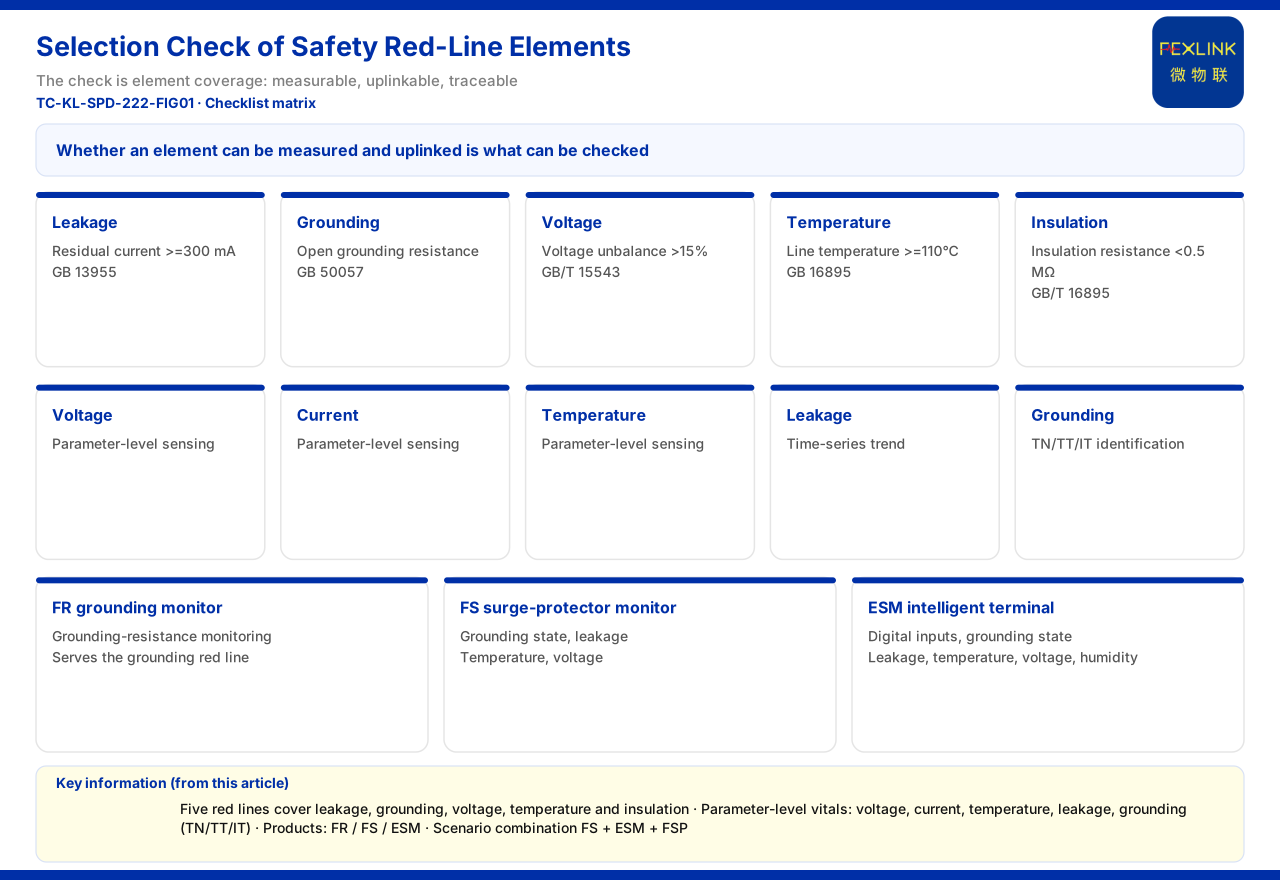
Direct answer
The safety red-line check in selection is essentially answering one question: can the chosen products collect the elements that the safety red-line criteria require. The product material lists five safety red-lines, involving residual current, abnormal open of grounding resistance, three-phase voltage unbalance, line temperature and insulation resistance. The check should compare these five element classes item by item with the product list and confirm that each has a carrying device able to collect and send it up. Note that the product material does not give a one-to-one table between safety red-lines and recommended models; the check should therefore land on element coverage rather than binding a safety red-line directly to a model. Whether the element can be collected and sent up is the inspectable object and the landing point of the check method here.
1. What element class each of the five safety red-lines points to
The product material lists the trigger condition and basis of each safety red-line: residual current reaching 300 mA or above, per GB 13955; abnormal open of grounding resistance, per GB 50057; three-phase voltage unbalance exceeding 15%, per GB/T 15543; line temperature reaching 110°C or above, per GB 16895; and insulation resistance below 0.5MΩ, per GB/T 16895. Translating the conditions into elements yields a list divided by physical quantity: leakage (residual current), grounding, voltage, temperature and insulation. The first step of the check is to confirm whether each of these five element classes has a corresponding collection arrangement in the on-site scheme, rather than saying vaguely that there is lightning-protection monitoring.
2. The landing point of elements in the parameter-level perception layer
The product material also gives a list of basic vital signs for parameter-level perception, including voltage, current, temperature, leakage (with time-series trends and safety red-line pre-position) and grounding (supporting TN, TT and IT system identification). This list overlaps heavily with the five safety red-lines, showing that the criteria of the safety red-lines are not created from nothing but built on parameter-level perception. Selection can use this list as a minimum element set for comparison: whether voltage, temperature, leakage and grounding each have an owner to collect them, and whether current is sufficient to support the related judgement. If an element on this list has no collection arrangement at all on site, the related safety red-line check cannot pass, and this gap should be found at the scheme stage.
3. Who on the product side can carry these elements
The product material gives explicit records of the product-side elements. The FR grounding resistance monitor (e.g. FR-01311-R) carries the grounding-related element, corresponding to the grounding abnormality item among the safety red-lines; the FS surge protective device monitor (e.g. FS-00011-R) covers grounding status, leakage current, temperature, voltage and other elements; and the ESM intelligent lightning-protection monitoring terminal (e.g. ESM-11312-R) has fuller element coverage, including digital inputs, grounding status, leakage current, temperature, voltage, humidity and lifetime estimation. The check can compare each safety red-line with the element lists of these products and confirm whether a carrier already exists. For example, a grounding-type safety red-line needs grounding-resistance monitoring capability, so the list should be confirmed to contain a device of the FR grounding resistance monitor kind, rather than judging coverage merely because a surge protective device is present.
4. How to organise the check table
Making the check into a table makes gaps easier to find. The rows can be the elements corresponding to the five safety red-lines, and the columns can include the element name, the criterion basis, whether there is a collection point on site, the carrying product name and model, and whether it can be sent up to the platform. For leakage, for example, fill in the residual-current criterion and basis in the row, then confirm whether the list contains a product covering the leakage-current element. For temperature, confirm whether the chosen type includes a temperature element and whether its range and environmental conditions cover the site. Every cell in the table can be traced back to existing records in the product material, so the check conclusion is not a subjective judgement but an item-by-item confirmation with evidence. The table itself needs no new material; it merely rearranges scattered information by safety red-line.
5. Scenario combinations as cross-validation
The product material gives its basis as a contrast between scenarios and recommended product combinations. In the surge protective device status monitoring (retrofit of existing SPDs) scenario, the recommended combination includes the FS surge protective device monitor, the ESM intelligent lightning-protection monitoring terminal and the SPD lightning-protection base. Comparing this combination with the check table can serve as cross-validation: if a project falls into a similar scenario and the list lacks one of these capabilities, one should return to the element layer to confirm whether a substitute truly exists or whether something was omitted. Note that the scenario combination is a recommendation given by the material, not a binding of a safety red-line to a model; it is used to indicate the breadth of coverage and cannot replace the item-by-item check.
6. Three common blind spots in the check
There are three common blind spots. The first is a device without the element: the list includes a surge protective device but no device collects grounding resistance, so the grounding-type safety red-line criterion cannot be triggered. The second is an element without an uplink: collection devices are installed on site, but the chosen communication method does not match the gateway or platform, so the data cannot be sent out and the safety red-line criterion is invisible on the platform. The third is collection without a basis: an alarm can be generated but cannot be traced to a specific standard clause, so during review it cannot be explained why the safety red-line holds. The product material lists the standard-clause reference and scenario tag as fields carried by an alarm, precisely signalling that the basis and the data should be kept together. Writing these three blind spots into the check table clearly reduces the situation where everything looks complete but does not actually pass.
7. The material gives no one-to-one mapping between safety red-lines and models
The boundary should be made clear: the product material does not give a check table or matrix of selection, safety red-line and product, nor does it give the recommended model corresponding to each safety red-line. One must therefore not infer from the product material that a given safety red-line must choose a given model. What the check can do is confirm that the element is collectable and can be sent up and record the criterion basis completely; as for the choice of a specific model, it should still be determined in conjunction with installation, supply and communication conditions. Keeping element coverage and model binding apart is the key to keeping this round of checking rigorous.
Scope and limitations
First, this article explains only the selection check method for safety red-line elements; the factual boundary is limited to the product material, and no parameter, standard or certification not listed there is introduced.
Second, the trigger conditions, basis standards, vital-sign list and product elements here are as recorded in the product material; this article does not infer the specifications of unlisted models from them.
Third, the product material gives no one-to-one relationship between safety red-lines and models; the check table here is a method induction from the listed facts and does not represent a decision standard given by the material.
Fourth, the safety red-line check of a specific project must be determined in conjunction with on-site collection points, standard applicability and platform decision logic; this article provides no compliance conclusion or selection calculation.