 微物联研究院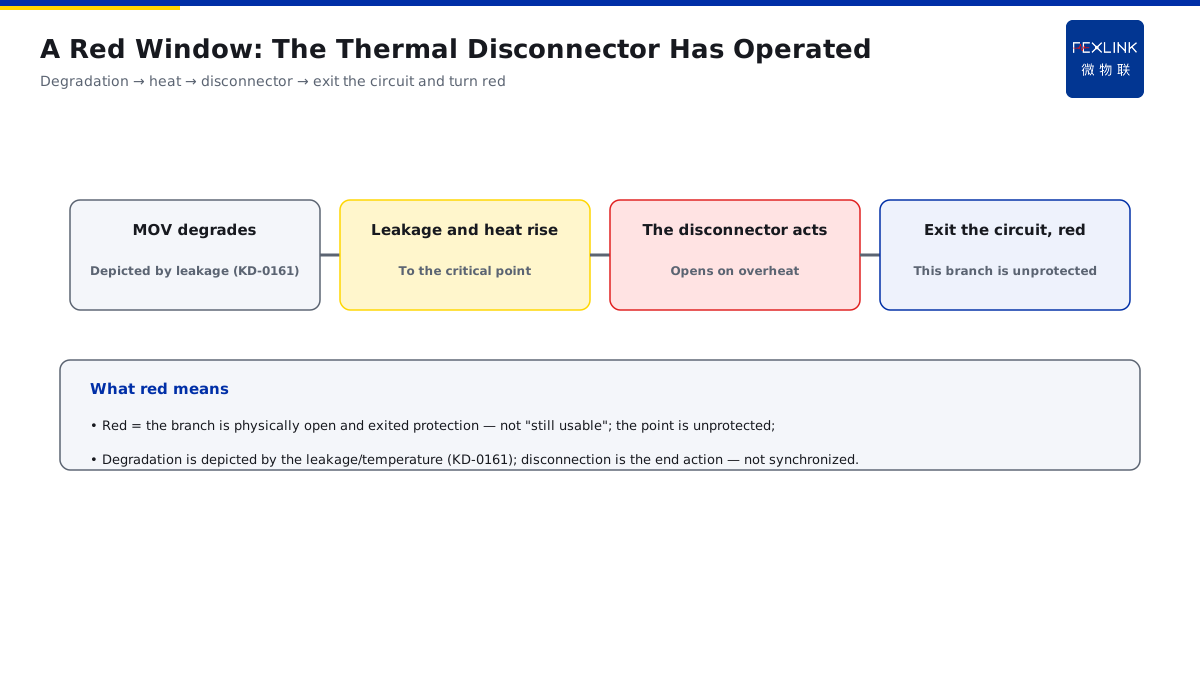
Direct Answer
The SPD window has turned red, yet the leakage current looks normal on site — should it be replaced now? The answer: a red indicator means the internal thermal disconnector/failure indicator has operated — the branch SPD has exited protection. The leakage reads normal at this time often because the disconnected branch no longer participates in the leakage circuit. Use the indicator/telemetry operation as the replacement basis; do not delay with "the leakage is still normal", because this point already has no effective protection.
At a switch room, an SPD indicator turned red and the maintenance staff measured a normal leakage and hesitated. After disassembly, it was confirmed that the internal thermal disconnector had operated and the branch was open — the leakage was normal because the disconnected branch no longer participated in the circuit, not because the SPD was healthy. After replacing it per the indicator, the protection was restored. The key distinction: the indicator operation outranks the leakage reading — red means it has exited protection; a "normal" leakage is the illusion of disconnection and cannot delay the replacement.
Why:
- The indicator meaning: red = the thermal disconnector/failure indicator has operated;
- The leakage illusion: the disconnected branch no longer participates in the leakage circuit;
- The priority: the indicator/telemetry operation outranks the leakage reading;
- The consequence: during the delay, this point has no effective protection.
Key insight: "A red indicator means it has exited protection — a normal leakage is the illusion of the disconnected branch; rely on the indicator/telemetry and do not delay the replacement."
At a project, an SPD indicator turned red with a normal leakage reading, and the maintenance delayed the replacement; in a later strike, the point had no protection and the equipment was damaged. Lesson: the indicator operation is the replacement signal — a normal leakage is not an exemption; delay leaves the point unprotected.
1. What the Red Indicator Means
Step one: understand the meaning of red first.
The thermal-disconnector mechanism:
- After MOV degradation, the leakage rises and heat builds up;
- The thermal disconnector operates on the detected overheat;
- The internal contact opens and exits the circuit;
- The window turns from green to red.
The meaning of the failure indicator:
- Red = this branch has exited protection;
- It is no longer "still usable";
- The inside is physically open;
- The point has no effective protection.
The relationship with the leakage:
- The degradation is depicted by the leakage/temperature (connecting to KD-0161);
- Disconnection is the action at the end of degradation;
- After the operation, the circuit state changes;
- The two are not synchronized in time.
Key insight: "A red window means the thermal disconnector has operated — the branch is physically open and has exited protection, not 'still usable'; red means replace."
2. Why the Leakage Looks "Normal" Then
Step two: explain the contradiction.
The illusion of disconnection:
- The branch is open after disconnection;
- It no longer participates in the leakage circuit;
- The measured leakage is naturally "normal";
- It is disconnection, not health.
The measuring position:
- The total leakage = the sum of the branches still in the circuit;
- The disconnected branch no longer contributes;
- The meter measures the circuit state;
- Not the health of this SPD.
The judgment points:
- A normal leakage is not a normal SPD;
- Look at the indicator/telemetry state;
- Combine the temperature and the action records;
- Do not be misled by "normal".
Key insight: "After disconnection the branch has left the circuit — a 'normal' leakage is the illusion of disconnection, not health; a normal leakage is not a normal SPD."
3. The Priority of the Indicator/Telemetry over the Leakage
Step three: which one decides.
Why the indicator outranks:
- The indicator/telemetry is the operation signal;
- It directly reflects the disconnection state;
- The leakage is an indirect inference;
- The operation signal is the most direct and reliable.
The priority rule:
- Indicator/telemetry operated → replace;
- A normal leakage cannot veto the indicator;
- An abnormal leakage → check further (connecting to KD-0191);
- Judge with the state and the data together.
Practice:
- See the telemetry with the FS/ESM SPD monitor;
- Look at the leakage-temperature-indicator together;
- Red means list it for replacement;
- Do not judge by a single leakage.
Key insight: "The indicator/telemetry operation outranks the leakage reading — red is the replacement signal; a normal leakage cannot veto the indicator operation."
4. The Safety Confirmation before Replacement
Step four: what to do before replacing.
De-energize and confirm:
- Open the SPD circuit power;
- Confirm no voltage before operating;
- Follow the operation procedures;
- Safety first.
State review:
- Review the indicator/telemetry state;
- Confirm whether it has disconnected;
- Check the appearance/temperature rise;
- Record the current state.
The replacement points:
- Replace with the same specification (Uc/In/Imax matched);
- Check the back-up protection (connecting to KD-0185);
- Re-test the state after replacement;
- The wiring follows the specifications.
Key insight: "De-energize and review before replacement — replace with the same specification, check the back-up, re-test after; both safety and matching in place."
5. Record and Review after Replacement
Step five: replacing is not the end.
Why review:
- Confirm the new SPD state is normal;
- Build the new baseline data;
- Check whether it will degrade again;
- Form the closed-loop management.
What to record:
- The time/model/position of the replacement;
- The degradation cause of the old SPD;
- The leakage/temperature baseline;
- The subsequent monitoring data.
The review points:
- The leakage/temperature baseline of the new SPD;
- A horizontal comparison at the same position;
- Key review in the storm season;
- Data-driven decisions.
Key insight: "Record and review after replacement — build a new baseline, check the degradation cause, review in the storm season; the data loop means the replacement is done."
6. Product Implementation: Monitoring and Replacement as One
WeiWuLian products manage SPD replacement:
- FS/ESM SPD Monitor: online leakage/temperature/telemetry;
- FSS Intelligent Surge Protective Device: built-in indicator and telemetry;
- State priority: the indicator operation outranks the leakage;
- Closed-loop management: red means a replacement reminder and review.
The design principle in one sentence: "The indicator operation is the replacement signal — a normal leakage is not an exemption; telemetry online, review after replacement; the data loop keeps the point protected."
7. Common Misjudgments
- "A normal leakage means no replacement": ignoring the disconnection illusion. Result: the point is unprotected. Correct: rely on the indicator.
- "Red still works": ignoring the disconnection. Result: running unprotected. Correct: red means replace.
- "Only the leakage, not the telemetry": ignoring the state signal. Result: a misjudged health. Correct: state + data together.
- "No review after replacement": ignoring the loop. Result: no awareness of the next degradation. Correct: record + review.
- "No degradation-cause check": ignoring the root cause. Result: the new SPD degrades again. Correct: check the cause + build a baseline.
Scope and Limitations
This article explains the replacement decision when the SPD disconnector indicator turns red but the leakage looks normal (the indicator meaning, the disconnection illusion, the priority, the safety confirmation, the post-replacement review), applicable to judging SPD state conflicts and managing replacements. The exact parameters and criteria follow IEC 61643-11, GB/T 18802.11 and the manufacturers' data; this article explains only the judgment logic and operating points. All cases are anonymized (a switch room, a project) and do not refer to any specific customer.