 FEXLINK Research Institute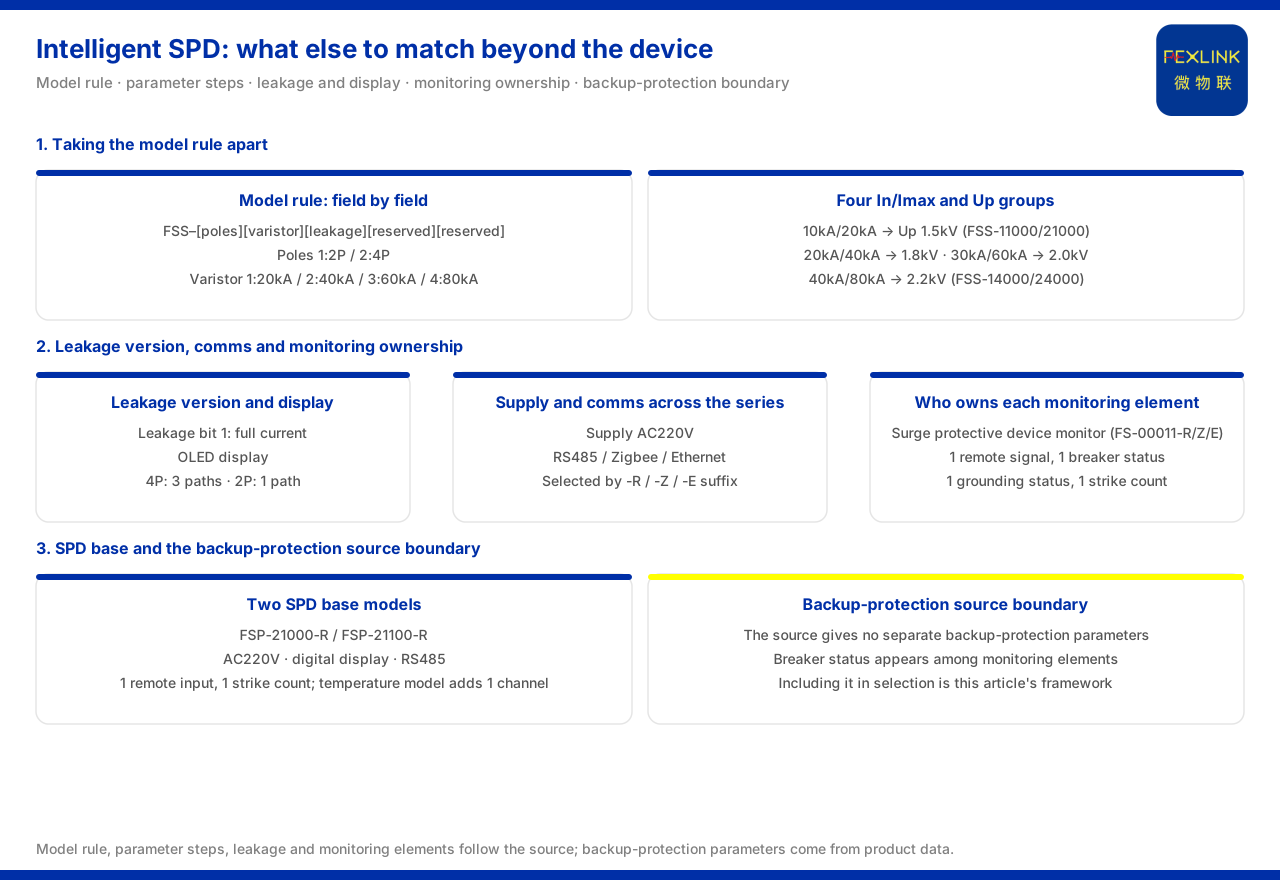
Direct answer
Selecting an intelligent surge protective device involves, besides its own parameters, two supporting matters: who carries status monitoring, and how the back-up protection is coordinated. The model rule the product knowledge base gives is "FSS–[phase][MOV level][leakage][reserved][reserved]–[communication]," in which phase 1 is 2P and 2 is 4P, MOV levels 1 to 4 correspond to maximum discharge currents of 20kA, 40kA, 60kA and 80kA, and leakage 0 is none and 1 is full current. The whole series has AC220V supply and supports RS485, with Zigbee and Ethernet selected by suffix. As for monitoring elements such as remote signalling, air-switch status, grounding status, lightning count, temperature, voltage and lifespan estimation, they appear in the model tables of the surge protective device monitor and the intelligent lightning-protection monitoring terminal; the SPD lightning-protection base provides 1 remote signalling input and 1 lightning count, and the variant with temperature adds 1 temperature channel. As for how the back-up protection, that is, the corresponding circuit breaker or air switch, is selected, the product knowledge base does not separately stipulate it for the intelligent surge protective device; the monitorable air-switch status appears among the monitoring elements above, so bringing back-up protection status into selection consideration is this article's framework rather than a direct proposition of the knowledge base.
1. Look at the model rule before the body
The model of the intelligent surge protective device is determined by a rule. The main segment the product knowledge base gives is, in order, phase, MOV level, leakage and two reserved positions, with the communication method listed separately. The phase digit distinguishes 2P and 4P, the MOV level digit distinguishes four steps of maximum discharge current, and the leakage digit distinguishes whether full-current monitoring is included. Once this structure is understood, the model can be broken into fields for verification: first confirm the phase, then the MOV level, then whether leakage is needed, and finally settle the communication by suffix. The role of the model rule is to structure the selection problem.
2. Phase and MOV level
Phase is the first field. Whether the protected loop is two-wire or four-wire decides whether 2P or 4P is chosen. MOV level is the second field, with four steps corresponding to maximum discharge currents of 20kA, 40kA, 60kA and 80kA; the model table gives nominal discharge current, maximum discharge current and voltage protection level as a group: 10kA and 20kA correspond to 1.5kV, 20kA and 40kA to 1.8kV, 30kA and 60kA to 2.0kV, and 40kA and 80kA to 2.2kV. Accordingly, the 20kA and 40kA steps correspond to the models FSS-12000/22000, and the 40kA and 80kA steps to the models FSS-14000/24000. Phase and MOV level together determine the protection step of the body.
3. Leakage models and status display
The leakage digit determines whether leakage monitoring is brought into the body. The product knowledge base records that the leakage models are the group whose leakage digit is 1; they use an OLED display and include leakage monitoring, in which the 4P type has 3 leakage channels and the 2P type has 1. By contrast, the standard model's display is a digital tube. Whether leakage is needed should follow from whether the leakage state must be observed on the protected loop, not be treated as an accessory to the protection step.
4. Monitoring elements outside the body
Once the protection step of the body is settled, the question of who acquires the monitoring information still remains. In the model table of the surge protective device monitor, the product knowledge base lists the monitoring elements, including remote signalling, air-switch status, grounding status, lightning count, leakage, temperature, voltage and lifespan estimation; among these, the surge protective device monitor (FS-00011-R/Z/E) provides 1 remote signalling channel, 1 air-switch status, 1 grounding status and 1 lightning count. The intelligent lightning-protection monitoring terminal likewise gives these capabilities in the form of monitoring elements. The body handles protection and the monitor side handles status acquisition, connected by a supporting relationship; viewing the two separately helps clarify from which device each item of data comes.
5. The supplement of the SPD lightning-protection base
The monitoring base is another supplementary path. The product knowledge base records that the SPD lightning-protection base has two models, the SPD lightning-protection base (FSP-21000-R) and the SPD lightning-protection base (FSP-21100-R), both with AC220V supply, a digital tube display, 1 remote signalling input and 1 lightning count, and RS485 communication; the variant with temperature additionally includes 1 temperature channel. The difference between the two models is whether temperature monitoring is included. Read together with the body and the monitor, the source of monitoring information may be several: the leakage variant of the body provides leakage monitoring, the monitor provides a fuller set of elements, and the base supplements remote signalling, lightning count and temperature. In compiling a scheme, it should be made clear which device carries each item of monitoring.
6. Back-up protection: knowledge-base boundary and selection framework
Back-up protection is a link often asked about in selection. The product knowledge base does not separately stipulate selection parameters for the back-up protection of the intelligent surge protective device, that is, the corresponding circuit breaker or air switch; it mentions the monitoring element "air-switch status" only in monitoring-related entries. What the knowledge base can provide is the fact that "air-switch status can be monitored," not "what back-up protection a given model should have." Therefore, bringing back-up protection status into the selection consideration belongs to the framework this article summarises: first confirm from the knowledge base that air-switch status is a monitorable element, then treat it as a supporting point to be confirmed together during selection. The parameters and settings of the specific back-up protection should be confirmed against the corresponding product's documentation and not inferred from the model table of the intelligent surge protective device. This distinction prevents "monitorable" from being misread as "already stipulated."
7. Selection and check order
The above can be drawn together into a check order. First, determine the phase by the loop conditions, taking a value between 2P and 4P. Second, determine the MOV level and the corresponding discharge capability and voltage protection level step by the protected-device conditions. Third, confirm whether leakage monitoring is needed, deciding between the leakage model and the standard model. Fourth, determine the communication method by suffix and confirm it is consistent with the site networking. Fifth, clarify whether the monitoring information is carried by the body, the monitor or the base, and verify the attribution of elements such as remote signalling, air-switch status, grounding status, lightning count, temperature, voltage and lifespan estimation item by item. Sixth, treat back-up protection status as a supporting item to be confirmed, but check its parameters and settings against the corresponding documentation. Followed in this order, selection extends from the body parameters to monitoring and supporting items, answering "which model and how to configure it" rather than looking at a single discharge-current figure.
Scope and limitations
First, this article restates only what the product knowledge base lists, and its factual boundary is limited to the model rule, parameter table, leakage-model configuration and monitoring elements of the intelligent surge protective device, and the model table of the SPD lightning-protection base.
Second, the phase rule of 1 for 2P and 2 for 4P, the MOV levels 1 to 4 corresponding to maximum discharge currents of 20kA, 40kA, 60kA and 80kA, leakage 0 for none and 1 for full current, and the grouped correspondence of nominal discharge current, maximum discharge current and voltage protection level from 1.5kV to 2.2kV, are cited as the knowledge base gives them.
Third, the whole series at AC220V, communication RS485, Zigbee and Ethernet selected by suffix, the OLED display and leakage channel counts of the leakage models (3 channels for the 4P type, 1 channel for the 2P type), and the digital tube display of the standard model, are cited as the knowledge base gives them.
Fourth, the monitoring elements of the surge protective device monitor and its 1 remote signalling channel, 1 air-switch status, 1 grounding status and 1 lightning count are cited from the knowledge-base model table.
Fifth, the AC220V, digital tube, 1 remote signalling input, 1 lightning count and RS485 of the two SPD lightning-protection base models, and the additional 1 temperature channel of the temperature variant, are cited from the knowledge-base model table.
Sixth, the product knowledge base does not separately stipulate selection parameters for the back-up protection of the intelligent surge protective device; the statement in this article that back-up protection status is brought into selection consideration is a methodological framework, not a direct proposition of the knowledge base; specific parameters and settings are subject to the corresponding product documentation.
Seventh, this article explains only the body parameters, monitoring elements and supporting relationships and provides no grading configuration or setting for a specific project; actual results are subject to the latest product documentation and the project solution.