 FEXLINK Research Institute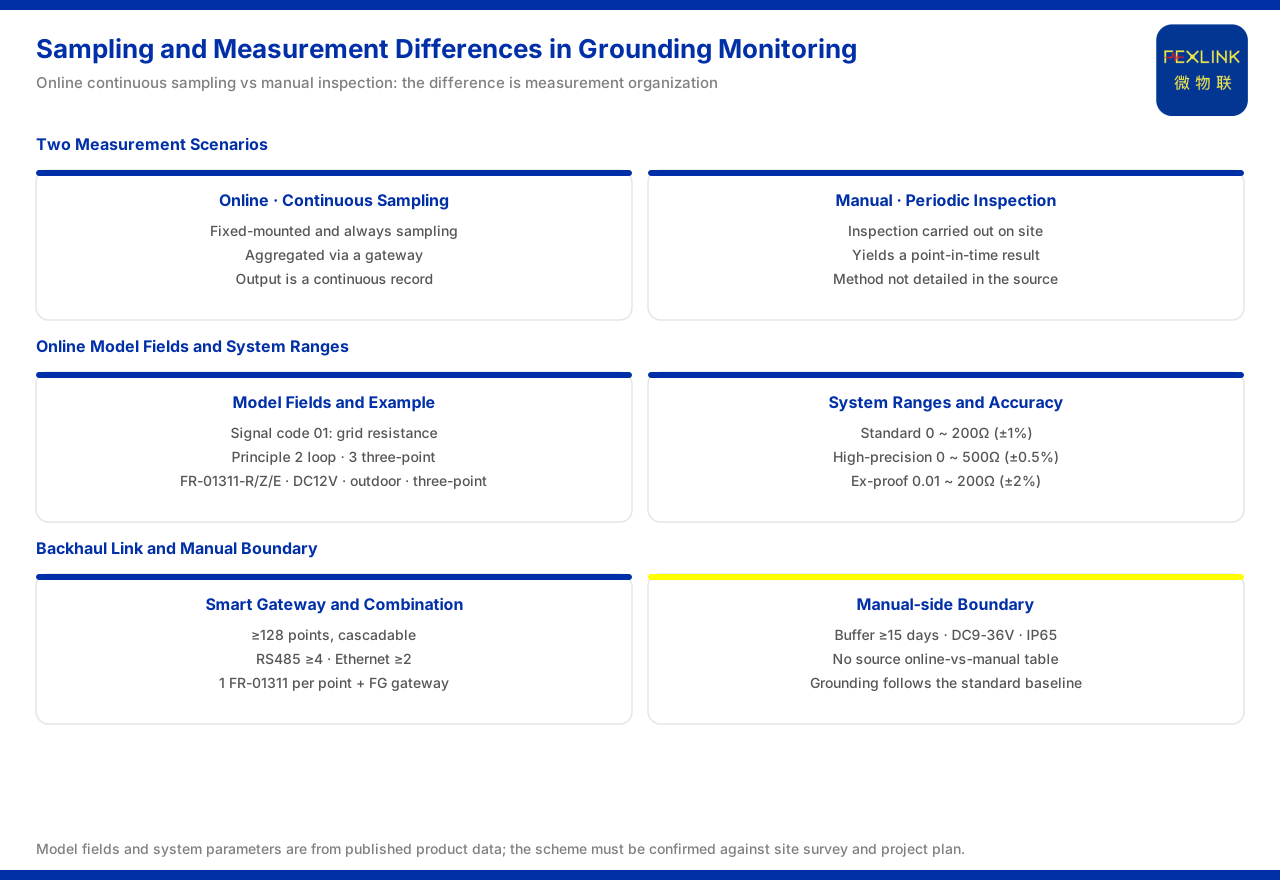
Direct answer
The difference between online sampling and manual detection in grounding monitoring lies not in the resistance value finally measured but in the way the measurement is organised: online monitoring samples the grounding-grid resistance continuously with a fixed installation and returns it through a gateway, while manual detection is a staged inspection carried out on site. The product knowledge base specifies that, in the model rule of the FR grounding resistance monitor (e.g. FR-01311-R), signal acquisition 01 is the grounding-grid resistance, detection principle 2 is the loop method and 3 the three-point method, and installation method 1 is outdoor and 2 indoor; in the model table, the FR grounding resistance monitor (FR-01311-R/Z/E) is all DC12V, outdoor-installed and three-electrode measured, communicating over RS485, Zigbee and Ethernet respectively, with an aluminium housing 204×202×72mm. Online monitoring provides a continuous sampling record, and manual detection provides an inspection result.
1. First distinguish the two measurement scenarios
Before discussing the difference, separate the two scenarios. On the online side, the device is fixed at the measured grounding grid, samples continuously in a set manner, and returns the data to the platform through a gateway, forming a continuous record; on the manual side, a periodic on-site inspection yields a result at a point in time. The two have different goals: online monitoring answers "how the grounding-grid resistance changes over time and whether there is an abnormal trend", while manual detection answers "whether the result detected at this moment meets the requirement". Separating the scenarios first gives meaning to the later comparison.
2. The online side: signal acquisition and detection principle
The observable object on the online side is specified by the model rule. The product knowledge base records that the model rule of the FR grounding resistance monitor is formed by signal acquisition, detection principle, installation method and power supply in the body segment, with communication listed separately; signal acquisition 01 means the grounding-grid resistance, that is, the physical quantity this series acquires is the resistance of the grounding grid; the detection principle is divided into two tiers, 2 the loop method and 3 the three-point method, corresponding to different on-site measurement methods. The installation method is 1 outdoor and 2 indoor.
3. The form of the online device in the model table
The model table further explains the form of the online device. The product knowledge base lists the FR grounding resistance monitor (FR-01311-R/Z/E), all DC12V-supplied, outdoor-installed and three-electrode measured, differing only in communication, respectively RS485, Zigbee and Ethernet; the housing is aluminium, 204×202×72mm. As can be seen, this is a fixed installation for online sampling, not a handheld inspection tool: it needs power, an installation position and a communication method.
4. System-level range and accuracy
The sampling accuracy and range of online monitoring are given by system-level reference parameters. The grounding resistance monitoring system reference parameters of the product knowledge base divide the monitoring unit into three tiers: the standard type 0 to 200Ω (±1%), the high-precision type 0 to 500Ω (±0.5%), and the explosion-proof type 0.01 to 200Ω (±2%) with an explosion-proof rating of Ex d IIB T4/T6 Gb; the system protection rating is IP65 and the operating temperature is -20 to 70℃ (the explosion-proof T6 type is -40 to 70℃). These three tiers show that online monitoring does not have only one range but is tiered by measurement occasion, with the explosion-proof type facing areas requiring an explosion-proof rating. When checking an online solution, in addition to confirming the model fields, one must return to the system parameters to confirm whether the range and accuracy tier cover the site's magnitude.
5. Gateway and link: how sampling is returned
The reason online monitoring is "continuous sampling" lies in the return link. The product knowledge base gives the parameters of the smart gateway of the grounding resistance monitoring system: no fewer than 128 points carried and cascadable, no fewer than 4 RS485 channels and no fewer than 2 Ethernet channels, 4G / 5G / LoRa optional, a data cache of no fewer than 15 days, DC9-36V wide-voltage supply, and a protection rating of IP65. The meaning of this link is that the data acquired by the online device is aggregated, cached and returned through the gateway, forming a continuous sampling record; the cache capability ensures no data loss when the uplink fluctuates.
6. The boundary of the manual inspection side
The manual inspection side must be explained within the boundary of the product knowledge base. In the chapter on the grounding resistance monitor, the product knowledge base records only the detection principle of the online device (loop method / three-point method) and signal acquisition 01 of the grounding-grid resistance; the method and instruments of manual detection are not unfolded in that chapter, and no explanation or comparison table of the measurement difference between online sampling and manual detection is given. This article therefore cannot assert from the product knowledge base which specific method manual detection uses, nor give a conclusion about the numerical difference between the two. What can be confirmed is that the position of online monitoring is continuous acquisition and that of manual detection is staged inspection, and the difference comes from the property of the measurement organisation, not from a recorded comparison datum.
7. How the two cooperate
Having established their respective positions, the cooperation relation is fairly clear. In its typical application scenarios and selection comparison, the product knowledge base gives the recommended product combination for the online monitoring of substation and traction-substation grounding grids as: one FR-01311 per grounding point, plus the FG lightning-protection smart gateway (e.g. FG-0221-ER), plus the FEXCloud IoT cloud platform; the product knowledge base also notes that the grounding resistance monitoring series has been applied to the online monitoring of railway traction-substation grounding grids and to the Jinzhou Port oil tank area (10 sets per tank). These records show that online monitoring carries the continuous-observation duty, while manual detection can serve as a staged supplementary check. The two are not substitutes but a cooperation of continuous record and staged inspection. In addition, the safety red-line guard specifies that "abnormal open circuit of grounding resistance" is a non-bypassable red line, based on GB 50057, showing that the bottom-line criterion of grounding state is governed by the national standard, to which both online and manual methods must return.
8. Reducing the difference to a checking order
Putting the above together, the difference between online sampling and manual detection reduces to a checking order. First, confirm the purpose: to observe trends and continuous records, choose online monitoring; to obtain a staged result, use manual inspection. Second, confirm the three groups of fields of the online solution: whether signal acquisition, detection principle and installation method align with the site. Third, confirm the range and accuracy tier, returning to the system parameters to check the standard, high-precision or explosion-proof type. Fourth, confirm the return link, checking by the gateway's carried points, interfaces and cache capability. Fifth, confirm the bottom-line criterion: an abnormal open circuit of grounding is a national-standard red-line item and must be governed by the standard.
Scope and limitations
First, this article restates only what the product knowledge base lists, with the factual boundary limited to the model rule of the grounding resistance monitor, the FR-01311 model table and housing, the range and accuracy and gateway parameters of the grounding resistance monitoring system, the typical scenario combination, and the grounding-related criterion in the safety red-line guard.
Second, the signal acquisition 01 as the grounding-grid resistance, detection principle 2 as the loop method / 3 as the three-point method, installation method 1 outdoor / 2 indoor, and the power supply, measurement method, installation environment, communication and housing dimensions of the FR-01311-R / Z / E types, are all cited from the product knowledge base.
Third, the system-level standard type 0 to 200Ω (±1%), high-precision type 0 to 500Ω (±0.5%), explosion-proof type 0.01 to 200Ω (±2%) with explosion-proof rating Ex d IIB T4/T6 Gb, IP65 and the operating temperature, and the smart gateway's carried points, interfaces, cache, supply and protection rating, are all cited from the product knowledge base.
Fourth, the application records such as railway traction-substation grounding-grid online monitoring and the Jinzhou Port oil tank area (10 sets per tank) are listed by the product knowledge base; this article only transcribes them and does not represent a commitment about the results of other projects.
Fifth, the product knowledge base gives no explanation or comparison table of the measurement difference between online sampling and manual detection, and does not unfold the specific method of manual detection.
Sixth, this article only explains the difference and cooperation of the two methods and provides no specific project range selection, grounding rectification or installation scheme; the relevant conclusions must be confirmed with site survey and the project solution.