 FEXLINK Research Institute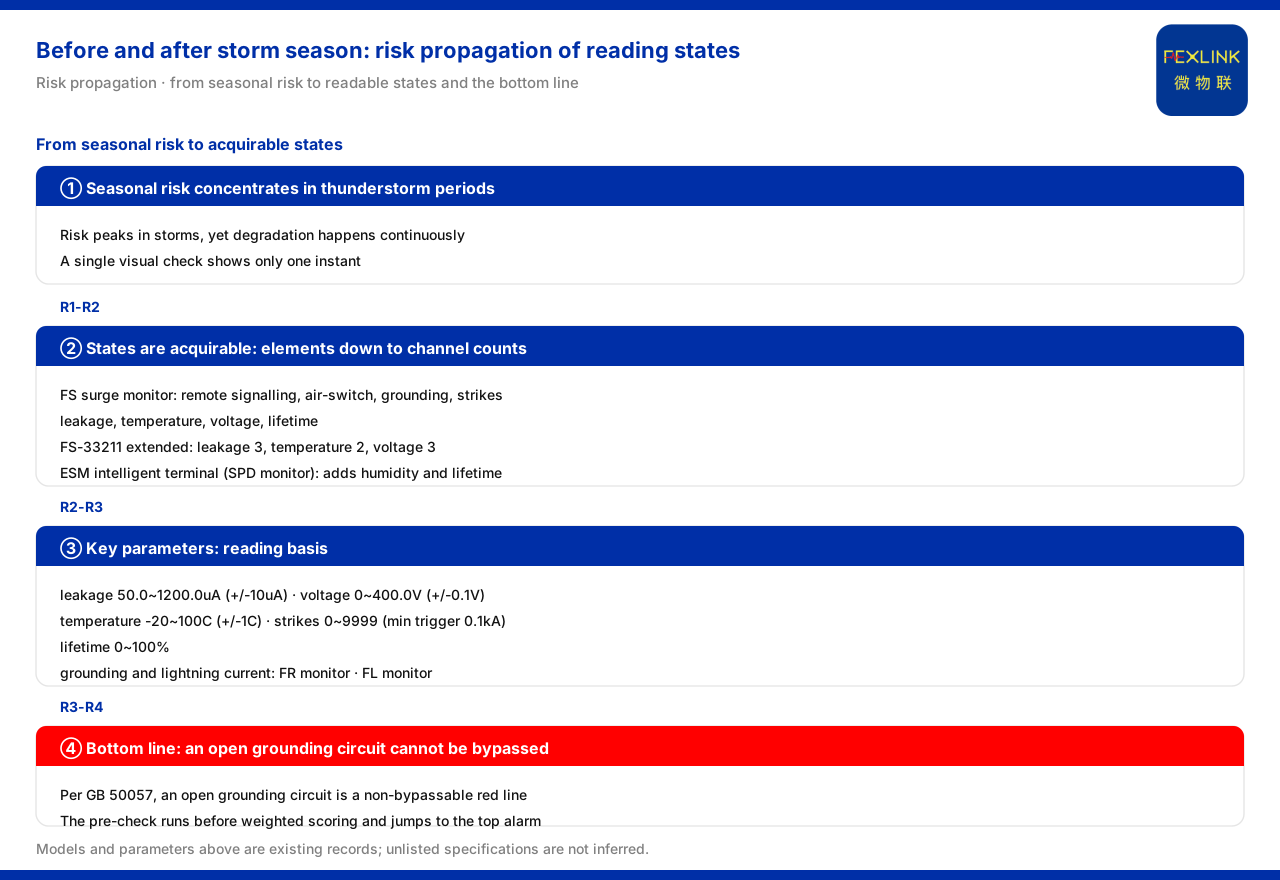
Direct answer
Around the thunderstorm season, the focus of lightning-protection management should shift from visual inspection to the reading of state quantities. The product material shows that the FS surge protective device monitor (e.g. FS-33211) can acquire remote signalling, air-switch state, grounding state, lightning strike count, leakage current, temperature, voltage and lifetime estimation; the ESM intelligent lightning-protection monitoring terminal (SPD monitor, e.g. ESM-21312) covers a more complete set of elements, adding humidity and lifetime estimation. What actually has to be read before and after the season is the change in these quantities, not a one-off visual conclusion.
1. What is read before and after the season is change, not a one-off visual check
Seasonal risk is concentrated in the thunderstorm period, while the degradation of device state happens continuously. The product material lists these acquirable quantities as monitoring elements, and they correspond exactly to several aspects of degradation: change in leakage current, temperature anomaly, accumulation of lightning strikes, and change in lifetime estimation. A single visual check at the seasonal node sees only a cross-section at one moment; only by acquiring these quantities continuously does a judgeable trend form.
The distinction is structural rather than stylistic. A visual check answers whether the device is still present and apparently intact; a state quantity answers how the device is behaving between events. A reading taken only once cannot separate a normal device from one that is slowly degrading, because at the instant of inspection both may look the same. Persisting the reading is what turns a momentary impression into a basis for judgment.
2. Readable state quantities of a surge protective device
The monitoring elements of the FS surge protective device monitor include remote signalling, air-switch state, grounding state, lightning strike count, leakage current, temperature, voltage and lifetime estimation. The extended-tier monitor in the product material (e.g. FS-33211) adds, on top of the basic elements, 3 leakage-current channels, 2 temperature channels, 3 voltage channels and lifetime estimation. The readable quantities are therefore already concrete down to channel counts and element types, and before and after the season they can be read item by item.
The basic tier and the extended tier differ not in connectivity but in depth. The basic tier answers whether the device has operated and whether the switch has opened; the extended tier adds quantities that vary continuously and can describe how the device behaves between events. Reading the tier that matches the installed equipment is the precondition for reading the quantities at all.
3. The reading basis for key parameters
In parameter terms, the key parameters given for the FS surge protective device monitor are leakage current 50.0~1200.0μA (±10μA), voltage 0~400.0V (±0.1V), temperature -20~100℃ (±1℃), lightning strike count 0~9999 times (minimum trigger 0.1kA) and lifetime estimation 0~100%. Checking both the current value and the historical value of each of these quantities is more meaningful than merely confirming that the surge protective device is still present.
Each item carries its own tolerance, so a value is interpretable only together with the range against which it was specified. Reading the set as a whole, rather than as a pass/fail on a single number, is what distinguishes a trend from a snapshot.
4. What the full-element terminal adds: humidity and lifetime
Terminal-level products provide a more complete basis. The ESM intelligent lightning-protection monitoring terminal (SPD monitor) is a full-element SPD monitoring terminal; besides switching quantity, grounding state, lightning strike count, leakage current, temperature and voltage, it adds humidity and lifetime estimation. Within the series, ESM-21312 has 3 leakage-current channels, 2 temperature channels and 3 voltage channels.
The fuller the set of elements, the better the terminal can separate "looks normal" from "is degrading". Humidity is an environmental element rather than a device element, so its inclusion extends observation from the device alone to the conditions in which the device operates.
5. Grounding and lightning current are also within monitoring scope
Problems at the grounding end are harder to notice on site. The FR grounding resistance monitor (e.g. FR-01311) uses DC12V, outdoor installation and the three-pole method, with communication selectable as RS485, Zigbee or Ethernet; the product material records that the FR/FRP series has been applied to grounding-grid online monitoring at railway traction substations and to the Jinzhou Port oil tank farm. In addition, the FL lightning current / transient current monitor is used to acquire the lightning current state quantity. That is, both the grounding resistance value and the lightning current itself fall within the monitorable range.
These two quantities are easy to overlook precisely because neither produces a visible sign during ordinary operation. Bringing them into monitoring shifts the question from whether a grounding point is intact today to whether its resistance is drifting over time.
6. Where these quantities sit in the system architecture
The product material summarizes the monitoring system as a general four-layer architecture. The perception layer consists of monitoring modules such as the surge protective device monitor, the grounding resistance monitor and the lightning current / transient current monitor, together with smart meters and sensors (Rogowski coil, NTC, microamp-level leakage current sensor). The edge layer consists of gateway devices such as the lightning-protection smart gateway, the intelligent edge computing gateway and the industrial gateway, as well as the industrial wearable controller and the cloud PLC. Reading state quantities before and after the season lands exactly at these two layers: acquisition at the perception layer and transport at the edge layer.
7. Bottom line: a grounding open-circuit anomaly cannot be bypassed
Whatever the number of monitoring elements, one class of failure must not be handled as an ordinary alarm. The product material lists a grounding resistance open-circuit anomaly as one of 5 non-bypassable safety red lines, with GB 50057 as the basis; moreover, the standard validation at the front layer (the pre-check that precedes the red line) executes before the weighted calculation, and a red-line trigger directly outputs the highest-level alarm and skips all weighted computation. Whether grounding holds is a bottom line, not a negotiable operating parameter.
The ordering matters: the safety judgment is placed before scoring so that it cannot be diluted by later weighting. A monitoring scheme may vary in how many elements it reads, but it may not vary in whether this condition is enforced.
Scope and limitations
First, this article explains only the state quantities that can be attended to before and after the thunderstorm season; the factual boundary is limited to what the product material lists, and no standard clause, parameter, certification or case not listed there is introduced.
Second, the product material does not give an independent state-quantity threshold list or seasonal criterion conditioned on "before or after the thunderstorm season"; the statement that trends should be attended to before and after the season is an editorial synthesis drawn from the listed monitoring elements, and does not mean that the material defines a seasonal threshold.
Third, the models and parameters in this article are all as recorded in the material; this article does not infer the specifications of unlisted models from them, nor does it draw performance or effect inferences.
Fourth, the specific inspection arrangement and monitoring scheme must be determined in conjunction with the on-site structure and operation requirements; this article does not provide selection or period-calculation results.