 FEXLINK Research Institute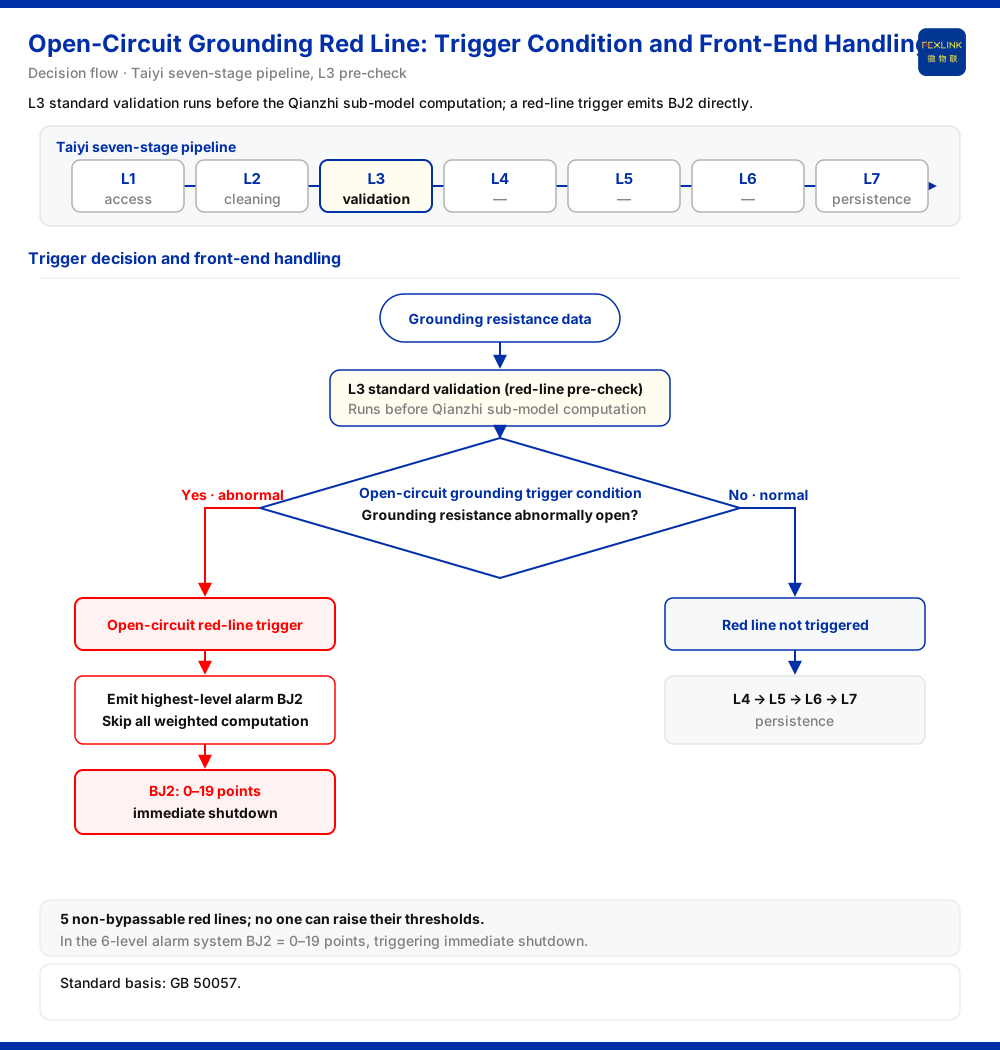
In grounding monitoring, one question must be settled first: when does a grounding abnormality count as a red-line event, and what does the system do about it? Under the knowledge base, the grounding red line triggers on "abnormal open circuit of the grounding resistance", with GB 50057 as the basis. The response is not an ordinary alarm: the front-end layer L3 standard check directly outputs the highest-level alarm BJ2 and skips all weighted computation. This article gives the direct answer first, then decomposes the mechanism layer by layer.
1. Direct Answer: One End Triggers, One End Handles
The core question splits into two: what triggers it, and what happens afterward.
At the trigger end, the grounding red line triggers on "abnormal open circuit of the grounding resistance", with GB 50057 as the basis. This is a state-type condition: it describes the state of the grounding path, not a negotiable numeric range.
At the handling end, the decision is carried by the front-end layer L3. The L3 standard check executes before the Qianzhi sub-model computation; once the red line triggers, it directly outputs the highest-level alarm BJ2 and skips all weighted computation. In the 6-level alarm system, BJ2 corresponds to 0-19 points, and its handling direction is immediate shutdown.
The two ends link into one mechanism chain: the open circuit is recognized, L3 judges the red line to hold, BJ2 is output directly, weighting is terminated, and the final handling is highest-level, immediate shutdown.
2. Reading the Trigger Condition
The core wording is "abnormal open circuit", annotated with GB 50057. Set against a threshold alarm, the difference is clear: a threshold alarm asks whether a value crossed a pre-defined line, requiring a threshold, unit and comparison direction; "abnormal open circuit" asks whether the grounding path is already open, which is a state fact.
The value of a state-type condition is its small decision space: open and not-open are distinguishable facts, so no subjective strictness enters at the trigger stage. This is why it suits a red line — a red line needs no sensitivity, only the absence of dispute, with no middle ground of "severe enough or not".
This article uses only the trigger condition written in the knowledge base and its GB 50057 basis. It does not expand on field causes, detection methods or specific resistance limits, nor cite standard clauses absent from the knowledge base; the boundary is the grounding red-line entry in the knowledge base.
3. Non-Bypassable: Five Red Lines and Frozen Thresholds
The grounding red line is not isolated. The knowledge base writes the red-line guard as a group of five rules, of which the grounding red line is one; their shared feature is that no one can raise the threshold. This carries two layers.
The first is nature: a red line is not an ordinary alarm threshold and cannot be adjusted to field preference, project difference or operational habit. Ordinary thresholds can be discussed in terms of strictness; red lines cannot.
The second is authority: there is no "appeal" channel, and the permission design allows no relaxation. "No one" emphasizes universality — not that a particular post cannot adjust it, but that no role can raise the threshold.
Facing the grounding red line, the space for discussion is compressed to "how to handle", with no room for "whether it counts". This is the divide from ordinary scoring: scoring can be weighted and compromised, whereas a red line judges only acknowledge or do not acknowledge.
4. Handling Mechanism: Why L3 Precedes Analysis
Handling after a trigger is specified by the front-end layer L3 in the knowledge base: the L3 standard check, that is, the red-line front-end precheck, executes before the Qianzhi sub-model computation; once the red line triggers, it directly outputs the highest-level alarm BJ2 and skips all weighted computation.
This contains three separable actions that together form a handling chain.
First, position: L3 sits before model computation — the red-line precheck is not a branch of the analysis but a front-end gate to it, running before any sub-model.
Second, action: triggering outputs the highest-level alarm BJ2, with no human step of "whether to escalate"; the output itself is the highest level.
Third, consequence: all weighted computation is skipped — specifically the weighted-merging step, not the related data, which still enters the data chain and simply no longer participates in score merging.
Why skip the weighting? Letting a red-line conclusion into composite scoring could let an average over several indicators dilute an established fact. Skipping it keeps the red-line conclusion from being overridden by other indicators, and the front-end position matters for the same reason: any analytical conclusion must rest on the premise that no red line was crossed.
5. The Meaning of BJ2: 0-19 Points and Immediate Shutdown
BJ2 is not an ordinary level. The 6-level alarm system in the knowledge base gives BJ2 a score range of 0-19 points and a handling requirement of immediate shutdown. The output after the grounding red line triggers is not merely labelled "highest level"; it carries the action direction "immediate shutdown" directly.
Writing the action into the alarm level means the mechanism issues the action requirement together with the conclusion, instead of leaving the decision to on-duty personnel. For a precondition risk such as a grounding open circuit, the intent is direct: no bargaining space is left in the handling sequence.
For the field, the action order on receiving BJ2 should be unambiguous: execute the immediate-shutdown requirement first, then troubleshoot the grounding path, rather than debating "whether it is really severe". This is institutional design, not a denial of field judgment: the red line front-loads and fixes the "does it hold" discussion so the field can concentrate on handling.
6. Engineering Footing: the FR Grounding Resistance Monitor and the Taiyi Hub
On the sensing side, the FR grounding resistance monitor (FR-01311-R) carries grounding-network resistance monitoring and is one source of grounding-state data (the knowledge base). Whether the grounding path is abnormal first requires usable monitoring data in the chain; the grounding resistance monitor therefore stands upstream of the data relevant to the grounding red line.
On the platform side, the Taiyi intelligent control hub system (V2.0) organizes processing as a seven-level pipeline: L1 access → L2 cleaning → L3 standard check (red-line front-end) → L4 → L5 → L6 → L7 persistence (the knowledge base). The standard check is placed at level 3, between "data cleaned" and "analysis begins".
This position determines the precheck's input and output: the input comes from just-cleaned data, and the output determines whether the downstream chain continues. L3 is thus a compliance gate between data availability and analysis start, and the grounding red line is a hard constraint on that gate.
7. Division of Labor with Conventional Alarms
In the 6-level alarm system, BJ2 is only one level, but its special character comes from its binding to the red line. The remaining levels handle continuous risks that can be compromised, reflecting severity through scores and allowing queuing and batching; BJ2 handles an uncompromisable precondition state and gives the strongest action directly.
The two should be understood separately and should not use the same response rhythm: continuous risks can be ordered by score and handled on plan; precondition risks must be answered immediately. Mixing the two rhythms is a common way the red-line mechanism is weakened in operation.
8. Reading Points
On receiving BJ2, two points must be remembered together: it is the highest-level alarm with a score range of 0-19 points, and it carries the immediate-shutdown requirement directly. The field action order should therefore be unambiguous: execute the handling requirement first, then troubleshoot the grounding-path problem.
Avoid reading the mechanism too narrowly. Skipping the weighted computation does not mean ignoring other monitoring data; only the weighted merging is skipped, and the related data is still needed for root-cause troubleshooting. The red-line decision also does not wait for manual escalation, since BJ2 is already the highest level. Understanding these boundaries separates the red-line mechanism from the conventional one.
Scope and Limitations
First, the grounding red-line trigger condition and its GB 50057 basis are limited to the grounding red-line entry in the knowledge base; this article does not cite standard clauses absent from the knowledge base or draw conclusions about specific grounding-resistance limits.
Second, the L3 front-end precheck and BJ2 output mechanism follow the knowledge base; BJ2's 0-19 point range and immediate-shutdown requirement follow the 6-level alarm system in the knowledge base.
Third, the seven-level pipeline description follows the knowledge base; it does not expand on the capabilities of L4 to L7 nor infer handling procedures, time limits or authority details beyond the knowledge base.
Fourth, the grounding resistance monitor's model and measurement-method information is limited to the knowledge base; this article does not infer specific product parameters, certifications or project applicability.
Fifth, expressions such as "five red lines" and "no one can raise the threshold" are limited to the red-line guard in the knowledge base and are not extended to other rules.