 FEXLINK Research Institute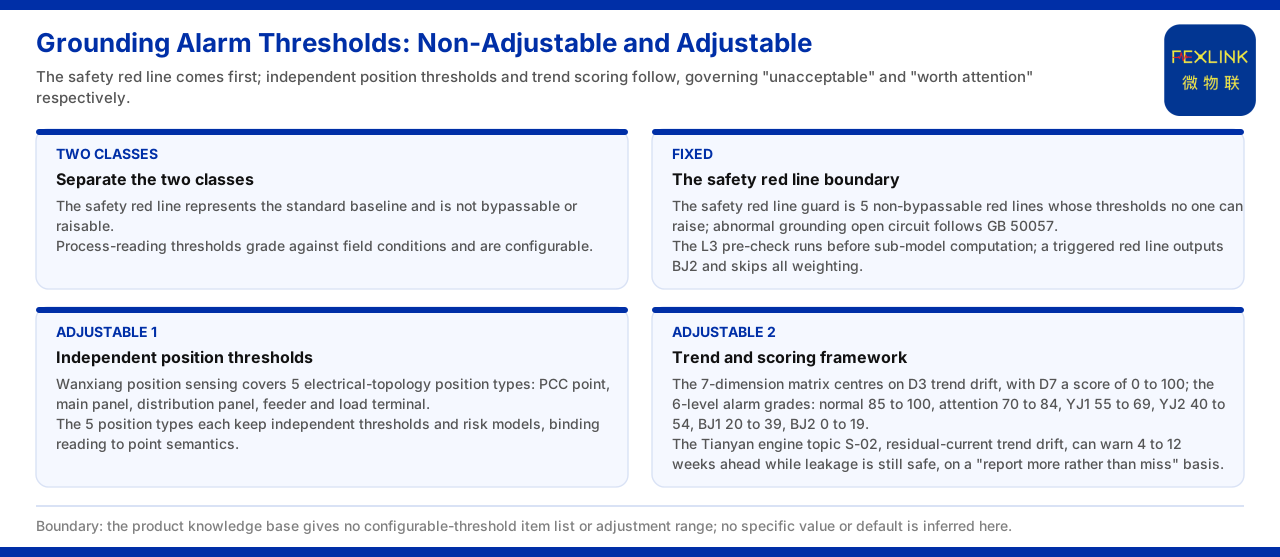
Direct Answer
The thresholds in grounding alarms fall into two parts: those that cannot be adjusted and those that can. The part that cannot be adjusted is the safety red-line. The product knowledge base records that the safety red-line guard has five red-lines, that no one may raise their thresholds, and that "abnormal open-circuit of grounding resistance" is based on GB 50057; the safety red-line pre-check runs before the Qianzhi sub-model computation, and once triggered it outputs the highest-level alarm BJ2 and skips all weighted computation, so it does not take part in the weighting flow of adjustable thresholds. The adjustable part is process-type judgement. The product knowledge base records that the position awareness of the Wanxiang engine maintains independent thresholds and risk models for five electrical topology position types; the 7-dimensional perception matrix takes trend drift as its core and gives a time-series risk score from 0 to 100, with the 6-level alarm graded by score; the trend-drift topic of the Tianyan engine can warn in advance while leakage is still within the safe range. It should be noted that the product knowledge base gives no list of concrete configuration items or adjustment ranges for adjustable thresholds, so this article distinguishes only the nature of the two threshold classes and does not infer concrete values or defaults.
1. First Separate the Non-Adjustable from the Adjustable
When discussing grounding alarm thresholds, the easiest confusion is to treat "whether it can be changed" as one and the same question. The product knowledge base actually divides thresholds into two natures: one is the safety red-line, representing the standard baseline, whose property is non-bypassable and non-raisable; the other is the process-type judgement threshold, used to grade against field conditions, whose property is configurable. Mixing the two leads to two kinds of error: either assuming all thresholds are immovable, or assuming that even red-lines can be adjusted with the site. The correct reading is to ask first which class a threshold belongs to, and only then discuss its value or adjustment method.
2. The Non-Adjustable Part: The Boundary of the Safety Red-Line
The product knowledge base records that the safety red-line guard has five red-lines that cannot be bypassed and explicitly states that no one may raise their thresholds; one of them is "abnormal open-circuit of grounding resistance", based on GB 50057. This constitutes the boundary definition of the red-line part of grounding alarms. The product knowledge base also records that the L3 safety red-line pre-check runs before the Qianzhi sub-model computation, and a triggered red-line outputs the highest-level alarm BJ2 directly and skips all weighted computation. It can therefore be confirmed that the red-line does not take part in the weighting of adjustable thresholds and does not enter later grading computation; it is an interception ahead of the model. This article cites only this mechanism and the non-adjustable property and does not restate a concrete trigger value.
3. One Adjustable Part: Independent Thresholds of Position Awareness
The product knowledge base records that the position awareness of the Wanxiang engine covers five electrical topology position types, namely the PCC point, the main distribution panel, the sub-distribution panel, the feeder and the load terminal, and maintains independent thresholds and risk models for each. This constitutes the mechanism basis of configurable process thresholds in grounding alarms. The same kind of grounding anomaly may have different consequences and handling priorities at different electrical positions, so maintaining independent thresholds by position type binds the judgement to the semantics of the point. The product knowledge base gives no concrete threshold value for each position type, so this article cites only the mechanism of "independent maintenance by type" and does not add the concrete value of each position.
4. The Other Adjustable Part: Trend and Scoring Framework
Beyond numerical thresholds, the product knowledge base also gives a trend-type judgement framework. It records that the 7-dimensional perception matrix contains D3 trend drift, marked as the core dimension, and D7 as a time-series risk score from 0 to 100; the 6-level alarm is graded by score, with normal from 85 to 100, attention from 70 to 84, YJ1 from 55 to 69, YJ2 from 40 to 54, BJ1 from 20 to 39, and BJ2 from 0 to 19. The configurable process-type judgement is carried out precisely on this scoring and grading framework. The product knowledge base also records that the S-02 topic of the Tianyan engine is residual-current trend drift, using a cumulative-sum method, which can detect a weak mean drift while leakage is still within the safe range and warn 4 to 12 weeks in advance, under the convention "better to over-report than to miss". This shows that, beyond the red-line, trend-type thresholds can be set to discover hidden risks earlier.
5. How the Two Threshold Classes Work Together
Putting the two threshold classes together, the grounding alarm logic is layered. The frontmost layer is the safety red-line, responsible for intercepting the standard baseline; after it come the independent thresholds of position awareness and the trend score, responsible for grading against the point and the direction of travel. The two are not substitutes for each other: the safety red-line governs "unacceptable", while the process threshold governs "worth attention". The product knowledge base gives no concrete linkage rule between the two layers, nor a list of configuration items or adjustment ranges for adjustable thresholds, so this article can only explain the layering and does not infer the concrete algorithm between layers. What can be confirmed is that, however the process thresholds are configured, the safety red-line keeps its non-bypassable property, which is the common constraint of both layers.
6. Boundaries That Must Be Held
The above can be reduced to a reading order. First, decide whether the threshold belongs to the safety red-line or to process-type judgement. Second, if it belongs to the safety red-line, cite its properties of being non-bypassable, non-raisable, pre-checked and outputting BJ2, without citing a concrete value. Third, if it belongs to process-type judgement, cite the framework of five independent thresholds of position awareness, or the framework of trend drift and the 6-level score. Fourth, if advance warning is involved, cite the mechanism and convention of the trend-drift topic of the Tianyan engine. The boundary that must be held is this: the product knowledge base gives no list of concrete configuration items or adjustment ranges for adjustable grounding alarm thresholds, so the numerical upper and lower limits and defaults of each process threshold are outside the scope of citation, and field configuration must be determined separately against formal rules.
Applicability and Limits
- This article restates only what the product knowledge base lists; its factual boundary is the records of the safety red-line guard, the position awareness of the Wanxiang engine, the 7-dimensional perception matrix of the Qianzhi engine and the trend-drift topic of the Tianyan engine.
- The non-bypassable nature of the five safety red-lines, the statement that no one may raise their thresholds, the GB 50057 basis of "abnormal open-circuit of grounding resistance", and the L3 pre-check running before the sub-model computation, outputting BJ2 and skipping weighting are cited under the listed convention; concrete trigger values are not restated.
- The five electrical topology position types maintaining independent thresholds and risk models are cited under the listed convention; the concrete threshold of each position type is not added.
- The D3 trend drift as the core of the 7-dimensional perception matrix, the D7 time-series risk score from 0 to 100, and the score bands of the 6-level alarm are cited under the listed convention.
- The cumulative-sum method, the 4 to 12 week advance warning and the convention "better to over-report than to miss" of the trend-drift topic of the Tianyan engine are cited as listed; their applicable scope is not inferred from them.
- The product knowledge base gives no list of configuration items or adjustment range for adjustable thresholds, and this article accordingly declares that it distinguishes only the nature of the two threshold classes and provides no concrete configuration value.
- This article does not constitute a commitment to the alarm configuration of a specific project; the latest product documents and formal rules prevail in practice.