 FEXLINK Research Institute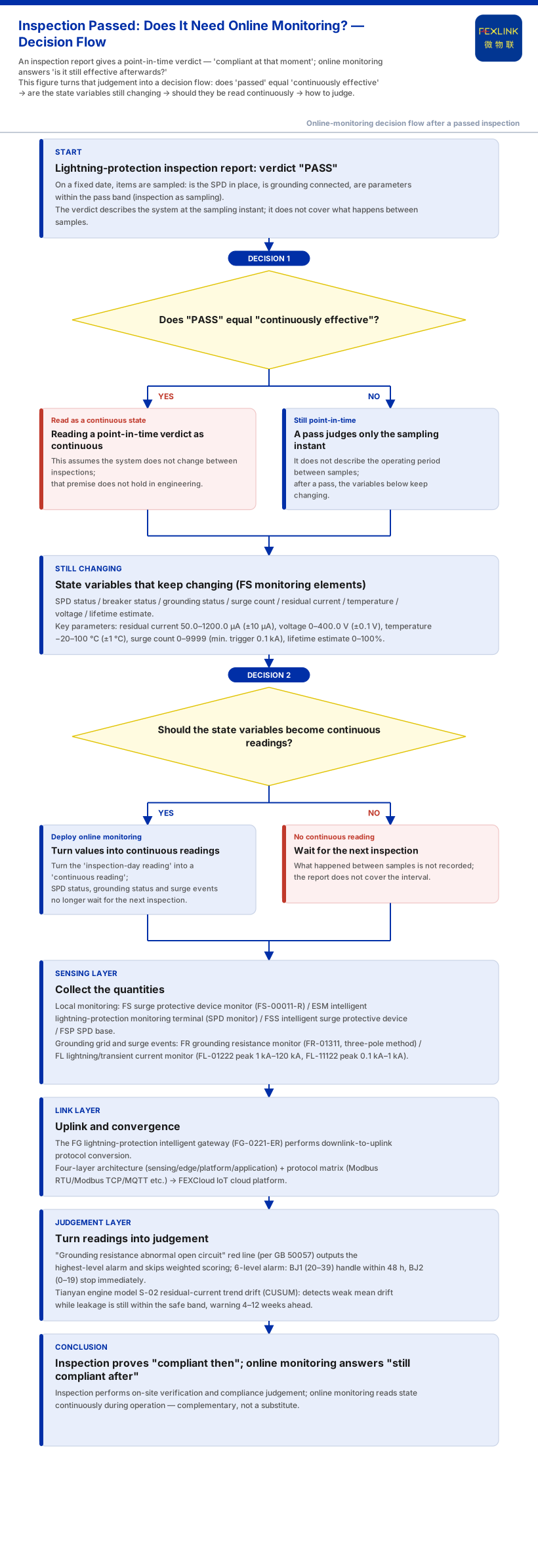
The Short Answer
A lightning protection inspection answers one question: "Was the system compliant at the moment it was tested?" It returns a point-in-time finding. Lightning protection effectiveness, by contrast, keeps changing with strikes, component degradation, and grounding variation — it is a state variable. Between a passing inspection and continued effectiveness lies a span of time that the inspection report does not capture. Online monitoring reads exactly that span. Products, models, parameters, architectures, and scenarios follow current product documentation, and this material does not replace the basis for engineering design, inspection, or acceptance.
1. A Passing Inspection Is a Point-in-Time Finding, Not a Continuous State
An inspection is, in essence, an on-site verification. On a specific date, it checks a defined set of items once: whether the surge protective device (SPD) is in place, whether grounding is continuous, whether parameters fall within the compliant range — and then it writes the conclusion into a report. That report describes the system state at the instant of inspection, not the operating process between two inspections. Any check at fixed intervals covers only the instant of checking; it cannot cover changes within the interval. This is a property of the cycle itself, independent of how carefully the inspection is performed.
A "passing inspection" and "the system remains effective thereafter" are therefore not the same statement. The former judges an instant; the latter describes an operating period. Treating them as equivalent assumes that a lightning protection system does not change between inspections — a premise that does not hold in engineering practice. The fact that a surge protector monitor lists grounding status, strike count, leakage current, temperature, voltage, and lifetime prediction as monitoring elements shows these are state variables meant to be read continuously, not static attributes sealed away by one inspection.
2. What Keeps Changing After a Pass
Does the system still change after it passes? The monitorable elements answer directly. The FS surge protector monitor incorporates remote signaling, air switch status, grounding status, strike count, leakage current, temperature, voltage, and lifetime prediction. Its key parameters are leakage current 50.0–1200.0 μA (±10 μA), voltage 0–400.0 V (±0.1 V), temperature −20–100 °C (±1 °C), strike count 0–9999 (minimum trigger 0.1 kA), and lifetime prediction 0–100%. Strike count reflects accumulated impulses, lifetime prediction remaining life, and leakage current and temperature current health. None is fixed once installed; all evolve with time and events. This article does not infer a quantitative model, degradation curve, or statistical law for how they change. What can be stated is that these state variables exist and can be acquired.
3. What Online Monitoring Reads: Turning State Variables into Continuous Readings
Because an inspection report covers only an instant, state variables must become continuous readings rather than "the value on inspection day." The monitoring-class devices in the product line take on this handoff. These products come from Weiwulian Technology (Shenzhen) Co., Ltd., and FEXCloud serves as the IoT cloud platform.
At the local monitoring layer, the FS surge protector monitor covers leakage current, temperature, voltage, strike count, and lifetime prediction, tiered by model. FS-00011 supports only remote signaling, air switch status, grounding status, and strike count; FS-03211 adds three leakage-current channels and two temperature channels; FS-33211 further adds three voltage channels and one lifetime-prediction channel. The ESM intelligent lightning protection monitoring terminal (SPD monitor) is a full-feature terminal whose elements also include humidity; its current parameter range includes 0.05–1.2 mA, and power may be DC5V or AC220V.
At the self-monitoring device layer, the FSS intelligent surge protector integrates protection and monitoring: In/Imax from 10 kA/20 kA to 40 kA/80 kA, Up 1.5 kV–2.2 kV, poles 2P/4P, the full series powered at AC220V, and communications RS485, Zigbee, and Ethernet selected by suffix. The FSP SPD base provides one remote-signaling input and one strike-count input; FSP-21000-R has no temperature, while FSP-21100-R includes it.
At the grounding-grid and strike-event layer, the FR grounding resistance monitor FR-01311 uses the three-pole method, is powered at DC12V, is installed outdoors, supports RS485/Zigbee/Ethernet, and has an aluminum enclosure of 204×202×72 mm. Among FL lightning/transient current monitors, FL-01222 (indoor) and FL-01212 (outdoor) have a peak range of 1 kA–120 kA with energy monitoring, while FL-11122 (indoor) has 0.1 kA–1 kA. SPD status, grounding status, and strike events no longer depend on the next inspection.
4. From Reading to Judgment: Architecture, Protocols, and Alarms
Reading is only the first step; data must travel upward and become a judgment. A monitoring system is typically organized into four layers — sensing, edge, platform, and application. The sensing layer acquires data from FS/FR/FL/ES-series monitoring modules, smart meters, and sensors; the edge layer uploads it through gateways to FEXCloud; and the application layer produces visualization, management of alarms, analytical reports, and mobile inspection. The protocol matrix specifies downlink Modbus RTU (RS485), Zigbee (Modbus), and LoRa, and uplink Modbus TCP/MQTT (Ethernet, 4G) with optional gateway-level IEC 61850; the FG intelligent lightning protection gateway performs the conversion from downlink to uplink. System-level parameters show "online" is systematic: units cover 0–200 Ω (standard, ±1%), 0–500 Ω (high-precision, ±0.5%), and 0.01–200 Ω explosion-proof (Ex d IIB T4/T6 Gb, ±2%); protection rating IP65 and operating temperature −20–70 °C; the gateway can host ≥128 points (cascadable), with RS485 ≥4 channels, Ethernet ≥2 ports, data cache ≥15 days, and wide DC9–36V power.
The judgment layer answers "what to do when an anomaly is read." "Abnormal open circuit of grounding resistance" is a red line that cannot be bypassed. Based on GB 50057, triggering it directly issues the highest-level alarm, skipping weighted scoring. Within the six-level system of alarms, BJ1 (20–39 points) requires handling within 48 hours, and BJ2 (0–19 points) immediate shutdown. The residual-current trend-drift (CUSUM) model of the Tianyan engine detects weak mean drift while leakage is still safe, warning 4–12 weeks ahead. These are the two increments over an inspection report: a report waits for the next sampling to learn grounding has opened, whereas the red line triggers on occurrence; a report records only present compliance, whereas the trend model extends judgment into future states. At scenario level, "surge protector status monitoring (retrofit of existing SPD)" recommends FS, ESM, and FSP; "online monitoring of substation/traction substation grounding grids" recommends FR-01311 (one set per point) plus FG plus FEXCloud.
5. Boundaries: What This Article Does Not Claim
First, inspection is point-in-time verification and online monitoring is continuous state reading during operation. They are complementary, not substitutes: online monitoring cannot replace inspection, which still carries out on-site verification and compliance determination.
Second, this article does not provide the inspection cycle, seasonal correction factors, or specific thresholds for alarms in lightning protection inspection (except the grounding open-circuit red line), nor retrofit procedures, construction sequence, bill-of-quantity conventions, sampling and reporting frequency, offline caching and backfill strategy, work-order grading rules for alarms, or evidence format. These depend on site conditions and project requirements.
Third, some quantitative indicators in product documentation (such as electrical hazard identification rate, alarm-compression ratio, warning lead time, and MTTR reduction) are vendor capability claims, not commitments to monitoring outcomes or a purchasing basis. Data on outcomes and investment should follow project measurement and contractual agreement.
Fourth, this article provides a technical analysis and does not replace the basis for engineering design, inspection, or acceptance. Where standards are involved, current official texts and applicable project requirements prevail.
Conclusion
Online monitoring is still needed after a lightning protection inspection passes because inspection gives "whether it was compliant at that moment," while effectiveness is a state variable that changes with time and events. SPD status, grounding status, strike count, leakage current, temperature, and lifetime prediction all keep changing during inspection intervals. Bridging that span is not about inspecting more often; it is about turning state variables into continuous readings. The FS surge protector monitor, the ESM terminal, the FSS intelligent surge protector, the FSP SPD base, the FR grounding resistance monitor, and the FL current monitors acquire the quantities; a four-layer architecture and protocol matrix aggregate them into FEXCloud; and the grounding open-circuit red line, the six-level system of alarms, and the trend model turn readings into judgment. Inspection proves "it was compliant then"; online monitoring answers "is it still compliant thereafter." Products, models, and parameters follow current documentation, and specific configurations depend on site conditions and project requirements.