 微物联研究院
Direct Answer
A lightning early-warning station alarms when the storm is still kilometres away — what physical quantity does it rely on, and how is the alarm calculated? The answer: the core of the lightning early warning is the ground atmospheric electric-field mill continuously measuring the disturbance of the natural electric field — as the thunderstorm cloud approaches, the cloud-charge induction reverses the ground electric field and sharply increases it; combined with the field-change rate and multi-station location, the warning can be issued minutes to tens of minutes before the cloud-to-ground flash; what it detects is the "cloud-charge state", not a flash that has already occurred.
At a wind farm an atmospheric electric-field mill was installed; about 15 minutes before the storm approached, the mill started to alarm, and the operation and maintenance shut down per the plan to avoid the strike; the lightning-location system later confirmed that the strike occurred 14 minutes after the alarm, successfully avoiding the peak period. The key distinction: the warning detects the "cloud-charge state" — as the storm cloud approaches, the ground electric field reverses and sharply increases, and the lead time is inferred from the field amplitude + the change rate + the multi-station location, not reported after the flash occurs.
Why:
- The detected physical quantity: the amplitude and the polarity change of the ground atmospheric electric field (kV/m);
- The warning mechanism: the cloud-charge induction reverses the ground electric field and sharply increases it;
- The algorithm combination: the field amplitude + the change rate + the multi-station location infer the warning;
- The source of the lead time: detecting the cloud-charge state, before the cloud-to-ground flash.
Key insight: "The warning detects the cloud-charge state through the electric field — as the storm cloud approaches, the ground electric field reverses and sharply increases, and the field amplitude + the change rate + the multi-station location infer the lead time; it reports 'a storm is coming', not 'a strike has arrived'."
At a park the warning was treated as a black box; after one false alarm, the warning function was directly cancelled; then a thunderstorm without warning damaged the equipment. The investigation found that the false alarm was caused by the local interference on the single-station field, and after the multi-station cross-check, the false-alarm rate dropped significantly. Lesson: the warning is not a black box — understanding the field-detection principle lets you judge whether a false/missed alarm is a device problem or an algorithm problem, and the single-station limitation must be compensated by the multi-station location.
Overview: run "how the field changes from clear sky to the storm → how the field mill measures → where the lead time comes from → the single-station limitation and the LLS cooperation" as one principle teardown. The lightning early warning can alarm while the storm is still kilometres away, relying not on "watching the lightning" but on the ground atmospheric electric-field mill continuously measuring the field disturbance: the clear-sky field is stable, and as the storm cloud approaches, the cloud-charge induction reverses the ground electric field and sharply increases it; the field amplitude and the change rate provide the warning criteria, and the multi-station network then gives the location. What it detects is the "cloud-charge state", so it can warn minutes to tens of minutes before the cloud-to-ground flash. The four layers are unfolded below.
A "thermometer and weather forecast" analogy: think of the field mill as a "storm thermometer". The lightning-location system (LLS) is like real-time news — a flash is broadcast only after it happens; the field mill is like a thermometer — what it measures is not "it is raining" but the state that "the temperature keeps climbing". As the storm cloud approaches, the charge in the cloud accumulates, and the "temperature" of the ground electric field climbs with it; the field mill reads the climbing trend and alarms in advance. The thermometer analogy: the LLS = real-time news (broadcast after the flash), the field mill = the thermometer (measuring the charge-accumulation state) — the state precedes the event, so the warning can be early.
1. From Clear Sky to the Storm: How the Field Changes
Step one: first look at how the atmospheric electric field changes from the clear sky to the storm.
The clear-sky field:
- The clear-sky ground field is stable;
- About 0.1–0.3 kV/m;
- Directed downward (positive charge above);
- Serves as the baseline.
The storm approach:
- The cloud-base negative charge strengthens;
- The ground field is induced to reverse;
- The amplitude sharply increases;
- From several kV/m to tens of kV/m.
The warning criteria:
- The field amplitude above the threshold;
- The change rate steeply rising;
- The polarity reversal confirming;
- The multi-parameter joint criteria.
Key insight: "The chain of the field change — the clear-sky field is stable as the baseline; as the storm cloud approaches, the cloud-base negative charge strengthens, the ground field reverses and sharply increases, and the amplitude + the change rate + the polarity jointly form the warning criteria."
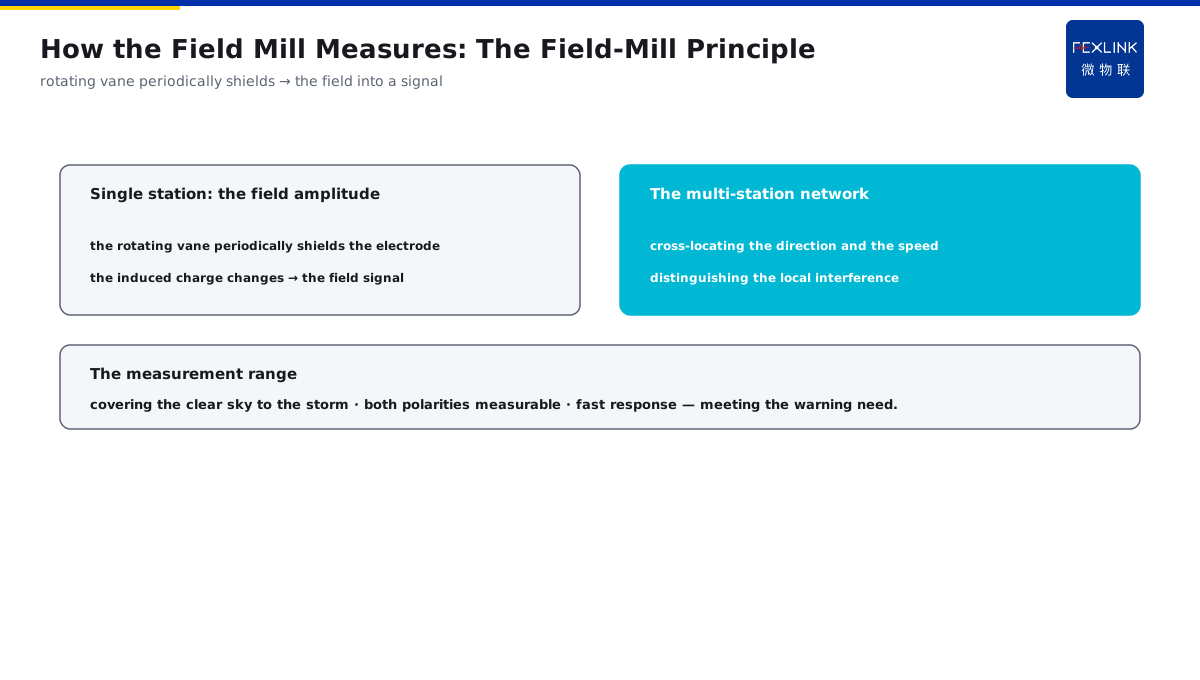
2. How the Field Mill Measures
Step two: how does the field-mill probe turn the "invisible electric field" into a measurable signal?
The probe principle:
- The rotating-vane (field-mill) type;
- The metal vane periodically shields the sensing electrode;
- The induced charge changes with the shielding;
- Converted into the field signal.
The measurement range:
- Covering the clear sky to the storm;
- Both polarities measurable;
- Fast response;
- Meeting the warning need.
The multi-station network:
- A single station measures the field amplitude;
- The multi-station cross-location;
- Distinguishing the local interference;
- Inferring the storm direction and the approach speed.
Key insight: "The field mill measures the field by the field-mill principle — the rotating vane periodically shields the sensing electrode and converts the field into a signal; the multi-station network cross-locates, distinguishing the local interference and inferring the storm direction and the approach speed."
3. Where the Lead Time Comes From
Step three: why can the field warning precede the cloud-to-ground flash by minutes to tens of minutes?
Detecting the state, not the event:
- The flash is the "event";
- The cloud-charge accumulation is the "state";
- The field reflects the state;
- The state precedes the event.
The lead-time magnitude:
- The cloud-charge accumulation takes time;
- The field changes gradually as the storm approaches;
- Minutes to tens of minutes ahead;
- The specific magnitude depends on the storm development.
The algorithm combination:
- The field-amplitude trend;
- The change-rate inflection;
- The multi-station direction;
- Comprehensively inferring the warning.
Key insight: "The lead time comes from 'detecting the state before the event' — the field reflects the cloud-charge-accumulation state, and the state precedes the cloud-to-ground flash; the field changes gradually as the storm approaches, and the amplitude trend, the change-rate inflection and the multi-station direction comprehensively infer the warning, minutes to tens of minutes ahead."
The two roots of the false/missed alarms: for an abnormal warning, first check it by principle in layers. The device layer — the probe contaminated/wet/mechanically failed, with the signal drifting and causing the false alarm; check the probe cleanliness and the self-test state; the environment layer — the local interference (nearby high-voltage lines/construction/artificial fields) misjudged by a single station, excluded by the multi-station cross-check; the algorithm layer — the threshold too sensitive or the change-rate criterion single, adjust the parameters and observe. The false/missed-alarm check: the device layer (probe contamination/wetness/failure → check the self-test), the environment layer (local interference → the multi-station cross), the algorithm layer (threshold too sensitive → adjust and observe) — check by layer, not by guessing.
4. The Single-Station Limitation and the LLS Cooperation
Step four: the single-station field warning has limitations and must be combined with the lightning-location system (LLS).
The single-station limitation:
- The local interference easily causes false alarms;
- Only the field measured, not the position;
- The far-storm amplitude underestimated;
- Limited reliability alone.
The LLS cooperation:
- The LLS locates the flashes that have occurred;
- The field warning governs the "future tense";
- The two are complementary in time;
- The joint criteria reduce the false/missed alarms.
The implementation:
- The field mill is the main warning;
- The LLS verifies and confirms;
- The single-station anomaly cross-confirmed;
- The combination improves the credibility.
Key insight: "The single station has limitations — the local interference easily causes false alarms and only the field is measured, not the position; the LLS cooperation complements it — the field governs the future tense and the LLS governs what has occurred, the joint criteria reduce the false/missed alarms, and the warning credibility is sufficient."
The three on-site installation points of the field mill: the installation quality directly decides the measurement credibility. One, the site selection — the probe far from the local interference sources such as high-voltage lines, chimneys and metal structures, with an open site preferred; two, the height — the probe height above the ground per the device manual, too low affected by the ground objects and too high difficult to maintain; three, the maintenance — regularly clean the probe and check the rotating vane and the sealing, and calibrate before the rainy season. With the three points done, the field data has reference value; otherwise the best algorithm is in vain. The three installation points: the site selection (far from the high-voltage/metal interference), the height (per the manual above the ground), the maintenance (regular cleaning/calibration before the rainy season) — the installation quality decides the data credibility.
5. Product Implementation: The Warning Made Visible
WeiWuLian products bring the lightning warning from the principle to verifiable operation:
- The FG Lightning-Protection Intelligent Gateway: the field-mill data aggregated;
- The threshold grading: the field-amplitude/change-rate graded alarms;
- The loop with the monitoring: the warning + the lightning-current/SPD monitoring linked;
- The data retention: the warning events traceable and reviewable.
The design principle in one sentence: "The field measures the state and the gateway does the grading — the atmospheric field amplitude + the change rate are graded for the warning, the FG gateway aggregates the data, the warning + the monitoring close the loop, and the false/missed alarms are reviewable."
Three judgments on why the lead time is "enough": whether to trust a warning and what action to take depends on three points. One, the lead-time magnitude — minutes to tens of minutes, corresponding to whether the shutdown/sail-retracting/evacuation plans can be executed in time; two, the change-rate direction — the field keeps increasing and the polarity reverses, meaning the storm is developing rather than dissipating, and the warning is credible; three, the multi-station consistency — the anomalies detected by multiple stations at the same time are real, while the single-station anomaly is mostly interference. With the three points combined, the warning is not "the wolf is coming" but an executable operation command. The three judgments on the credibility: whether the lead time is enough for the plan, whether the change rate keeps increasing with the polarity reversal, and whether the multi-station is consistent — with the three combined, the warning is an executable command.
6. Common Understanding Misjudgments
- "The warning reports only when the flash occurs": wrong. It detects the cloud-charge state, minutes to tens of minutes before the cloud-to-ground flash.
- "The field mill measures the strike position": wrong. A single station measures only the field; the location needs the multi-station/LLS.
- "A false alarm means the device is broken": wrong. The single-station local interference also causes false alarms; cross-check to judge.
- "The higher the field amplitude, the closer the lightning": incomplete. The change rate and the polarity must also be seen; the multi-parameter joint judgment.
- "With the warning, no SPD is needed": wrong. The warning is an operation-phase means, while the SPD is the protection foundation; the two complement.
Scope and Limitations
This article tears down the atmospheric electric-field detection principle of the lightning early warning (the field change, the probe principle, the source of the lead time, the single-station limitation and the LLS cooperation), applicable to warning-system understanding and false/missed-alarm judgments. The specific threshold values and installation specifications follow the relevant standards and the device manuals; this article explains only the physical mechanism. All cases are anonymized (a wind farm/a park) and do not refer to any specific customer.