 微物联研究院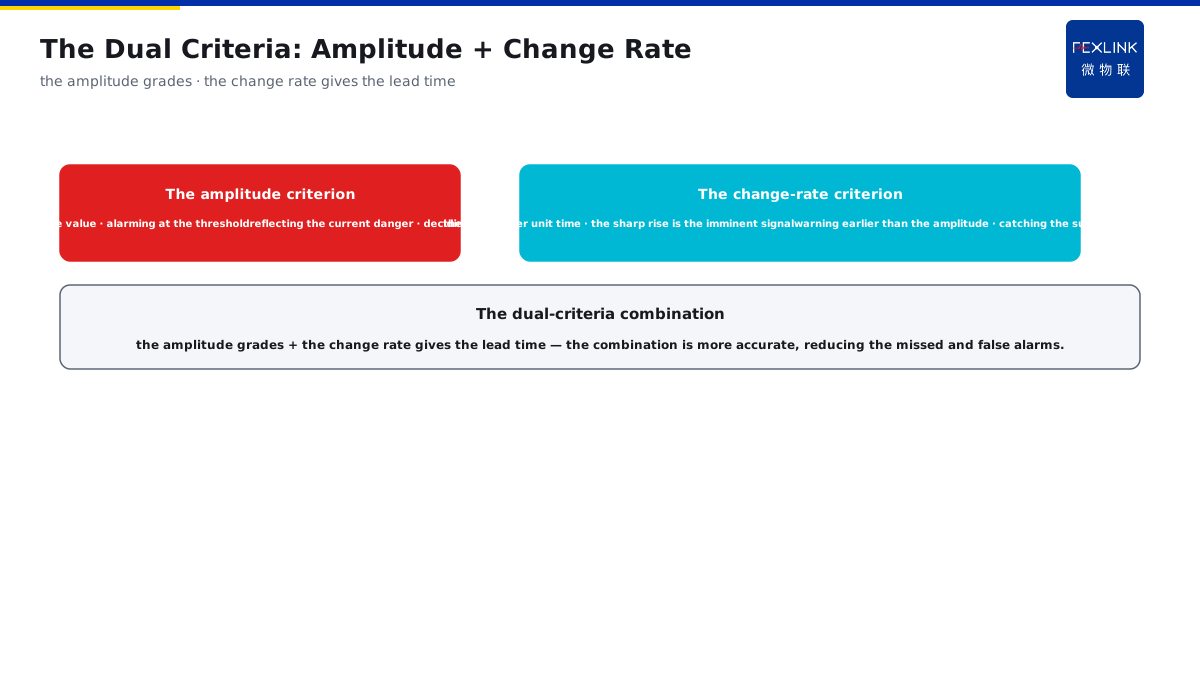
Direct Answer
When the warning platform reports "field 3 kV/m, orange alert", how should this number be judged and what actions should be started? The answer: the atmospheric electric-field intensity (in kV/m) increases as the thunderstorm approaches, and the warning is graded by the field amplitude and the change rate — the grades before approaching the danger threshold (attention/alert/alarm) correspond to different actions such as "stop the outdoor high-altitude work, disconnect the important equipment, evacuate the personnel"; the specific thresholds must be calibrated against the local thunderstorm intensity and the device warning capability, and fixed values cannot be reused.
At an open-air material yard with frequent summer thunderstorms, the warning platform reported "field 2.5 kV/m, orange alert"; the duty staff stopped the crane work and evacuated the personnel indoors per the plan; twenty minutes later the thunderstorm passed, and no personnel or equipment loss occurred on site. The key distinction: the threshold is not "one dead number" — the field amplitude plus the change rate (dE/dt) form the dual criteria for the grading, and attention/alert/alarm correspond to different actions; the thresholds must be calibrated against the site altitude and humidity, and fixed values cannot be reused.
Why:
- The field grows with the thunderstorm: the closer the thunderstorm, the stronger the field;
- The amplitude criterion: the field size decides the warning grade;
- The change-rate criterion: the sharp field rise is the imminent-strike signal;
- The action correspondence: each warning grade corresponds to different actions.
Key insight: "The threshold has dual criteria — the field amplitude (the size decides the grade) plus the change rate dE/dt (the sharp rise is the imminent-strike signal); attention/alert/alarm correspond to different actions, and the thresholds are calibrated against the site altitude and humidity, without fixed values."
At a scenic-area cableway, before the thunderstorm season, the warning was set with the manufacturer default thresholds; when the thunderstorm approached, the shutdown was not triggered and tourists were stranded at a high altitude; the review found that the local thunderstorm field was low and the default thresholds were too conservative. After the thresholds were recalibrated, the shutdown was triggered ten minutes before the thunderstorm. Lesson: the default threshold is not universal — the site altitude, humidity and the thunderstorm intensity all affect the field characteristics, and the thresholds must be locally calibrated, otherwise the warning "exists in name only".
Overview: run "how the field threshold changes with the thunderstorm → how the amplitude and the change rate form the dual criteria → what actions the three warning grades correspond to → why the threshold must be calibrated against the site" as one warning-reading cognition. When the warning platform reports "field 3 kV/m, orange alert", this number is not isolated — the atmospheric electric-field intensity increases as the thunderstorm approaches, and the warning is graded by the field amplitude and the change rate, corresponding to different actions. The specific thresholds must be calibrated against the local thunderstorm intensity and the device warning capability. The four layers are unfolded below.
A "thermometer" analogy: think of the atmospheric field as a "thunderstorm thermometer". At ordinary times the field is stable, like the normal room temperature; as the thunderstorm approaches, the field rises, like the temperature gradually increasing; near the strike, the field rises sharply, like the temperature suddenly soaring — at this point the "boiling" (the discharge) is nearest. The amplitude is the "current temperature" (deciding the danger grade), and the change rate is the "heating speed" (giving the lead time): even the rapid heating tells you the danger is coming earlier than the temperature itself. The three warning grades are the three "temperature gears" — attention is "mind against catching a cold", alert is "prepare to close the window", and alarm is "evacuate now". The thermometer analogy: the field = the thunderstorm thermometer, the amplitude = the current temperature (deciding the grade), and the change rate = the heating speed (giving the lead time) — attention = mind it, alert = prepare to close the window, and alarm = evacuate now.
1. The Field Threshold: How It Changes with the Thunderstorm
Step one: first look at how the atmospheric electric-field intensity changes as the thunderstorm approaches.
The field sources:
- The thunderstorm cloud charged;
- The field between the cloud base and the ground;
- The closer the thunderstorm, the stronger the field;
- The field reflecting the approaching thunderstorm.
The change characteristics:
- The field stable at ordinary times;
- The field increasing as the thunderstorm approaches;
- Rising sharply near the strike;
- Falling back after the discharge.
The meaning of the reading:
- The field value reflecting the danger degree;
- The sharp rise predicting the imminent discharge;
- The platform reporting the real-time field;
- The actions executed by the grade.
Key insight: "The field changes with the thunderstorm — the charged cloud produces the cloud-ground field, the closer the thunderstorm, the stronger the field, rising sharply near the strike and falling back after the discharge; the field value reflects the danger degree, and the sharp rise predicts the imminent discharge."
2. The Dual Criteria: How to Use the Amplitude and the Change Rate
Step two: the amplitude threshold and the change rate (dE/dt) form the dual criteria.
The amplitude criterion:
- The absolute value of the field;
- Alarming when reaching the threshold;
- Reflecting the current danger degree;
- Deciding the warning grade.
The change-rate criterion:
- The field change per unit time;
- The sharp rise is the imminent-strike signal;
- Warning earlier than the amplitude;
- Catching the sudden change.
The dual-criteria combination:
- The amplitude decides the grade;
- The change rate gives the lead time;
- The combination is more accurate;
- Reducing the missed and false alarms.
Key insight: "The dual criteria work together — the amplitude decides the grade (reflecting the current danger), and the change rate gives the lead time (the sharp rise warns earlier than the amplitude); the combination reduces the missed and false alarms."
3. The Three Warning Grades: What Actions They Correspond to
Step three: what actions the attention/alert/alarm grades correspond to.
The attention grade (the early stage):
- The field starting to rise;
- Notifying the work area to pay attention;
- The high-altitude work preparing to stop;
- The equipment protection preparing.
The alert grade (approaching):
- The field increasing obviously;
- Stopping the outdoor high-altitude work;
- Disconnecting the important equipment;
- The personnel keeping away from the open ground.
The alarm grade (imminent):
- The field rising sharply/over the threshold;
- The personnel evacuating indoors;
- All the equipment protection engaged;
- Until the thunderstorm passes.
Key insight: "The three-grade actions are graded — the attention grade prepares (notify + prepare to stop), the alert grade stops (stop the high-altitude work/disconnect the important equipment/keep away from the open ground), and the alarm grade evacuates (evacuate the personnel indoors/all the protection engaged) — the actions escalate by the grade."
4. The Threshold Calibration: Why Fixed Values Cannot Be Reused
Step four: why the threshold must be calibrated against the site altitude and humidity.
The altitude influence:
- The air thin at a high altitude;
- The field distribution different;
- The threshold adjusted accordingly;
- The plain value inaccurate.
The humidity influence:
- The humidity affects the discharge conditions;
- The field characteristics different in the humid areas;
- The threshold locally calibrated;
- Combined with the historical thunderstorm data.
The calibration method:
- Accumulating the local thunderstorm data;
- Adjusting the threshold against the strike records;
- Combined with the device warning capability;
- Continuously optimizing the threshold.
Key insight: "The threshold must be calibrated — the field distribution differs at a high altitude and the humidity affects the discharge conditions; use the local historical thunderstorm data against the strike records to adjust the threshold, combined with the device warning capability, and continuously optimize it, without fixed values."
5. Product Implementation: The Warning Readable and Executable
WeiWuLian products bring the warning reading to the executable level:
- FG intelligent lightning-protection gateway: the field-data collection and the grading;
- Intelligent lightning-protection online monitoring: the thresholds calibrated and the actions configured;
- The data review: the warning compared with the strike;
- The loop improvement: the thresholds continuously optimized.
The design principle in one sentence: "The field readable and the warning executable — the FG collects the field data for the grading, the thresholds calibrated against the site and the actions configured by the grade, the review after the strike optimizes the warning from 'seeing a number' to 'taking an action'."
6. Common Understanding Misjudgments
- "The field 3 kV/m is dangerous": wrong. The danger depends on the grading and the local calibration, not a fixed value.
- "Only the amplitude, not the change rate": wrong. The sharp rise warns earlier than the amplitude.
- "Continue working when the warning comes": wrong. The alarm grade must evacuate, and the high-altitude work without stopping is risky.
- "The default threshold is universal": wrong. The altitude and the humidity affect the field characteristics, and the threshold must be locally calibrated.
- "One warning is done": wrong. The threshold must be continuously optimized and calibrated against the strike records.
Scope and Limitations
This article explains the reading of the lightning-warning electric-field thresholds (the field change, the dual criteria, the three-grade actions, and the threshold calibration), applicable to the warning-platform reading and the on-site action judgment. The specific thresholds are determined by the device calibration and the local thunderstorm data; this article explains only the reading method. All cases are anonymized (an open-air material yard/a scenic-area cableway) and do not refer to any specific customer.