 微物联研究院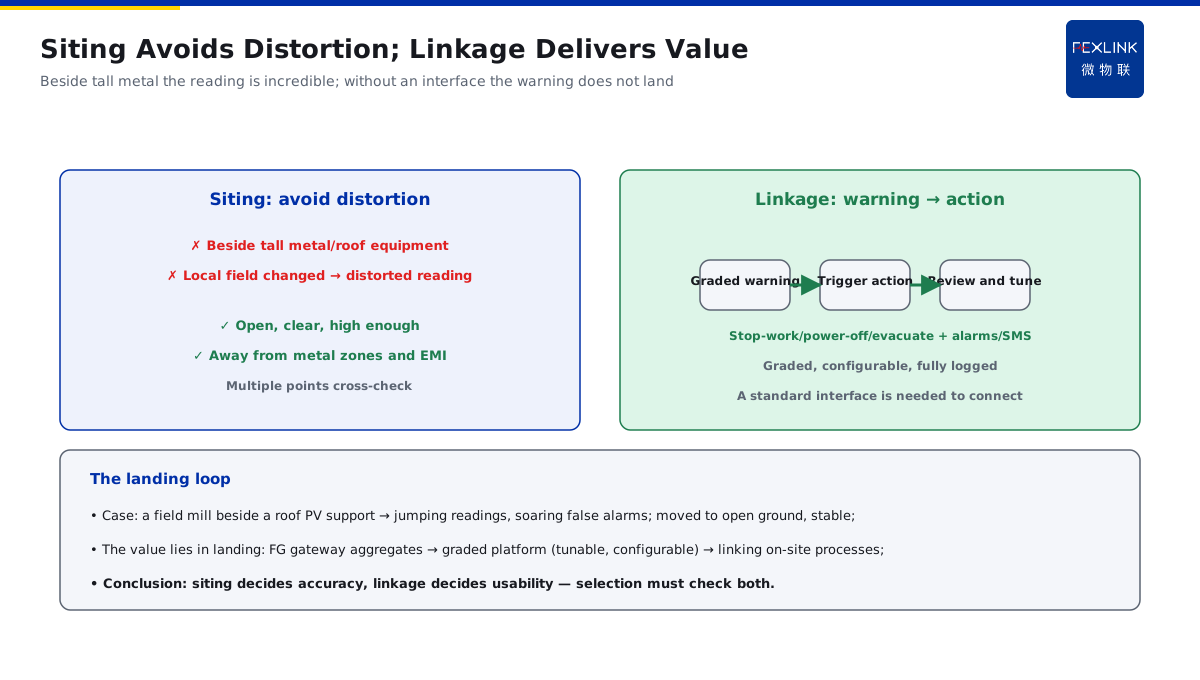
Direct Answer
A project wants lightning warning; by what indicators do you select an atmospheric field mill, and where must it be installed to work? The answer: select on the effective detection radius (which decides the coverage), the number of warning levels and the adjustability of the thresholds, whether the installation point avoids local field distortion (tall metal structures and roof equipment disturb the measurement), and whether it can link with on-site stop-work/power-off processes; when the coverage of one unit is limited, a large site should be covered by multi-point networking rather than one unit trying to "cover the whole site".
A large logistics park wanted "one field mill to cover the whole site". After evaluating the radius, the vendor changed it to a three-point network: two points at the site edge plus one at the center, with the coverage radii cross-verified. In the storm season, many warnings were validated against lightning location. The key distinction: the detection radius decides single-unit coverage, the installation position decides measurement credibility, networking decides large-area coverage, and linkage decides value delivery — selection is the loop of these four, not "buy one and install it".
Why:
- Detection radius: match the protected range; if insufficient, network;
- Levels and thresholds: the number of levels and adjustable thresholds adapt to the site;
- Installation position: avoid field-distortion sources, so the reading is credible;
- Linkage interface: connect to stop-work/power-off processes, so the warning lands.
Key insight: "Selection looks at four things: is the radius enough, can the thresholds be tuned, where to install so it is accurate, and can it link — one unit covering the whole site is a big mistake."
At a plant, the field mill was installed beside a large roof-mounted PV support; readings jumped frequently and the false-alarm rate soared. After moving it to an open, clear spot away from the metal support, the curve stabilized and the false-alarm rate fell. Lesson: without avoiding field-distortion sources, even a good instrument's readings are not credible — siting matters as much as selection.
1. Matching the Detection Radius to the Protected Range
Step one: how much can one unit cover.
The meaning of the detection radius:
- The effective detection radius of the field mill;
- It decides the storm-approach perception range of one unit;
- Field changes within the radius can be measured reliably;
- It is the first indicator of selection.
Matching the protected range:
- A small area (one building/switch room) can be covered by one unit;
- A large site (park/open-pit mine) needs multiple units networked;
- An insufficient radius → missed perception at the edge;
- Coverage must cross over with no blind zones.
Vendor rating vs the field:
- The rated radius is based on an ideal environment;
- On-site terrain/buildings affect the actual radius;
- Evaluate the effective radius on site;
- Leave margin: rating × a factor.
Key insight: "The detection radius decides coverage — one unit is enough for a small area, but a large site must be networked; the actual radius is often lower than the rating, so leave margin."
2. The Number of Warning Levels and Threshold Adjustability
Step two: can the levels adapt to the site.
The number of levels:
- Commonly yellow/orange/red, three levels;
- Some products have more levels;
- Finer levels → more precise actions;
- But too many levels add operational complexity.
Threshold adjustability:
- Amplitude and rate thresholds are configurable;
- Tuned to local storm characteristics (connecting to KD-0183);
- Adjustable on site → false alarms optimizable;
- Not adjustable → false alarms must be tolerated.
Selection points:
- Adjustable thresholds are a hard requirement;
- The levels correspond one-to-one to actions;
- The platform supports level configuration;
- Tune after on-site verification.
Key insight: "The number of levels decides the action granularity, and threshold adjustability decides whether false alarms are controllable — both are hard indicators; be careful with products that cannot be tuned."
3. Why the Installation Position Must Avoid Field-Distortion Sources
Step three: where to install so it measures accurately.
Field-distortion sources:
- Tall metal structures (towers/masts/chimneys);
- Roof equipment (PV/antennas/water tanks);
- Building edges/corners;
- Metal fences/cable-dense areas.
The effect of distortion:
- The local field is changed by metal;
- The reading deviates from the true ambient field;
- Frequent jumps → false alarms;
- Measurement credibility falls.
Installation requirements:
- Open, clear places, high enough above the ground;
- Away from the influence zone of metal;
- Far from strong EMI sources;
- Multiple points cross-check each other.
Key insight: "Field-distortion sources twist the reading — beside a tall metal object, even a good instrument is not credible; siting matters as much as selection."
4. Single-Unit Coverage vs Multi-Point Networking
Step four: one unit or several.
When one unit fits:
- The protected range is smaller than the effective radius;
- The site is open with little obstruction;
- Small projects with limited budgets;
- One point can cover it.
When networking fits:
- Large sites (parks/airports/open-pit mines);
- Undulating terrain with obstructions;
- Edge coverage and cross-verification are needed;
- Networking coverage > one unit "covering the whole site".
Networking points:
- Place points along the site edge plus the center;
- Coverage radii cross over with no blind zones;
- Multiple points aggregate into the gateway (FG);
- Grade by the whole-site assessment.
Key insight: "When one unit's coverage is limited, multi-point networking is the answer — edge-plus-center cross layout, with data aggregated into the gateway for unified grading."
5. The Linkage Interface with On-Site Processes
Step five: how the warning becomes an action.
What to link:
- Stop-work/evacuation orders;
- Power-off/disconnecting vulnerable circuits;
- Audible-visual alarms/SMS push;
- Integration with access control/dispatch systems.
How to link:
- The platform outputs graded signals;
- Triggers the corresponding action per the plan;
- Supports manual confirmation and automatic linkage;
- Fully logged and reviewable.
Selection points:
- Standard linkage interfaces (interfaces/protocols);
- Ability to connect with existing systems;
- Configurable, graded actions;
- The warning-action-review loop.
Key insight: "The value of the warning lies in landing — selection must look at the linkage interface: can it connect to stop-work/power-off processes, are actions graded, and is everything reviewable."
6. Product Implementation: The Complete Selection Loop
WeiWuLian products close the four selection items:
- FG Lightning-Protection Intelligent Gateway: multi-point data aggregation and unified grading;
- Field-mill support: installation siting and distortion-avoidance guidance;
- Graded warning platform: adjustable thresholds, configurable actions;
- Linkage and review: connecting to on-site processes, optimizing after review.
The design principle in one sentence: "Radius matches coverage, thresholds adapt to the site, siting guarantees credibility, linkage delivers value — closing the four selection items makes the warning truly effective."
7. Common Misjudgments
- "One unit covers the whole site": ignoring the detection radius. Result: missed perception at the edge. Correct: evaluate by radius, network multiple points.
- "The thresholds are fixed at the factory": not adjustable. Result: false alarms cannot be optimized. Correct: choose products with adjustable thresholds.
- "Install it high and it works": ignoring distortion sources. Result: incredible readings. Correct: avoid metal, choose open spots.
- "Only look at the price": ignoring the linkage interface. Result: the warning does not land. Correct: check the linkage capability.
- "Treat the rated radius as actual": ignoring on-site loss. Result: insufficient coverage. Correct: evaluate on site and leave margin.
Scope and Limitations
This article explains the four key dimensions of selecting a lightning-warning system (atmospheric field mill): the detection radius and coverage match, threshold adjustability, distortion-avoiding siting, and the linkage interface, plus the single-unit vs networking logic, applicable to selection decisions. The exact radius, level settings and installation requirements follow the vendor's specifications and on-site measurements, tuned to local storm characteristics. All cases are anonymized (a logistics park, a plant) and do not refer to any specific customer.