 微物联研究院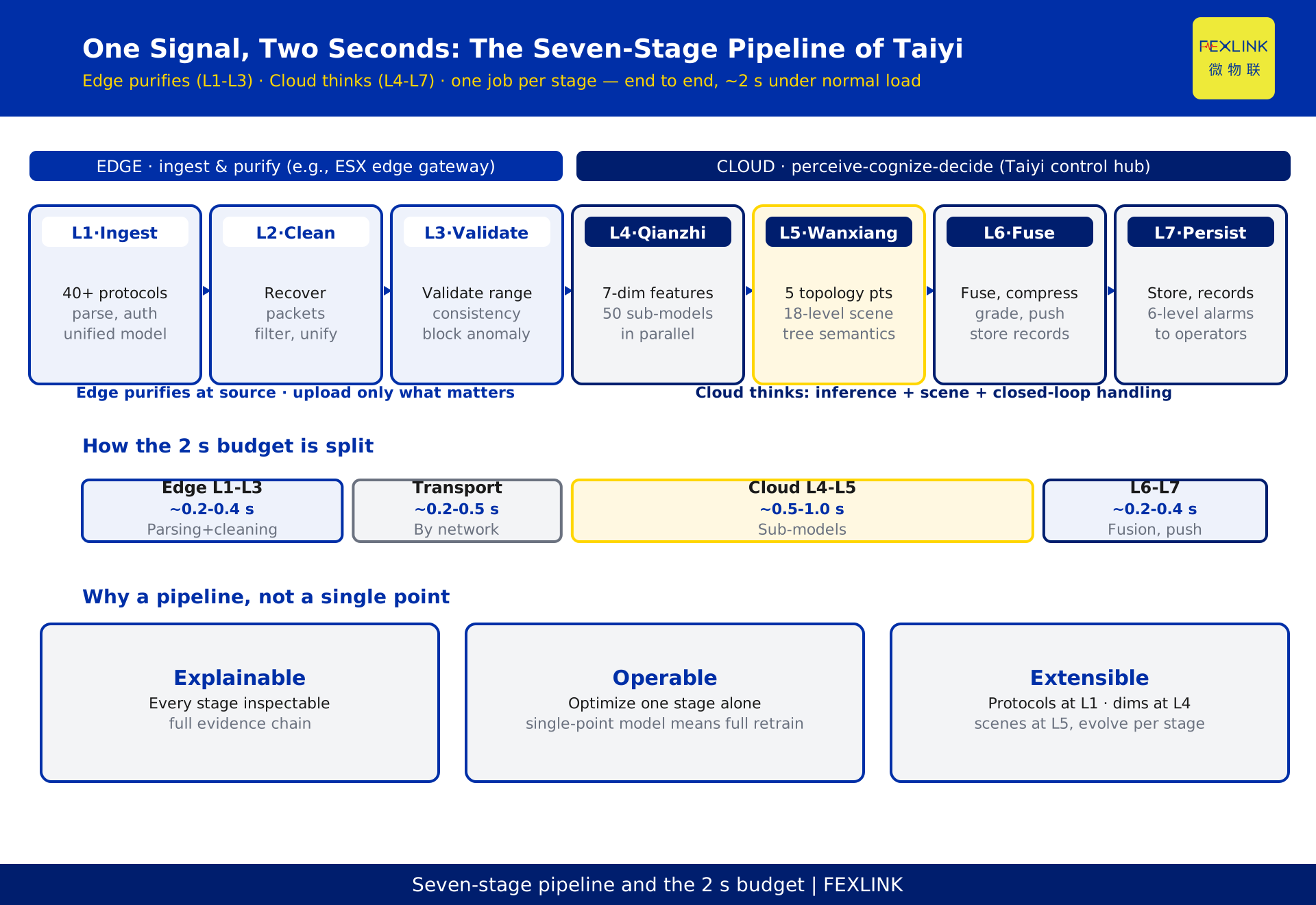
Direct Answer
From a field signal to a risk alarm, the FEXLINK Taiyi control hub is designed to work end to end within 2 seconds. That "2 seconds" is not achieved by a single fast point but by a seven-stage pipeline: L1 ingest → L2 cleaning → L3 validation → L4 Qianzhi perception → L5 Wanxiang cognition → L6 fusion decision → L7 persistence and push. The first three stages do "ingest and purify" at the edge; the middle two do "perceive and understand" in the cloud; the last two do "decide and deliver." In one sentence: the 2 seconds come not from "one very fast server" but from a pipeline design where the edge and cloud have clear roles and each stage does exactly one thing.
1. What "Within 2 Seconds" Means
First, understand what "2 seconds" means in electrical-safety scenarios. Electrical hazard discovery comes in two flavors. One is post-event tracing — the fault has already happened, and you dig through records for the cause; seconds or even minutes do not matter. The other is pre-event warning — signal the hazard before it becomes an accident, giving operators time to respond. The 2-second goal of the seven-stage pipeline serves the latter.
The value of 2 seconds: it requires that the whole chain — sensor sampling, data upload, cleaning, validation, algorithm analysis, alarm push — has no obvious waiting. If any stage queues serially, recomputes, or waits for human confirmation, the 2 seconds break. So 2 seconds is both a performance target and an architecture constraint: it forces every stage to be automated, parallel, and free of manual intervention. Looked at more closely, it covers the full loop from "signal reaching the platform" to "alarm reaching the operator" — not single-point compute time. The real value is that no link in the whole chain stalls.
2. The Seven-Stage Pipeline at a Glance
| Stage | Name | Core task | Where it runs |
|---|---|---|---|
| L1 | Ingest | 40+ protocol parsing, device auth, data intake | Edge |
| L2 | Cleaning | Packet recovery, noise removal, format unification | Edge |
| L3 | Validation | Dimension/range/consistency checks, anomaly blocking | Edge |
| L4 | Qianzhi perception | Multi-dimensional, multi-model feature extraction and scoring | Cloud |
| L5 | Wanxiang cognition | Location/scene association, semantic understanding | Cloud |
| L6 | Fusion decision | Cross-dimension fusion, risk grading | Cloud |
| L7 | Persistence & push | Result storage, alarm delivery, records | Cloud |
One key design rule: whatever can go to the edge does not stay in the cloud. L1–L3 live at the edge to purify the flood of raw data at the source — only data "worth analyzing" is uploaded, saving both bandwidth and latency, and freeing the time budget that L4–L7 need to hit 2 seconds.
3. L1–L3: Ingest, Cleaning, and Validation (the Edge Does the Heavy Lifting)
L1 ingest solves "data getting in." Field devices are heterogeneous: smart meters speak DL/T 645, SPD monitoring uses proprietary protocols, busbar monitoring uses Modbus, and gateways may talk MQTT to the platform. Parsing of 40+ protocols is unified here; a device is authenticated and assigned a unified data model as soon as it connects.
L2 cleaning solves "data being clean." Missing packets are recovered, duplicates removed, noise filtered, and formats unified to the platform standard. Cleaning quality determines the input quality of every downstream algorithm — dirty data into an algorithm defeats even the best model.
L3 validation solves "data being trustworthy." Every quantity has dimensional, range, and consistency constraints: an over-range voltage like 99999 V, a contradictory reading at the same point, or an out-of-order timestamp is blocked here. The first three levels of the G5 four-level cleaning system (dedup, denoise, correction) map to L2–L3; the fourth, semantic cleaning, happens in L4–L5.
4. L4 Qianzhi: Multi-Dimensional, Multi-Model Perception
Past the edge's three gates, the cloud's first stop is the Qianzhi engine. Its job is to turn "one number" into "a set of features": for the same electrical signal, extract features along seven dimensions at once — amplitude, rate of change, trend, density, fluctuation, correlation, and temporal risk — each scored by an independent sub-model, outputting a continuous 0–100 risk score rather than a plain "normal/abnormal."
The benefit of seven parallel dimensions: an occasional fluctuation in one dimension does not trigger a false alarm (D2 rate high but D1 amplitude normal suggests a mere load swing); real problems usually light up several dimensions at once (D3 trend rising + D4 anomaly density up + D7 temporal risk accumulating). Cross-dimension corroboration is the precondition for a high-quality conclusion within 2 seconds — fast, but never a single-point guess.
An example of seven-dimensional parallelism: a voltage dip occurs on a workshop feeder. D1 amplitude drops clearly, D2 rate is high, D5 fluctuation rises — but D3 trend does not keep climbing and D7 temporal risk does not accumulate. The seven dimensions together judge it "transient disturbance" rather than "ongoing degradation," and the system issues an observe-level notice instead of a limit alarm. Judging on any single dimension would almost certainly false-alarm. Another value of the seven dimensions is noise immunity: an occasional spike from a single sensor shows up once in D1/D2, whereas a real hazard leaves correlated traces across multiple dimensions.
5. L5 Wanxiang: Location and Scene Cognition
Qianzhi answers "what is happening to this signal"; Wanxiang answers "where is this signal happening, and what does that mean." It maps measurement points to five topological locations (point of common coupling, main switchboard, distribution board, feeder, load terminal) and then performs semantic understanding with an 18-level scene tree.
The same temperature reading is medium risk at the main busbar but possibly high risk at a terminal — because heat capacity, cooling, and failure consequences differ. Wanxiang encodes that "field common sense" into the algorithm: different locations get different thresholds and risk models. This stage upgrades alarms from "data-level" to "semantic-level": not "sensor 3 is at 65 °C" but "terminal X on distribution board Y is at 65 °C, high risk."
One more scene-based example: the same 65 °C is within a normal load-rise range on the main busbar at the point of common coupling; at a distribution board's outgoing terminal, heat accumulation is already worth attention; at a load terminal's connection point, it suggests abnormally rising contact resistance and is high risk. Wanxiang maps the three locations to different temperature-to-risk models and produces completely different conclusions. That is the engineering value of "location awareness" — the same number carries entirely different meaning at different points in the topology.
6. L6–L7: Fusion Decision and Persistent Push
L6 fusion decision combines Qianzhi's multi-dimensional features with Wanxiang's location and scene: cross-dimension fusion (electrical quantities + temperature + harmonics judged together), cross-point correlation (adjacent terminals abnormal at the same time), and cross-window aggregation (multiple alarms in a short window merged into one high-severity alarm). Alarm compression happens here — masses of duplicate, related, and minor alarms are merged so that only meaningful, high-value alarms are pushed.
L7 persistence and push is the last mile: results are written into the data-asset library to form records, and alarms reach operators by 6-level severity and subscription rules (app, SMS, platform pop-up). An alarm is not "sent and done" — it enters a closed loop: handling status, review results, and effectiveness assessment are all written back into the same record.
7. End-to-End Latency Budget: How the 2 Seconds Are Split
The 2 seconds are not split evenly; they follow "where time is worth spending":
- Edge L1–L3: ~0.2–0.4 s. Protocol parsing and cleaning are deterministic computation — fast, and must be fast;
- Transport: ~0.2–0.5 s. The edge-to-cloud link is budgeted according to field network conditions;
- Cloud L4–L5: ~0.5–1.0 s. Multi sub-model parallel inference; this is the main compute budget;
- L6–L7: ~0.2–0.4 s. Fusion decision and push, emphasizing determinism and reachability.
Actual latency fluctuates with data volume, but every stage has a defined budget and parallelism strategy (e.g., 50 sub-models in parallel at L4, batched alarm merging at L6), keeping 2 seconds reachable under normal load.
Also worth clarifying: the edge does not mean "a local server." Edge devices such as the ESX intelligent edge computing gateway complete protocol parsing, cleaning, and validation at L1–L3, upload only standardized features and key waveforms, and keep raw bulk data locally by policy or archive on demand. This "edge purifies, cloud thinks" pairing is the spatial foundation on which the 2-second latency stands.
8. Engineering Value: Why a Pipeline, Not a Single Point
Finally, an engineering question: why not make "perception + cognition + decision" a single-point large model?
First, explainability. Every stage of the pipeline can be inspected: what was cleaned, what features were extracted, why this risk grade — all traceable. A single black box offers no such evidence chain.
Second, operability. If one stage is slow or false-alarming, optimize it alone without touching the others. Upgrading a single-point model means retraining everything — far riskier.
Third, extensibility. New protocols join at L1, new dimensions at L4, new scenes at L5 — each stage evolves independently. That is the core value of the "edge does the heavy lifting, cloud does the thinking" architecture: it makes 2 seconds reachable not only today, but next year and the year after.
Scope and Limitations
The seven-stage pipeline architecture and 2-second latency budget discussed here apply to understanding FEXLINK's device-edge-cloud risk-handling chain. "2 seconds" refers to representative end-to-end latency under normal load; actual values depend on field networks, data volume, and concurrency, and must not be read as a hard guarantee in every scenario. The perception, cognition, and decision capabilities of L4–L7 depend on edge data quality and algorithm models; specific capability boundaries are subject to product documentation. No specific project cases are referenced.