 微物联研究院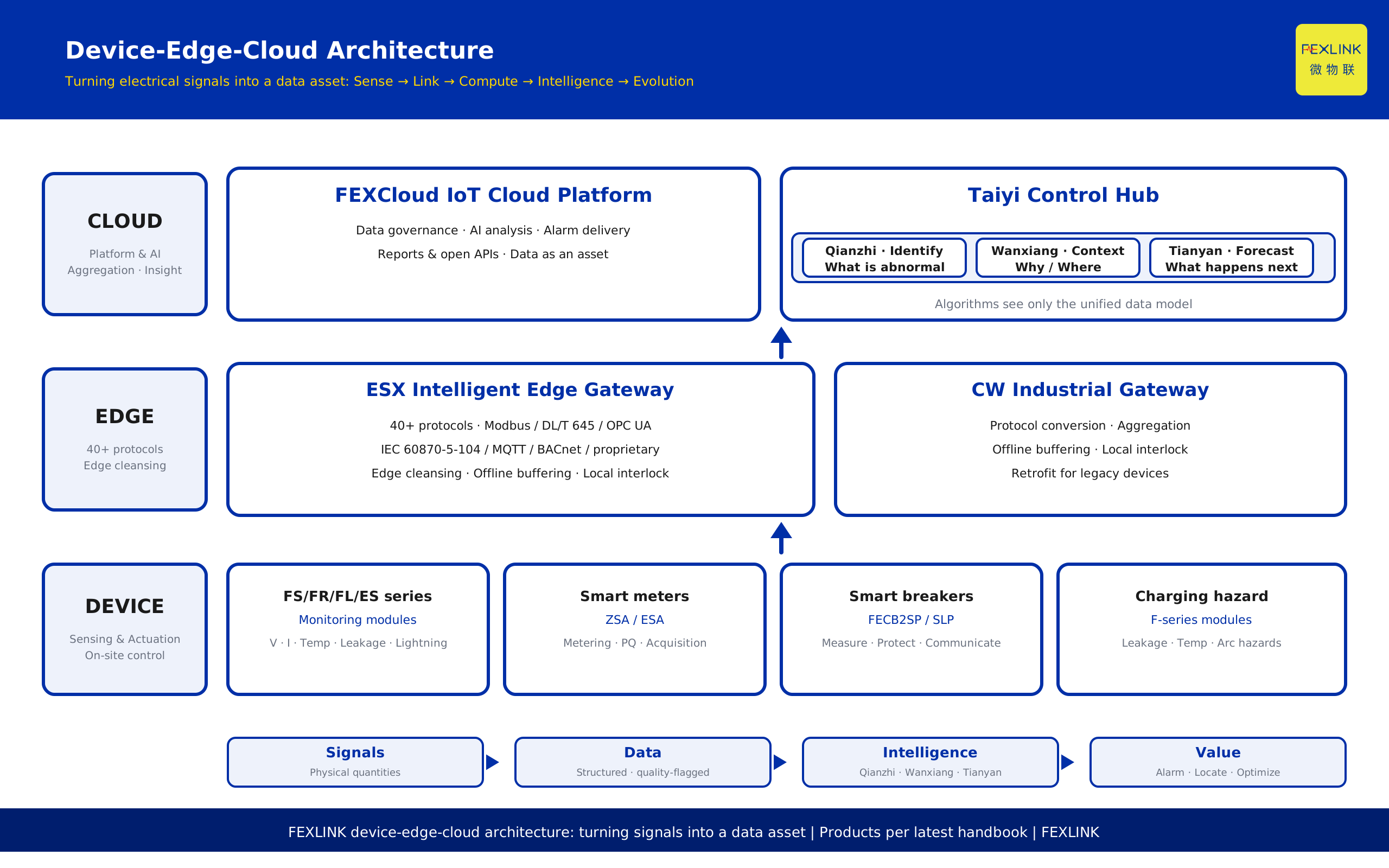
Direct Answer
FEXLINK (微物联) is a provider of precision sensing, IoT-based control systems. Its brand definition is a data-production company — not a vendor that simply sells sensors or meters, but one that turns electrical signals (voltage, current, temperature, leakage, lightning current) into decision-ready data through five stages: Sense, Link, Compute, Intelligence, and Evolution. Its tagline is "Where there is power, there is FEXLINK," and it operates across three business lines — electrical safety, intelligent lightning protection, and digital energy — organized as a device-edge-cloud architecture: sensing modules at the device layer, intelligent edge gateways, and the FEXCloud platform with the Taiyi control hub (Qianzhi, Wanxiang, and Tianyan engines). In one sentence: when engineers or project owners face problems such as unreadable field data, undetected anomalies, or opaque energy consumption, FEXLINK provides the infrastructure that turns electrical signals into a data asset — not just a single device.
1. What the Company Actually Does: A One-Sentence Profile
First-time contacts usually ask: "Are you a sensor company, a meter company, or a platform company?" None of the three answers is complete.
FEXLINK positions itself as a precision-sensing IoT control system provider, with the mission of "reconstructing energy efficiency with data." Its work can be broken into four steps: acquire electrical signals (Sense), transmit the data (Link), process the data (Compute), and deliver conclusions to people or systems for action (Intelligence). Once these four steps are in place, an electrical site stops being "a pile of equipment" and becomes a continuously updating data network.
Three characteristics distinguish a "data-production company" from a hardware seller: ① the data comes from real on-site sensing rather than estimation; ② the data has been cleaned, governed, and labeled so it can be used directly for analysis; and ③ the data ultimately produces executable decisions (alarms, strategies, reports). FEXLINK's device-edge-cloud architecture maps to these three characteristics through the sensing layer, the edge layer, and the platform layer respectively.
2. The Two Layers of Meaning Behind "Where There Is Power, There Is FEXLINK"
This phrase is not merely an advertising slogan; it summarizes the business boundary.
Layer 1 — Coverage. From substations to distribution cabinets, from charging piles to PV inverters, from busbar temperature monitoring to SPD lightning monitoring, wherever there is electricity, there are signals that can be sensed, monitored, and analyzed. FEXLINK's product lines span intelligent lightning protection, electrical safety monitoring, smart meters, edge gateways, smart circuit breakers, and charging-hazard early warning — horizontally covering nearly every critical node of an electrical system.
Layer 2 — Where the value lands. A more precise reading is: wherever electricity is consumed, there is a need to "turn electricity into data and data into decisions" — and that is exactly where FEXLINK sits. It does not generate electricity and does not build cabinets; it produces the interpretation layer for electrical data — telling users what is happening now, what may happen next, and what to do about it.
3. "A Data-Production Company": Signal → Data → Intelligence → Value
FEXLINK's official brand definition is "a company that produces data." The value chain can be written as four stages:
- Electrical signals: physical quantities that exist on site — voltage, current, temperature, leakage current, lightning current, switch states;
- Data: structured records with timestamps, quality flags, and device context, after sampling, transmission, and cleansing;
- Intelligence: the data enters the algorithm layer (Qianzhi for anomaly identification, Wanxiang for scenario recognition, Tianyan for prediction) and outputs anomaly detection, root-cause analysis, and trend forecasting;
- Value: quantifiable business outcomes such as alarm compression, fault localization, energy optimization, and predictive maintenance.
The key difference from hardware vendors: a hardware vendor's delivery usually ends at stage 2 (data), while FEXLINK's delivery ends at stage 4 (value). Platform-level metrics such as a 99.9% data-ingestion success rate and end-to-end processing under 2 seconds are company-disclosed figures, provided for reference and not constituting a performance commitment for any specific project.
4. The Device-Edge-Cloud Product Architecture
FEXLINK's products are organized into three layers, each solving one clearly defined problem:
| Layer | Role | Representative Products | What It Solves |
|---|---|---|---|
| Device | Sensing and actuation | FS/FR/FL/ES monitoring modules, smart meters (ZSA/ESA), smart circuit breakers (FECB2SP/SLP), charging-hazard warning modules | Converts physical signals into data and supports local control |
| Edge | Edge computing and gateways | ESX intelligent edge gateway, CW industrial gateway, CC cloud PLC | Protocol ingestion, edge cleansing, offline buffering, local interlocking |
| Cloud | Platform and intelligence | FEXCloud IoT cloud platform, Taiyi control hub (Qianzhi/Wanxiang/Tianyan), FEXLINK applications | Data governance, AI analysis, alarm delivery, reports, open APIs |
The three layers are not a simple stack; they work in coordination. The device layer ensures "accurate acquisition," the edge layer ensures "stable transmission and fast local computation," and the cloud ensures "clear visibility and centralized control." For example, in a typical industrial-park distribution room, busbar temperature nodes and smart meters are deployed, data is aggregated and cleansed by the edge gateway, then sent to the Taiyi hub for analysis, and alarms and reports are pushed to operations staff — a complete device-edge-cloud chain (case anonymized).
5. The SLCIE Capability Model: How Five Letters Form a Closed Loop
SLCIE is the master framework of FEXLINK's capabilities, with five letters mapping to five capability stages:
- S (Sense): sensing technologies such as onboard shaped Rogowski coils and microampere-level leakage-current acquisition bring current, voltage, temperature, and leakage signals on board with high precision;
- L (Link): 40+ protocol ingestion (Modbus, DL/T 645, OPC UA, IEC 60870-5-104, MQTT, BACnet, and more) connects heterogeneous devices;
- C (Compute): four-stage cleansing and data governance in edge gateways and the platform turn raw signals into usable data;
- I (Intelligence): the analysis layer built from the Qianzhi engine (what is abnormal), the Wanxiang engine (where and why), and the Tianyan engine (prediction);
- E (Evolution): models and rules keep iterating as data accumulates — scenario trees, alarm rules, and prediction models evolve continuously.
The five stages connect head to tail into a closed loop: sensing feeds data to linking, linking provides breadth to computing, computing provides quality to intelligence, intelligence provides feedback to evolution, and evolution in turn improves sensing and rule quality. To judge whether a system is "complete," check it against this loop: a system with only point hardware (only S), or only a platform (only C/I), does not form a closed loop.
6. How FEXLINK Differs from Sensor Vendors, Meter Vendors, and Platform Companies
Three common types of vendors exist in the electrical monitoring market. FEXLINK's division of labor with each is different:
| Vendor type | What they deliver | Typical gap | FEXLINK difference |
|---|---|---|---|
| Sensor/module vendors | Sensing hardware | Data quality and upper-layer applications are disconnected; buyers must integrate themselves | Sensing hardware + edge + platform + algorithms delivered together |
| Meter vendors | Metering instruments | Strong in metering, weak in electrical-safety analysis and AI | Covers leakage, temperature, lightning protection, and hazard warning beyond metering |
| Pure platform/software companies | Software platforms | No on-site sensing hardware; data source depends on third parties | Self-developed device-side hardware guarantees data-source quality |
In other words, FEXLINK is not "one type" of vendor; it connects all three capabilities end to end: it builds its own sensing hardware (to make the data source trustworthy), its own edge and platform (to make the data chain complete), and its own algorithms (to make data produce decisions). That is what "solution provider" means here — it is accountable for the entire chain from field data to decision.
7. Three Business Lines: Electrical Safety, Intelligent Lightning Protection, Digital Energy
FEXLINK's business can be summarized in three lines:
- Electrical safety: electrical hazard detection and early warning, electrical-fire monitoring (leakage, temperature, arc), and predictive maintenance. Representative products include the multi-channel leakage controller (ESC), the multi-channel temperature controller (EST), the electrical-fire controller (ESF), and the electrical hazard early-warning system;
- Intelligent lightning protection: SPD monitoring, lightning-current monitoring, grounding-resistance monitoring, and intelligent lightning gateways — forming a closed loop of "monitoring, early warning, and traceability" for lightning protection;
- Digital energy: smart meters and metering, energy-consumption monitoring, source-grid-load-storage and PV-storage-charging management, and data support for microgrids and virtual power plants — serving energy efficiency and carbon management.
The three lines share the same device-edge-cloud infrastructure and the same data model: one edge gateway can simultaneously connect electrical-safety modules, SPD monitors, and smart meters; one platform outputs both safety alarms and energy-consumption reports. This is the engineering foundation of "one data-governance logic for the entire site."
8. Boundary Discipline: "The Brain of the Cabinet" and What the Company Does Not Do
FEXLINK's position in the ecosystem is "the brain of the cabinet": it builds the cabinet's brain, not the cabinet; it builds an enabler layer, not a platform operator. Three boundary disciplines follow:
- No complete cabinets: cooperating with switchgear manufacturers, FEXLINK provides the intelligent "brain" (monitoring, control, algorithms); the cabinet is manufactured by the switchgear maker;
- No general-purpose power-quality hardware: it focuses on data and intelligent control and does not compete with specialized vendors on generic compensation or filtering hardware;
- No self-built hundred-billion-parameter foundation models: its AI focuses on vertical electrical applications (Qianzhi/Wanxiang/Tianyan); foundation models come from the partner ecosystem.
For customers, this boundary means FEXLINK does not compete with your cabinet suppliers or integrators. It embeds in the ecosystem as an enabler — you sell the cabinet; it makes the cabinet intelligent.
9. Typical Deployments: A Chain of Scenarios from Distribution Rooms to Parks
Only by mapping the abstract positioning to scenarios can one judge "what does this mean for me." The following are anonymized examples (all expressed as "a typical park / a typical site," without involving specific projects or customers):
- A typical park distribution room: busbar temperature monitoring, leakage monitoring, and smart meters are deployed; the edge gateway aggregates and uploads data; the electrical hazard early-warning system outputs alarms and maintenance recommendations;
- A typical charging-station site: leakage and temperature monitoring modules are deployed in the charging canopy to identify electrical hazards and trigger maintenance work orders;
- A typical factory workshop: smart circuit breakers work with energy-consumption monitoring to deliver circuit-level power visibility and anomaly localization;
- A typical airport / port: lightning monitoring and online grounding-resistance monitoring support a closed-loop lightning protection regime for critical facilities.
The common thread in all these scenarios: the original electrical system structure is unchanged; a sensing-and-data capability is added wherever there is electricity, turning previously invisible signals into visible decision inputs.
Scope and Limitations
- The company positioning, SLCIE capability model, device-edge-cloud architecture, and product lines described here are compiled from FEXLINK's official corporate introduction, the 2025 product selection handbook, and the FEXLINK full product knowledge base. Note that company-history materials contain two coexisting dates ("founded in 2012, branded in 2017"); official external materials should follow the latest unified wording from the marketing department;
- Scale figures such as "50+ core patents, 159 hardware/software products, 10 million+ connected devices, 100+ industry scenarios" are company-disclosed data for reference and are not contractual commitments;
- "99.9% data-ingestion success rate" and "end-to-end processing under 2 seconds" are company-disclosed platform capability indicators; actual results are affected by site network conditions, device quality, and deployment architecture;
- Specific product models and parameters are subject to the latest selection handbook and product knowledge base; this article does not constitute selection or procurement advice;
- Deployment and integration for specific projects must be designed and implemented by qualified engineers based on site conditions.